Best Degree Courses for Science Students After 12th: 2026 Guide to Programs, Careers & Fees
Home / Online B.Com / Best Degree Courses for Science Students After 12th: 2026 Guide to Programs, Careers & Fees
| The best degree courses for science students in 2026 fall into four tracks: professional degrees (B.Tech, MBBS, B.Pharm, B.Arch), core science degrees (B.Sc PCM, B.Sc CBZ, Biotechnology), technology degrees (BCA, B.Sc Data Science), and flexible UGC-DEB entitled online or distance degrees.
PCM students usually move towards engineering, computing and mathematical sciences. PCB students usually move towards medicine, pharmacy and life sciences. Students who did not clear NEET or JEE still have strong options: B.Sc., BCA, BBA, and B.Com remain career-relevant and can now be completed online or in distance mode. Jaipur National University (JNU Jaipur) Online offers UGC-DEB entitled and approved programs, including Distance B.Sc PCM, Distance B.Sc CBZ, Online BCA, Online BBA and Online B.Com, from a NAAC A+ accredited university. |
Choosing between the best degree courses for science students is the single most consequential decision most 17- and 18-year-olds make. The science stream opens more doors than any other, and that abundance is exactly what makes the choice hard. Engineering and medicine dominate the conversation, but they account for only a fraction of where science graduates actually end up working.
This guide maps the full landscape of degree options after Class 12 science for PCM students, for PCB students, and for the large group of learners who did not clear a competitive entrance exam but still want a recognised, career-relevant degree. It covers program duration, indicative fees, realistic salary expectations, and the growing category of UGC-DEB entitled online and distance degrees that has changed the calculation for thousands of students since 2021.
If you already know you want flexibility because you are preparing for a competitive exam alongside your degree, working part-time, or studying from a smaller town, the online degree courses after 12th offered by Jaipur National University (JNU Jaipur) Online are worth reading about in the dedicated section below.
What Makes a Degree “Best” for a Science Student in 2026?
There is no universally best program. A degree earns its place among the best degree courses for science students when four things line up:
- Aptitude fit. Your comfort with the underlying subject, calculus for engineering, biology for medicine, logic and abstraction for computing.
- Career visibility. You should be able to name three real job roles the degree leads to, not just a vague field.
- Recognition. The awarding university must be UGC-recognised, and for online or distance mode, UGC-DEB entitled or approved. This determines whether your degree is accepted for government jobs, higher studies and overseas evaluation.
- Return on investment. Total fee versus realistic entry salary, including the opportunity cost of the years you spend studying.
Apply those four filters and the shortlist of degree options after Class 12 science becomes far more manageable. The table below summarises the main contenders.
Best Degree Courses for Science Students: 2026 Snapshot
| Degree Program | Best Suited For | Duration | Typical Career Direction |
|---|---|---|---|
| B.Tech / B.E. | PCM | 4 years | Software engineering, core engineering, product, manufacturing, R&D |
| MBBS / BDS / BAMS | PCB (NEET) | 4.5–5.5 years | Clinical practice, hospital medicine, dentistry, public health |
| B.Pharm | PCB / PCM | 4 years | Pharmaceutical formulation, drug regulatory affairs, medical writing, quality control |
| B.Arch | PCM (NATA) | 5 years | Architecture, urban design, interior and space design consulting |
| B.Sc PCM | PCM | 3 years | Analytics, teaching, research, government technical services, PG in physics/maths/chemistry |
| B.Sc CBZ | PCB | 3 years | Life sciences, biotechnology, lab and clinical research, pharma support roles, M.Sc pathways |
| BCA | PCM / any stream | 3 years | Software development, data analytics, cloud, cyber security, IT support |
| B.Sc Data Science / AI | PCM | 3 years | Data analyst, ML associate, business intelligence, product analytics |
| B.Sc Nursing / Allied Health | PCB | 3–4 years | Nursing, paramedical services, diagnostics, healthcare administration |
| BBA / B.Com | Any stream | 3 years | Business analysis, finance, operations, marketing, entrepreneurship, MBA pathway |
Know More: CA Salary in India 2026: Fresher to Partner Pay Scale, Monthly In-Hand & Career Path
Best Courses After 12th Science for PCM Students
For PCM students, the best courses after 12th science cluster around engineering, computing and the mathematical sciences. The traditional first choice is B.Tech, and it remains a strong one, particularly Computer Science, Artificial Intelligence and Data Science, and Electronics. But B.Tech is not the only credible route, and for many students it is not the most efficient one.
1. B.Tech / B.E.
Four years, entrance-driven, and heavily dependent on the institution you get into. A B.Tech from a well-placed college still produces the strongest early-career salary curve in India. A B.Tech from a poorly placed one often underperforms a focused three-year computing degree paired with certifications.
2. BCA (Bachelor of Computer Applications)
A three-year degree focused on programming, databases, networking and application development. BCA has become the pragmatic alternative to B.Tech for students who want to enter software without a four-year commitment or an entrance exam. It also feeds naturally into MCA or an MBA. Specialisation areas that hire well in 2026 include full-stack development, data science, cloud computing and cyber security.
3. B.Sc PCM
Among BSc courses after 12th, the PCM combination remains the most versatile. It builds genuine analytical depth across physics, chemistry and mathematics, and it is the standard entry route to M.Sc programs, B.Ed and teaching careers, research assistantships, and technical posts in ISRO, DRDO, defence services and state scientific departments. It is also the degree most commonly used as a base while preparing for UPSC, SSC, banking or state PSC examinations.
4. B.Arch and Design
B.Arch requires NATA and runs five years, combining structural engineering with spatial creativity. Adjacent options include B.Des in industrial, product or interaction design, which increasingly hire from science backgrounds.
5. B.Sc in Data Science, Statistics or Computer Science
These specialised science degrees sit at the intersection of mathematics and computing. They are shorter than engineering, and the skill set — Python, SQL, statistical modelling, visualisation, transfers directly into analyst roles.
Best Courses After 12th Science for PCB Students
PCB students face a narrower entrance funnel because NEET gates the medical seats. The important thing to understand is how much sits outside that gate.
- MBBS, BDS, BAMS, BHMS — the NEET-dependent professional degrees. High commitment, long duration, strong long-term stability.
- B.Pharm — four years, no NEET requirement at most universities. India’s pharmaceutical sector supports steady demand in formulation, quality assurance and regulatory affairs.
- B.Sc Nursing and allied health — nursing, physiotherapy, medical laboratory technology and radiology have strong domestic and international demand.
- B.Sc CBZ (Chemistry, Botany, Zoology) — the core life-sciences degree. It leads to M.Sc specialisations in microbiology, biotechnology, genetics and environmental science, and to laboratory and research roles in pharma, agriculture and food technology.
- B.Sc Biotechnology, Forensic Science, Nutrition and Dietetics — applied specialisations with defined, identifiable job roles.
A point worth stating plainly: not clearing NEET is not the end of a science career. B.Sc CBZ, B.Pharm and allied health degrees together account for far more employed science graduates in India than MBBS does.
Read More: Online IT Courses After 12th: Fees, Eligibility, Salary & Career Scope in 2026
Career Options After 12th Science Without NEET or JEE
Every year a large share of science students do not clear a competitive entrance exam. The productive response is to pick a degree that builds a hireable skill and to start early. The table below maps common career paths to their entry degree and realistic starting compensation.
| Career Path | Entry Degree | Core Skills to Build | Indicative Entry Salary |
|---|---|---|---|
| Software Developer | BCA / B.Sc CS / B.Tech | Java or Python, DSA, Git, SQL, one framework | ₹3.5–7 LPA |
| Data Analyst | BCA / B.Sc PCM / B.Sc Stats | Excel, SQL, Python, Power BI or Tableau | ₹4–8 LPA |
| Cyber Security Analyst | BCA / B.Sc CS + certification | Networking, Linux, SIEM tools, ethical hacking | ₹4–9 LPA |
| Cloud / DevOps Associate | BCA / B.Tech + AWS or Azure cert | Linux, containers, CI/CD, one cloud platform | ₹4–8 LPA |
| Lab / Research Associate | B.Sc CBZ / Biotechnology | Instrumentation, documentation, GLP compliance | ₹2.5–5 LPA |
| Pharma Quality & Regulatory | B.Pharm / B.Sc Chemistry | GMP, documentation, analytical techniques | ₹3–6 LPA |
| Teaching & Academia | B.Sc PCM or CBZ + B.Ed / M.Sc | Subject depth, pedagogy, NET or SET | ₹3–6 LPA |
| Government Technical Services | B.Sc PCM / CBZ | Aptitude, general studies, exam preparation | Pay Level 6–7 |
| Business & Operations Analyst | BBA / B.Com | Excel, reporting, process mapping, communication | ₹3–6 LPA |
| Digital Marketing Specialist | Any degree + diploma | SEO, performance ads, analytics, content | ₹3–6 LPA |
Know More: Types of Indexes in SQL Server: All 12 Types Explained with Syntax (2026)
Online and Distance Degrees: The Third Path Science Students Now Have
Until recently, the best degree courses for science students were available in one format only full-time, on campus, in a city you had to move to. That changed after the UGC opened online and open-and-distance learning to recognised universities. A degree earned in online or distance mode from a UGC-DEB entitled university carries the same legal validity as an on-campus degree for employment, government recruitment, and admission to higher studies.
That validity is why online degree courses after 12th have moved from a fallback option to a mainstream first choice. This matters for four groups of science students in particular:
- Students preparing for NEET, JEE, UPSC or a state PSC who want a valid degree running in parallel rather than a wasted drop year.
- Students in tier-2 and tier-3 towns for whom relocation costs more than tuition.
- Students who need to work or support a family while studying.
- Students who want to add a job-ready skill like data science, AI, cloud, cyber security alongside a core degree.
The trade-off is real and worth naming: online and distance science degrees are not a substitute for programs requiring supervised clinical or heavy wet-lab practice. You cannot do MBBS or B.Pharm this way. For BSc courses after 12th in the PCM and CBZ combinations, for computing, and for commerce and management degrees, the format works well.
On-Campus vs Online vs Distance: An Honest Comparison
| Parameter | On-Campus Degree | Online Degree (UGC-DEB) | Distance Degree (UGC-DEB) |
|---|---|---|---|
| Legal validity | Fully valid | Fully valid — equivalent to on-campus | Fully valid — equivalent to on-campus |
| Typical total fee | High; plus hostel and living costs | Moderate | Lowest |
| Schedule | Fixed timetable, daily attendance | Live plus recorded sessions, self-paced | Self-learning material, periodic contact |
| Lab access | Full physical laboratories | Virtual labs and simulations | Self-learning material with practical components |
| Works alongside a job or exam prep | Difficult | Yes | Yes |
| Peer network | Strongest | Moderate — cohort and forums | Limited |
| Best for | Students who need structure and campus placement | Working learners and exam aspirants wanting live teaching | Cost-sensitive learners who are self-directed |
Know More: Types of University in India: Which One Fits a Student Best?
JNU Jaipur Online: UGC-DEB Entitled Degrees for Science Students
Jaipur National University (JNU Jaipur) is a NAAC A+ accredited private university in Rajasthan, recognised by the UGC under Section 2(f) and established in 2007. Its Centre for Distance and Online Education (CDOE) delivers UGC-DEB entitled online programs and UGC-DEB approved distance programs, with a 150-acre campus, 300+ laboratories and a student community of over 80,000 behind them. India Today Group has placed the university second in Rajasthan.
What makes JNU Jaipur Online relevant specifically to this article is that it offers something most online universities do not: genuine B.Sc programs in the PCM and CBZ combinations, not just computing and management degrees. For a science student who wants to stay in science, that is the differentiator.
| Program | Mode | Duration | Total Fee (₹) | Best Suited For |
|---|---|---|---|---|
| B.Sc PCM | Distance | 3 years | 54,000 | PCM students targeting M.Sc, teaching, research or government technical exams |
| B.Sc CBZ | Distance | 3 years | 54,000 | PCB students pursuing life sciences, biotech or lab-based careers without NEET |
| BCA | Online | 3 years | 1,04,160 | Science students entering software, data or IT with live online teaching |
| BCA | Distance | 3 years | 54,000 | Self-directed learners wanting a computing degree at the lowest cost |
| BBA | Online | 3 years | 1,04,160 | Science students pivoting to business, analytics or an MBA pathway |
| B.Com | Online | 3 years | 67,200 | Students moving towards finance, accounting or commerce careers |
| MCA | Online | 2 years | 1,06,400 | BCA or B.Sc graduates advancing into senior technology roles |
| M.Sc Mathematics | Online | 2 years | 67,200 | B.Sc PCM graduates continuing in mathematical sciences or teaching |
| Diploma in Data Science / AI & ML / Cyber Security | Online | 1 year | On request | Any 10+2 science student adding a job-ready specialisation |
| Diploma in Cloud Computing / UI-UX / DCA | Online | 1 year | On request | Skill-first learners building a portfolio alongside a degree |
Why Science Students Choose JNU Jaipur Online
- UGC-DEB entitled and approved. Degrees are valid for government jobs, private employment, and postgraduate admission in India and abroad.
- NAAC A+ accreditation. An institutional quality marker that matters when employers and foreign universities evaluate an online degree.
- Real science degrees, not just IT. B.Sc PCM covers wave mechanics, differential calculus, organic chemistry, thermodynamics, quantum mechanics and numerical methods across six semesters with practical components, not a diluted syllabus.
- Affordability. A three-year distance B.Sc at ₹54,000 total is a fraction of an equivalent private on-campus degree, before you count living costs.
- 24×7 LMS access. Web and mobile learning, recorded lectures, digital self-learning material and doubt support.
- Placement support. 100+ hiring partners and an established recruiter network.
- Two intakes a year. January and July sessions, with a 10% early-bird scholarship on program fees for early applicants.
Know More: What Is IoA Accreditation and Why Does It Matter for Students?
How to Choose the Right Degree: A Five-Step Framework
Once you have shortlisted two or three of the best degree courses for science students, run each one through this five-step check before you pay a registration fee.
- Audit your Class 11 and 12 performance honestly. Which subject did you score well in without forcing yourself? That signal is more reliable than aspiration.
- Name three job roles. If you cannot name three concrete roles a degree leads to, you do not understand it well enough yet. Read job descriptions on hiring platforms, not brochures.
- Check recognition before anything else. Verify UGC recognition, and for online or distance mode, confirm UGC-DEB entitlement for the specific program and session. Every legitimate university publishes this openly.
- Model the money. Total fee, plus living costs, versus realistic entry salary. A ₹54,000 degree that leads to a ₹4 LPA job outperforms a ₹15 lakh degree that leads to the same one.
- Decide on format last. Once you know the subject, choose the mode that fits your life. If you need to work, prepare for an exam, or stay at home, an online or distance degree from a recognised university is a legitimate first choice, not a fallback.
Admission Process at JNU Jaipur Online
- Registration. Choose the January or July session and pay the registration fee.
- Online application. Complete the application form and upload your Class 10 and 12 marksheets, ID proof and photograph.
- Document verification. The university reviews and verifies your submitted documents.
- Final registration and LMS activation. On approval, complete enrolment and receive your LMS credentials by email to begin learning.
Eligibility for B.Sc PCM is Class 12 with Physics, Chemistry and Mathematics from a recognised board, with the required aggregate in those subjects and in English. Online BCA, BBA and B.Com accept 10+2 from any stream. Admission enquiries: +91 8823999275.
Conclusion
The best degree courses for science students are the ones that match your actual aptitude, lead to work you can name, come from a recognised university, and pay back what they cost. Engineering and medicine are excellent for the students genuinely suited to them. For everyone else and that is the majority B.Sc PCM, B.Sc CBZ, BCA, B.Pharm and allied health degrees build real, employable careers.
What has changed in 2026 is format. A recognised degree no longer requires relocating, and a competitive-exam year no longer has to be a blank year on your record. If flexibility, recognition and affordability all matter to you, explore the online degree courses after 12th and distance B.Sc programs at JNU Jaipur Online, a NAAC A+ university offering UGC-DEB entitled degrees with January and July intakes.
| Ready to Apply?
Explore JNU Jaipur Online’s UGC-DEB entitled programs and apply for the current session: https://online.jnujaipur.ac.in/ Distance B.Sc PCM: https://online.jnujaipur.ac.in/distance-bsc-pcm Distance B.Sc CBZ: https://online.jnujaipur.ac.in/distance-bsc-cbz Online BCA: https://online.jnujaipur.ac.in/online-bca Admission enquiry: +91 8823999275 | admissions.cdoe@jnujaipur.ac.in |
Frequently Asked Questions
- Which is the best degree course for science students after 12th?
There is no single best option. For PCM students, B.Tech, BCA and B.Sc PCM are the strongest routes. For PCB students, MBBS, B.Pharm, B.Sc Nursing and B.Sc CBZ lead the list. The right choice depends on your aptitude, the career roles you want, the university’s recognition status, and the fee-to-salary return. Among the best degree courses for science students, the ones that consistently pay off are those where you can name three concrete job roles before you enrol.
- Is an online B.Sc degree valid in India?
Yes. A B.Sc completed in online or distance mode from a UGC-DEB entitled or approved university holds the same legal validity as an on-campus degree. It is accepted for government recruitment, private employment and postgraduate admission in India and abroad. JNU Jaipur’s distance B.Sc PCM and B.Sc CBZ programs are UGC-DEB approved and the university is NAAC A+ accredited.
- What are the best courses after 12th science without NEET?
B.Pharm, B.Sc Nursing, B.Sc Biotechnology, B.Sc CBZ, B.Sc Forensic Science, physiotherapy and medical laboratory technology are the leading non-NEET options for PCB students. BCA, B.Sc Data Science, BBA and B.Com are also open to science students and are among the fastest routes to employment.
- Can I do a B.Sc while preparing for NEET or JEE?
Yes, and it is one of the most practical uses of a distance degree. A distance B.Sc PCM or B.Sc CBZ lets you keep a valid degree progressing during a preparation year, so a drop year does not become a gap on your academic record. JNU Jaipur offers both combinations in distance mode at ₹54,000 for the full three years.
- Which science degree has the highest salary potential?
Computing and data roles currently have the steepest early-career curve — software development, data science, cloud and cyber security typically start between ₹4 and ₹9 LPA and scale quickly. MBBS has the highest long-term ceiling but the longest runway. B.Pharm and allied health offer stable mid-range compensation with reliable demand.
- What is the difference between online and distance degrees at JNU Jaipur?
Online programs are delivered through live and recorded sessions on the LMS with structured teaching support, and are UGC-DEB entitled. Distance programs are built around self-learning material with periodic academic support, are UGC-DEB approved, and cost less. Both award the same degree with the same validity. B.Sc PCM and B.Sc CBZ are offered in distance mode; BCA, BBA and B.Com are available in online mode.
- Which BSc courses after 12th have the best scope in 2026?
B.Sc Data Science, B.Sc Computer Science, B.Sc Biotechnology and B.Sc PCM have the strongest combination of demand and progression options. B.Sc PCM in particular remains the most versatile because it feeds into M.Sc programs, teaching, research and government technical services simultaneously.
- When do admissions open at JNU Jaipur Online?
JNU Jaipur Online runs two intakes each year — January and July. Applications for its online degree courses after 12th open ahead of each session, and a 10% early-bird scholarship on program fees is available to early applicants. The process is four steps: registration, online application with documents, verification, and LMS activation.
Related Blogs
Can I Do BCA Without Maths in 12th? Eligibility, Colleges & Career Scope
Yes, you can do a BCA without maths in Class 12. Most Indian universities, including…

BBA Career Guide 2026: Jobs, Salary, Scope & Career Options After BBA
Finishing a Bachelor of Business Administration opens more doors than almost any other undergraduate degree…
What Is Corporate Accounting? Meaning, Types, Process, Salary and Career Scope
Corporate accounting is the branch of accounting that records, summarises and reports the financial transactions…

Dive Into The World Of Computer Applications: What Are The Top Reasons To Choose BCA In 2025-26
Digital transformation has become an integral part of the contemporary Indian industries; hence, the majority…
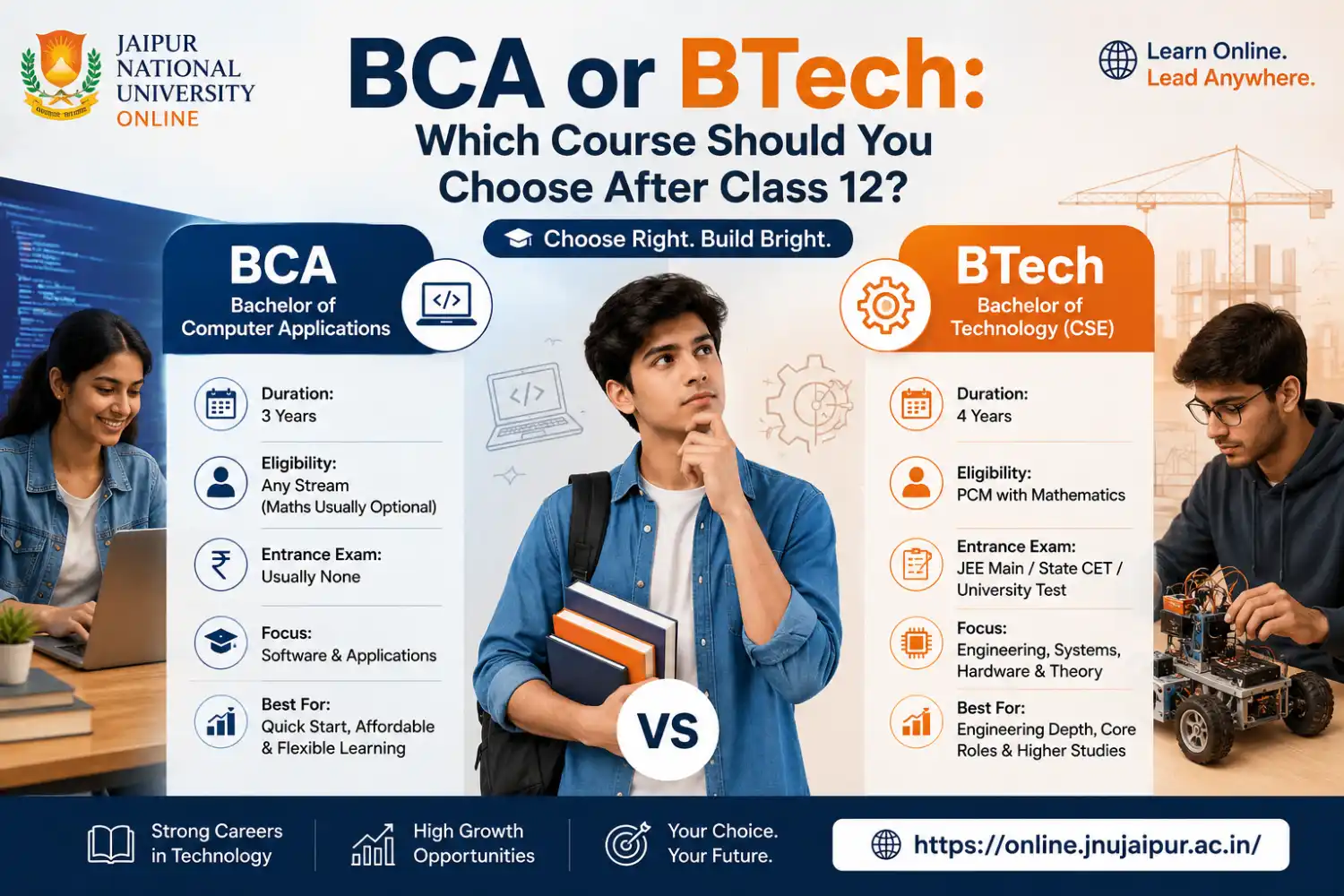
BCA or BTech: Which Course Should You Choose After Class 12?
Choose a BCA if you want a three-year, software-focused degree that is affordable, flexible, and…
AI and Cloud Computing in BCA: How Online Programs Are Future-Proofing the Degree in 2026
In 2026, the Bachelor of Computer Applications is no longer a basic programming degree. Leading…