How to Become a Software Developer After BCA: Skills, Courses, and Career Path
Home / Online BCA / How to Become a Software Developer After BCA: Skills, Courses, and Career Path
To become a software developer after a BCA, master at least one programming language such as Python, Java, or JavaScript, build real projects for a strong portfolio, and gain hands-on experience through internships before you apply for developer roles. A BCA already gives you the computer science foundation, so the path from here is mostly about turning that knowledge into practical, job-ready coding skills. With focused effort, most BCA graduates can move into an entry-level software developer role within twelve to eighteen months.
A BCA is one of the most direct undergraduate routes into software development, and the demand for developers in India shows no sign of slowing. If you have finished, or are finishing, a Bachelor of Computer Applications and you want to write code for a living, the good news is that you are already most of the way there. This guide lays out the complete path to becoming a software developer after a BCA: the skills to build, the courses and certifications worth taking, the roles you can target, a realistic timeline, and the salary scope at each stage of your career.
Can a BCA Graduate Become a Software Developer?
Yes, a BCA graduate can certainly become a software developer. A Bachelor of Computer Applications is built around programming, databases, and software concepts, which is exactly the groundwork the role demands. You do not need a B.Tech to write professional code. In the IT industry, employers hire on the strength of your skills, your projects, and your problem-solving, not solely on the name of your degree, and a large number of working developers come from BCA and MCA backgrounds.
What Does a Software Developer Actually Do?
A software developer designs, writes, tests, and maintains the applications and systems that people and businesses rely on every day. The work is varied, but the core responsibilities are consistent:
- Writing clean, efficient code in one or more programming languages.
- Designing software features based on user and business requirements.
- Testing, debugging, and fixing issues to keep applications reliable.
- Using version control such as Git to manage and collaborate on code.
- Deploying software and maintaining it with updates and improvements.
In short, a developer turns ideas and requirements into working software. The day-to-day blends focused coding with teamwork, problem-solving, and continuous learning.
What Is the Step-by-Step Path to Become a Software Developer After BCA?
The path from a BCA to a software developer job follows seven clear steps. The roadmap below shows the full journey at a glance.
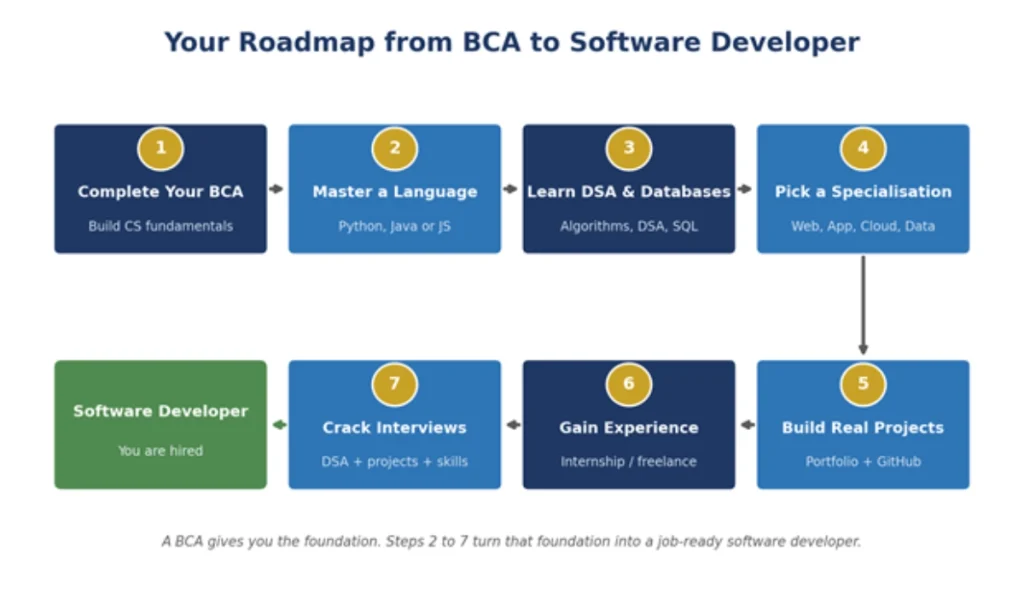
The seven-step roadmap from a BCA to a job-ready software developer.
Here is what each step involves:
- Complete your BCA: build a strong base in programming, databases, and core computer science.
- Master a language: go deep on one language such as Python, Java, or JavaScript rather than learning many at a surface level.
- Learn data structures, algorithms, and databases: these are the foundation of efficient code and almost every interview.
- Pick a specialisation: choose a direction such as web, mobile app, cloud, or data development.
- Build real projects: create applications and publish them on GitHub to prove your skills.
- Gain experience: take up an internship or freelance work to learn how software is built in the real world.
- Crack interviews: prepare with data structures practice, your project portfolio, and your communication skills.
What Skills Do You Need to Become a Software Developer?
Becoming a software developer takes a balance of technical and soft skills. Employers look for coding ability, but they value clear thinking and teamwork just as highly. The table below summarises both sides.
|
You do not need every skill on day one. Start with one language and data structures, then add the rest as your projects grow more ambitious.
Which Programming Languages Should You Learn After BCA?
The best programming language to learn after a BCA depends on the kind of developer you want to become. The table below maps the most in-demand languages to their strengths.
|
A practical approach is to pick one language, usually Python or JavaScript for beginners, and learn it thoroughly before branching out. Depth in one language is far more valuable to an employer than a shallow grasp of several.
What Courses and Certifications Should You Take After BCA?
A BCA combined with focused upskilling is a powerful combination. Beyond the degree, short specialised courses and certifications help you stand out and move faster into a developer role. Strong options include full-stack web development, data science, cloud computing, artificial intelligence and machine learning, and recognised industry certifications from providers such as Amazon Web Services, Microsoft, Google, and Oracle.
Jaipur National University offers a set of one-year online diplomas in exactly these areas, which sit neatly alongside a BCA, as well as an online MCA programme for graduates who want to go deeper on the technical track. For a closer look at the technologies shaping the field, you can also read our guide on AI and cloud computing in BCA.
What Are the Career Options and Job Roles After BCA in Software Development?
Software development opens a wide range of roles, and you can shape your career around the area you enjoy most. Common job roles include:
- Software developer and programmer
- Front-end, back-end, and full-stack web developer
- Mobile application developer
- Software tester and quality assurance engineer
- Data analyst, data engineer, or AI and machine learning developer
- DevOps engineer and cloud developer, as you gain experience
What Is the Salary of a Software Developer in India?
Software development is one of the better-paying career paths in India, and earnings rise steeply with experience and skill. The infographic below shows how pay typically progresses through a developer career.
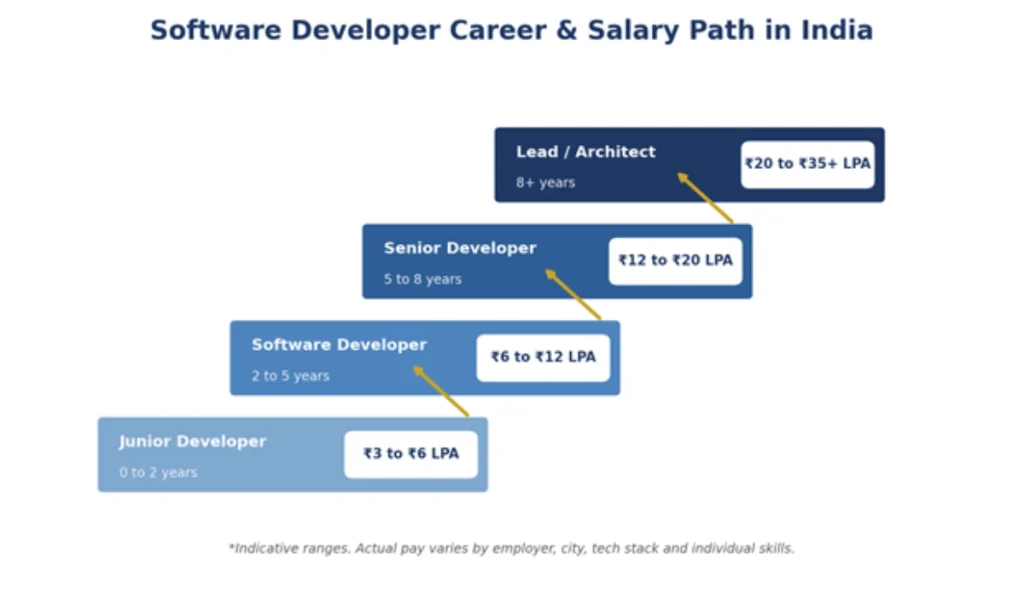
Indicative software developer salary progression in India, from junior developer to lead or architect.
The table below sets out the same indicative ranges. Treat them as a guide, since actual pay depends on the employer, the city, your technology stack, and your skills.
|
Should You Do an MCA or Start Working After BCA?
Both routes lead to a strong software career, and the right one depends on your goals. Start working after your BCA if you already have solid coding skills and you want industry experience and an income sooner. Choose an MCA if you want deeper technical expertise, a stronger profile for senior or specialised roles, or a route into research and teaching. A popular middle path is to begin working after the BCA and study an online MCA at the same time, which builds experience and qualifications together.
How Can JNU Online Help You Become a Software Developer?
Jaipur National University, through its Centre for Distance and Online Education, offers a clear and affordable route into software development. Its UGC-DEB entitled, NAAC A+ accredited online BCA programme builds the programming foundation, while a range of one-year online diplomas let you specialise in the skills employers want. Key advantages include:
- A recognised online BCA, plus diplomas in data science, cloud computing, and AI and machine learning to specialise.
- Affordable, transparent fees and flexible, self-paced learning that fits around work.
- UGC-DEB entitled and NAAC A+ accredited, so your qualifications carry full recognition.
- Placement support through a network of 100+ hiring partners.
When you are ready, you can review the admission and registration process, apply online, or contact the JNU Online admissions team to plan your path into software development.
Conclusion
Becoming a software developer after a BCA is a realistic and rewarding goal. The degree gives you the foundation, and the rest of the journey is about steady practice: master one language, learn data structures, build real projects, gain experience, and prepare for interviews. The demand for developers in India is strong, the pay grows quickly with experience, and your degree stream is never a barrier when your skills speak for themselves.
If you want a flexible and affordable route, the online BCA at JNU, together with its specialised online diplomas, gives you both the foundation and the job-ready skills to start your career in software development. Explore the programmes and take your first step today.
Frequently Asked Questions
Can a BCA student become a software developer?
Yes. A BCA is built around programming and computer applications, which makes it a natural route into software development. Employers hire on skills and projects, so a BCA graduate with strong coding ability can certainly become a software developer.
Do I need a B.Tech to become a software developer?
No. A B.Tech is not required to become a software developer. Many working developers hold a BCA or MCA. What matters most is your programming ability, your project portfolio, and your problem-solving skills.
Which programming language is best after BCA?
Python and JavaScript are excellent first languages after a BCA because they are versatile and beginner friendly. Java is strong for enterprise and Android work. The best approach is to learn one language thoroughly before adding others.
How long does it take to become a software developer after BCA?
With focused, consistent effort, most BCA graduates become job-ready software developers within twelve to eighteen months, and often sooner if they begin building skills during the final year of the degree.
What is the salary of a software developer after BCA?
Indicative salaries for software developers in India start at about 3 to 6 lakh per year for junior roles and rise to 12 to 20 lakh or more for senior developers. Actual pay depends on the employer, city, technology stack, and skills.
Is an MCA necessary to become a software developer after BCA?
No, an MCA is not necessary. You can start working as a developer straight after a BCA if your skills are strong. An MCA helps if you want deeper expertise or a stronger profile for senior and specialised roles, and many students study it online while working.
Can I become a software developer after BCA without coding experience?
Yes, but you will need to build coding skills first. Start by learning one programming language and the basics of data structures, then practise by building small projects. Coding ability, not prior experience, is what gets you hired.
Which course is best after BCA for software development?
Full-stack development, data science, cloud computing, and AI and machine learning are among the best courses after a BCA for software development. Short online diplomas and recognised industry certifications help you specialise and stand out.
Related Blogs
BCA or BTech: Which Course Should You Choose After Class 12?
Choose a BCA if you want a three-year, software-focused degree that is affordable, flexible, and…
Cyber Hygiene for Students: The Complete 2026 Guide to Protecting Your Digital Identity Online
You probably assume you are not worth hacking. No salary, no fixed deposit, no company…

BBA vs BCA vs MCA: Which is Better for Your Future in 2026?
Introduction: Career Uncertainty Post 12th or College Selecting a course after Class 12 or college…
Online BCA vs Regular BCA: Which Is Better for Your Career in 2026?
Quick Answer The choice between online BCA vs regular BCA depends entirely on your situation….
Online IT Courses After 12th: Fees, Eligibility, Salary & Career Scope in 2026
The best online IT courses after 12th in India are the three-year BCA degree and…
Types of Indexes in SQL Server: All 12 Types Explained with Syntax (2026)
SQL Server supports twelve distinct index types: clustered, non-clustered, unique, filtered, clustered columnstore, non-clustered column…