
BCA or BTech: Which Course Should You Choose After Class 12?
Home / Online BCA / BCA or BTech: Which Course Should You Choose After Class 12?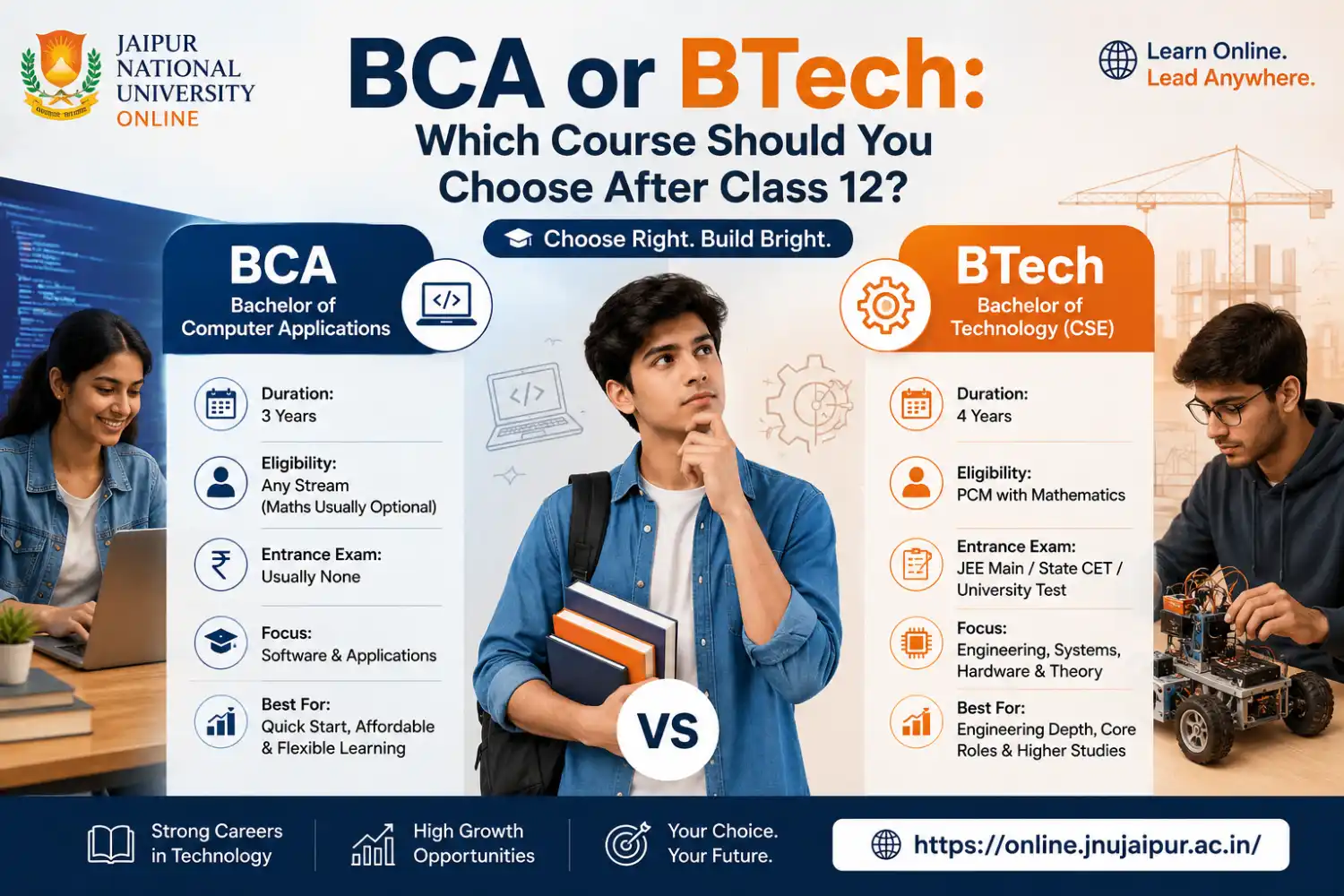
Choose a BCA if you want a three-year, software-focused degree that is affordable, flexible, and open to students from any stream, including those who did not study mathematics. Choose a BTech if you want a four-year engineering degree with greater technical depth, you studied Physics, Chemistry, and Mathematics, and you can clear an entrance exam such as JEE. Both BCA and BTech lead to strong careers in technology, so the BCA vs BTech decision comes down to your stream, your budget, the depth of engineering you want, and how soon you wish to start working.
After Class 12, students drawn to computers and coding face one of the most common dilemmas in Indian higher education: BCA or BTech. Both are respected routes into the technology industry, both can lead to software roles, and both are in steady demand. Yet they differ in length, cost, eligibility, and the kind of work they prepare you for. This guide compares BCA vs BTech across every factor that matters, from eligibility and fees to careers and salary, so you can decide which course fits your goals.
What Is the Difference Between BCA and BTech?
The main difference between BCA and BTech is depth and duration. A BCA, or Bachelor of Computer Applications, is a three-year degree focused on software and computer applications, and it is open to students from any stream. A BTech, or Bachelor of Technology, is a four-year engineering degree with broader and deeper coverage of computer science, including theory, systems, and hardware, and it usually requires mathematics and an entrance exam. The chart below compares the two at a glance.
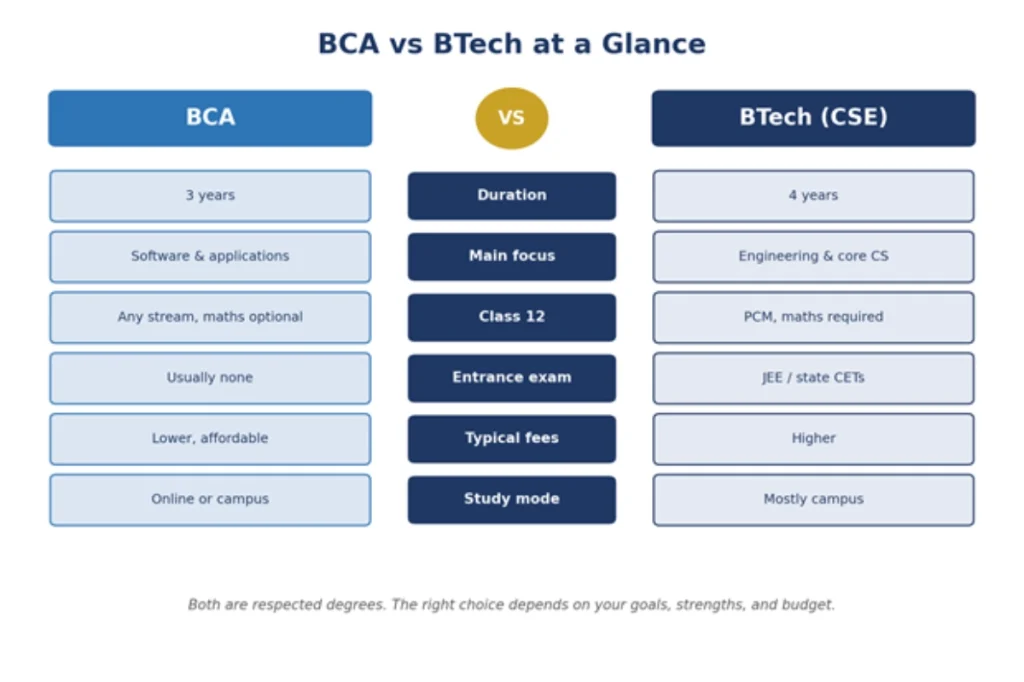
BCA vs BTech compared across the factors that matter most when choosing after Class 12.
The table below sets out the full comparison in detail.
|
What Is a BCA Degree?
A BCA, the Bachelor of Computer Applications, is a three-year undergraduate degree that builds practical skills in programming, software development, and computer applications. It covers languages such as C, C++, Java, and Python, along with web development, database management, and core computer science. A BCA is open to students from any Class 12 stream, mathematics is usually optional, and admission is most often based on merit rather than an entrance exam. The degree is widely available online as well as on campus.
A BCA suits students who want a focused, affordable, and flexible route into software and IT roles, and who would rather start building job-ready skills quickly than spend four years on an engineering programme.
What Is a BTech Degree?
A BTech, the Bachelor of Technology, is a four-year professional engineering degree. A BTech in Computer Science covers programming alongside deeper engineering subjects such as data structures, computer architecture, operating systems, networks, and advanced mathematics, supported by laboratory work and industrial internships. Admission generally requires Physics, Chemistry, and Mathematics in Class 12, together with an entrance exam such as JEE Main or a state CET.
A BTech suits students who enjoy mathematics and engineering, who want the greatest technical depth, and who are aiming for core engineering roles, research, or recruitment at top product companies.
BCA or BTech: Which Is Better for a Tech Career?
Neither course is universally better, and the honest answer depends on your goals. Both a BCA and a BTech can lead to a software career, and skilled graduates from both do well in the industry. A BTech offers greater technical depth, a stronger edge for core engineering and high-paying roles at premier product companies, and broader options for advanced study. A BCA offers a faster, more affordable, and more flexible path into software and IT roles, with no compulsory mathematics and no entrance exam.
In other words, a BTech rewards students who want engineering depth and can commit four years and a higher budget, while a BCA rewards students who want a practical, accessible route into software. What matters most in the long run is the skills you build, not the name of the degree alone.
What Are the Eligibility and Admission Requirements for BCA and BTech?
The eligibility and admission routes are quite different.
- For a BCA, you usually need a 10+2 pass in any stream with a minimum aggregate of around 45 to 50 percent, mathematics is generally not compulsory, and admission is most often direct or merit-based.
- For a BTech, you usually need a 10+2 pass with Physics, Chemistry, and Mathematics and an aggregate of around 50 percent or higher, and you must clear an entrance exam such as JEE Main, a state CET, or a university test.
What Are the Career Options After BCA and BTech?
Both degrees open strong careers in technology, with a good deal of overlap in software roles. After a BCA, common roles include:
- Software developer, web developer, and mobile app developer
- Software tester and quality assurance analyst
- System administrator and IT support engineer
- Junior data analyst and, with upskilling, data or AI roles
After a BTech, graduates can take up these same software roles and also move into:
- Software engineer and systems engineer at product companies
- Core engineering, hardware, and embedded systems roles
- Data science, machine learning, and research and development positions
How Do BCA and BTech Salaries Compare in India?
BTech graduates, especially from well-known institutes, often start with higher salary packages than BCA graduates, because many core engineering and top product-company roles recruit specifically from engineering programmes. That said, a skilled BCA graduate competes well for software and IT roles, and the gap narrows with experience and proven ability.
The table below shows indicative ranges, which vary widely by college, city, and skills.
|
These figures are a guide, not a guarantee. In software, your salary is driven far more by your skills, your portfolio, and the company you join than by whether you hold a BCA or a BTech.
Which Course Is Better for Higher Studies?
Both degrees lead to strong postgraduate options. A BCA flows naturally into an MCA or an MBA, while a BTech leads into an MTech, an MS in India or abroad, or an MBA, and makes you eligible for the GATE examination. A BCA graduate can also pursue an MBA and many management roles. The key point is that a BCA does not close the door to higher study; it simply points towards MCA and management routes rather than MTech.
Is BCA or BTech Better for Students Without Maths or a Science Background?
For students who did not study mathematics, or who come from a commerce or arts background, a BCA is clearly the better fit.
A BTech almost always requires Physics, Chemistry, and Mathematics in Class 12, which rules it out for many non-science students.
A BCA, by contrast, welcomes students from every stream and usually treats mathematics as optional, which makes it the natural route into a technology career for non-maths and non-science students.
Which Should You Choose, BCA or BTech?
If you are still weighing the decision, the guide below makes it clearer. It comes down to your stream, your budget, and the kind of career you want.
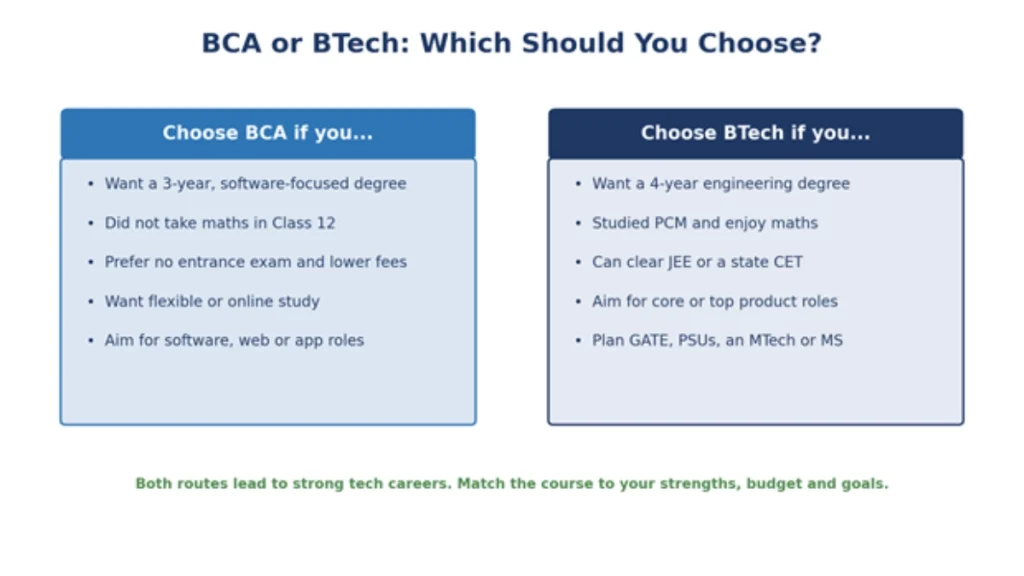
A quick guide to choosing between BCA and BTech based on your goals and background.
Choose a BCA if you:
- Want a three-year, software-focused degree
- Did not take mathematics in Class 12, or come from commerce or arts
- Prefer no entrance exam and lower fees
- Want the flexibility of online study
Choose a BTech if you:
- Want a four-year engineering degree with deeper technical content
- Studied Physics, Chemistry, and Mathematics and enjoy maths
- Can clear an entrance exam such as JEE or a state CET
- Are aiming for core engineering, top product roles, GATE, or an MTech
Why Choose JNU Online for Your BCA?
Jaipur National University, through its Centre for Distance and Online Education, offers a UGC-DEB entitled, NAAC A+ accredited online BCA programme that is open to students from every Class 12 stream. It is a practical, affordable route into a software career, with a few clear advantages:
- Open to all streams, with no compulsory mathematics and no entrance exam.
- Affordable, transparent fees and flexible, self-paced online learning.
- UGC-DEB entitled and NAAC A+ accredited, so the degree carries full recognition.
- Specialised one-year diplomas and an online MCA to deepen your skills, plus placement support through 100+ hiring partners.
When you are ready, you can review the admission and registration process, apply online, or contact the JNU Online admissions team to discuss which route fits your goals. You can also read our guide on AI and cloud computing in BCA to see where the degree can take you.
The Final Word on BCA vs BTech
The BCA vs BTech decision is not about which degree is superior. It is about which one fits your stream, your budget, and the career you want. A BTech offers four years of engineering depth and a strong edge for core and top product roles, for students who studied maths and can clear an entrance exam. A BCA offers a three-year, affordable, and flexible route into software, open to every stream and free of a maths barrier. Both lead to rewarding careers in technology when you pair them with the right skills.
If a BCA fits your goals, the online BCA at JNU gives you a recognised, affordable, and flexible way to start your career in technology. Explore the programme and take your first step today.
Frequently Asked Questions
What is the difference between BCA and BTech?
A BCA is a three-year degree focused on software and computer applications, open to any stream and usually without an entrance exam. A BTech is a four-year engineering degree with deeper technical content that requires Physics, Chemistry, and Mathematics and an entrance exam such as JEE.
Is BCA better than BTech?
Neither is better in absolute terms. A BCA is better for a faster, affordable, and flexible route into software, especially for non-maths students. A BTech is better for engineering depth and core or top product-company roles. The right choice depends on your goals and background.
Can I do BCA without maths, unlike BTech?
Yes. A BCA is open to students from any stream and usually treats mathematics as optional, while a BTech almost always requires Physics, Chemistry, and Mathematics in Class 12. This makes a BCA the better route for students without maths.
Is BTech harder than BCA?
A BTech is generally more demanding, with heavier mathematics, engineering theory, and a four-year duration. A BCA is more application-focused and lighter on advanced maths. Difficulty ultimately depends on your strengths and interests.
Does BTech pay more than BCA?
BTech graduates, particularly from well-known institutes, often start with higher packages, because many core and top product roles recruit from engineering programmes. However, skilled BCA graduates compete well for software roles, and the gap narrows with experience and ability.
Can a BCA graduate become a software engineer like a BTech graduate?
Yes. Many software developers and engineers hold a BCA. Employers in the software industry hire on skills, projects, and problem-solving, so a BCA graduate with strong coding ability can work in the same software roles as a BTech graduate.
Can I do an MTech or MS after BCA?
An MTech usually requires a BTech or BE, so it is generally not open to BCA graduates. After a BCA, the natural higher-study routes are an MCA or an MBA. Some MS programmes abroad may accept a BCA with a strong profile, so check individual requirements.
Should I choose BCA or BTech for a software career?
Both lead to software careers. Choose a BCA for a quicker, affordable, and flexible route, particularly if you did not study maths. Choose a BTech if you want engineering depth and are aiming for core or premier product-company roles.
Related Blogs

The Future of Online Degrees in India: Why BBA, BCA & MCA Are Booming
There is a tremendous amount of change going on in India’s educational landscape. With its…
How to Become a Software Developer After BCA: Skills, Courses, and Career Path
To become a software developer after a BCA, master at least one programming language such…
Online BCA After 12th Commerce or Arts: Is It Possible? Eligibility Explained
Quick Answer Yes, you can absolutely pursue an online BCA after 12th from Commerce or…
Can I Do BCA Without Maths in 12th? Eligibility, Colleges & Career Scope
Yes, you can do a BCA without maths in Class 12. Most Indian universities, including…

Exploring Employability: What Jobs Can You Expect After An Online BCA Degree?
Introduction The global digital evolution has left a significant impact on the educational sector, and…

Online IT Courses After 12th: Fees, Eligibility, Salary & Career Scope in 2026
The best online IT courses after 12th in India are the three-year BCA degree and…