Online Courses for Journalism in 2026: Why Fact Checking Skills Now Decide Who Gets Hired
Home / Online MA JMC / Online Courses for Journalism in 2026: Why Fact Checking Skills Now Decide Who Gets Hired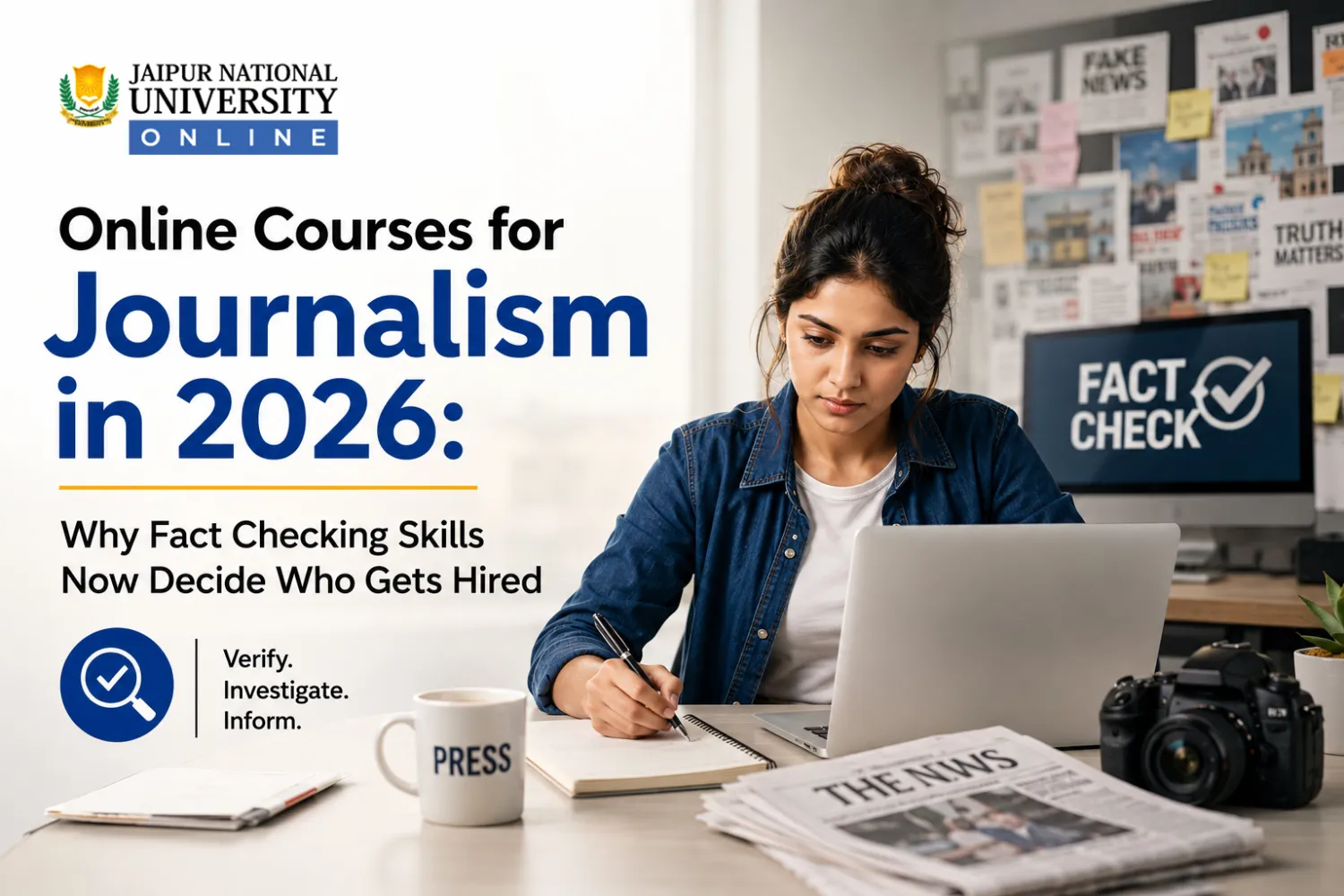
If you are searching for online courses for journalism in 2026, here is the short answer most “best course” lists skip: the single skill that now separates a hireable journalist from an unemployable one is not writing, shooting, or anchoring — it is verification. India saw more political deepfakes than almost any country on earth during its last general election, and newsrooms are scrambling for people who can tell what is real. This guide explains why fact-checking became the defining skill of modern journalism, the exact digital journalism skills employers now test for, how to become a fact checker in India, and which online programme actually trains you for it — including Jaipur National University’s UGC-DEB-approved online MA in Journalism and Mass Communication.
What are the best online courses for journalism in 2026 — and why the answer changed?
Most “best online courses for journalism” lists rank programmes by brand name: a foreign university certificate here, a familiar platform diploma there. That was useful when the job was simply learning to write a news report. It is no longer enough. The 2026 media industry is being reshaped by artificial intelligence — AI can now draft a routine report, generate a photorealistic image of an event that never happened, and clone a politician’s voice in seconds.
In that environment, employers are not asking “can you write?” They are asking “can you prove what is true?” The best online courses for journalism today are the ones that build that proof-making ability — verification, source-checking, media law, and data literacy — alongside classic reporting. Everything that follows is a map of that shift, so you can pick a course that trains you for the job that actually exists.
Why is fact-checking the #1 journalism skill in 2026?
India is the clearest example in the world of why verification now matters more than volume. During the country’s most recent general election, industry analyses estimated that more than 75% of voters were exposed to political deepfakes, and roughly one in four could not tell AI-generated content from the real thing. Verification firms reported a steep spike in synthetic-media activity — one analysis put the rise in deepfake attempts at around 280% — and fact-checking coalitions worked around the clock to debunk fake videos of actors, politicians, and even deceased leaders.
India also has the world’s largest WhatsApp user base — more than 400 million people — where unverified forwards have, in the past, escalated into real-world violence. The uncomfortable truth for newsrooms is that most journalists were never trained for this. Verification experts have repeatedly noted that many working reporters still lack the basic open-source-intelligence and verification skills needed to debunk even a crude fake, let alone a sophisticated deepfake.
That gap is exactly where the jobs are. Every credible outlet — from legacy networks to digital-first newsrooms and dedicated fact-checking units — now needs people who can verify before they publish. Building these verification skills is the fastest way to make yourself hireable in Indian media today.
Not all fake content is the same, and a good fact-checker learns to tell the categories apart. Here is what today’s Indian information landscape actually looks like:
| Type of misinformation | What it is | The verification response |
|---|---|---|
| Deepfake | AI-generated video or audio that convincingly shows a real person saying or doing something they never did. | Reverse-search the original, check for lip-sync and lighting artefacts, confirm with the person or their office. |
| Cheapfake | Real footage edited with basic tools—slowed, spliced, or re-captioned—to mislead. | Locate the original clip, compare timestamps, restore the missing context. |
| Manipulated media | Genuine images or documents altered in part (a changed number, a swapped face). | Error-level analysis, metadata checks, and cross-referencing primary sources. |
| AI-generated “news” | Fabricated articles, quotes, or images produced at scale by text and image models. | Trace the primary source, confirm the outlet exists, look for missing citations. |
| Coordinated forwards | Identical unverified messages spread rapidly across WhatsApp and social groups. | Trace the first appearance, check fact-check databases, run a reverse image search. |
What digital journalism skills does a fact-checker actually use?
Fact-checking is a craft with a repeatable toolkit — it is about method, not opinion. The good news for anyone comparing online courses for journalism is that these skills are teachable and testable, which is exactly why serious programmes now build them in. These are the core digital journalism skills that turn a reporter into a verifier:
| Skill | What it involves | Tools & examples |
|---|---|---|
| Source verification | Confirming who said what, when, and whether they are authentic. | Official records, direct contact, cross-referencing statements. |
| Reverse image & video search | Finding where a visual first appeared to expose recycled or fake footage. | Reverse-image engines, InVID, frame-by-frame analysis. |
| Open-source intelligence (OSINT) | Geolocating and time-stamping events using public clues. | Maps, shadows, weather archives, satellite imagery. |
| Data journalism | Interrogating datasets, election numbers, and public disclosures. | Spreadsheets, basic statistics, data visualisation. |
| Media law & ethics | Knowing what you can publish and how to protect sources. | Press regulations, right-to-information, editorial codes. |
| Digital publishing & SEO | Packaging verified stories so they reach audiences before the fakes do. | CMS, headline craft, structured data. |
How to become a fact checker in India: a practical roadmap
So how to become a fact checker in India, step by step? There is no single licence — but there is a well-worn path that hiring editors recognise.
- Build a credible foundation. Start with structured online courses for journalism or, better, an accredited online MA in Journalism and Mass Communication that includes media law, ethics, and research — the theoretical backbone verification rests on.
- Master the verification toolkit. Learn reverse image search, OSINT geolocation, and metadata analysis. Free resources from global fact-checking bodies are a strong supplement to a degree.
- Learn to read data. Election data (psephology), budgets, and public records are where many of the biggest checks live. Data journalism turns a spreadsheet into a story you can defend.
- Build a public portfolio. Debunk real claims on a blog or newsletter. A file of verified checks is worth more to an editor than any certificate alone.
- Plug into the ecosystem. India has active fact-checking coalitions and verification units; their internships and fellowships are the fastest on-ramp into a paid role.
- Specialise. Political misinformation, health misinformation, and financial scams each need domain knowledge. Pick a beat and go deep.
Traditional reporter vs fact-check-ready journalist
A decade ago, the reporter’s job was linear: chase the story, file it fast, and get it into print or on air before a rival. Speed was the edge. Today, speed without proof is a liability — publishing an unverified deepfake can cost an outlet its credibility overnight.
The fact-check-ready journalist works differently. They verify before they publish, keep an audit trail of how each claim was confirmed, and distribute the verified story across web, social, and video so it reaches audiences before the fake does. They pair old-fashioned curiosity with a modern toolkit — and that combination is precisely what the strongest online courses for journalism are now built to produce.
What jobs can you get — and what do they pay?
The payoff for building these verification skills is a widening set of roles that barely existed a decade ago. The salary ranges below are indicative of the Indian market in 2026 and vary with city, employer, and portfolio strength.
| Role | What you do | Indicative salary (India, 2026) |
|---|---|---|
| Fact-Checker / Verification Journalist | Verify claims, images, and videos for a newsroom or fact-check unit. | ₹3–7 LPA |
| Digital / Multimedia Journalist | Report, shoot, and publish verified stories across platforms. | ₹3.5–8 LPA |
| Data Journalist | Build and check data-driven investigations and election coverage. | ₹4–10 LPA |
| OSINT / Investigative Researcher | Trace sources, geolocate footage, and support investigations. | ₹4–12 LPA |
| Social Media / Newsroom Editor | Manage verification and publishing on fast-moving platforms. | ₹4–10 LPA |
| Content Strategist / Media Consultant | Advise brands and outlets on credible, trustworthy content. | ₹5–14 LPA |
Which online course for journalism should you choose? Where JNU fits
This is where the choice gets real. A short certificate can teach you a single tool. But verification careers reward depth — media law, research methodology, ethics, and hands-on projects — the things a full postgraduate programme is built to deliver. If you want a credential employers recognise, and one that actually trains the reporting and verification skills above, an accredited online MA in Journalism and Mass Communication is the strongest single investment.
Jaipur National University’s Online MA (JMC) is a clear example of a programme built for this new reality. It is delivered fully online through JNU’s Centre for Distance and Online Education, is approved by the UGC-DEB, and comes from a NAAC A+ accredited, UGC Section 2(f) recognised university whose degrees carry AIU equivalence — so the qualification holds the same weight as an on-campus MA. It runs over two years, is open to graduates from any stream with 50% marks, and at a total fee of ₹78,400 (₹19,600 per semester) it is one of the most affordable accredited routes into the field — well below many comparable online MA JMC programmes.
What makes it genuinely relevant to fact-checking is the curriculum, not the marketing. Several papers map almost directly onto the verification and digital journalism skills employers are hiring for:
| Paper (JNU Online MA JMC) | Skill it builds | Why it matters for fact-checking |
|---|---|---|
| Media Ethics & Laws (Sem 1) | Editorial ethics, defamation, source protection. | The legal and ethical backbone every verification decision rests on. |
| New Media + Digital & Web Media (Sem 2) | Digital reporting, web publishing, platform literacy. | You verify and publish where misinformation actually spreads. |
| Beat Journalism: Cyber Crime (Sem 2) | Reporting on online crime and manipulation. | Direct grounding in the deepfake, scam, and impersonation ecosystem. |
| Psychology & Data Journalism (Sem 3) | Election data analysis and data-driven reporting. | Election misinformation is checked with data, not opinion. |
| Advance Research (Sem 3) | Research methodology and source rigour. | Verification is applied research—this is the method behind it. |
| New Media/Social Media Dissertation + 10-week Internship (Sem 4) | An independent verified project plus real newsroom experience. | A portfolio and hands-on practice—exactly what editors hire on. |
The bottom line
In 2026, the smartest way to future-proof a media career is to become the person who can tell what is true. AI has made content infinitely cheap; it has made verified content priceless. Whether you begin with short online courses for journalism or commit to an accredited online MA (JMC) like JNU’s, prioritise the programmes that build real verification and reporting skills. That is the difference between adding to the noise and being trusted to cut through it — and, increasingly, the difference between who gets hired and who does not.
Frequently Asked Questions
What are the best online courses for journalism in India in 2026?
The best online courses for journalism in 2026 are those that teach verification and digital reporting skills, not just writing. Look for programmes covering fact-checking, media law, data journalism, and digital publishing. An accredited postgraduate degree offers the most depth and a recognised credential.
How do I become a fact checker in India?
To become a fact checker in India, build a foundation through an accredited journalism programme, master verification tools like reverse image search and OSINT, learn to read data, publish a portfolio of debunks, and connect with India’s fact-checking coalitions through internships or fellowships.
Is an online MA in Journalism and Mass Communication valid in India?
Yes. An online MA in Journalism and Mass Communication from a UGC-DEB-approved university is treated as equivalent to an on-campus degree. JNU’s Online MA (JMC), for example, is UGC-DEB approved and comes from a NAAC A+ accredited, UGC Section 2(f) recognised university with AIU equivalence.
What digital journalism skills do employers want in 2026?
In 2026, employers want source verification, reverse image and video search, OSINT geolocation, data journalism, media law and ethics, and digital publishing. Together, these skills let you confirm what is true and publish it credibly across platforms.
Can I learn fact-checking through an online journalism course?
Yes. Verification is a teachable, method-based skill. Structured online courses for journalism — especially an online MA (JMC) with modules in media law, research, and data journalism — build the fact-checking foundation employers now test for.
What is the fee and duration of JNU’s Online MA (JMC)?
JNU’s Online MA in Journalism and Mass Communication runs for two years and costs ₹78,400 in total for Indian students (₹19,600 per semester), making it one of the more affordable accredited options in the country.
Related Blogs
How Online Courses For Mass Communication Train Journalists to Navigate Internet Shutdowns in Crisis Zones
In 2025 alone, researchers counted more than 200 major government-imposed internet outages worldwide, affecting nearly…
Deepfakes, AI and the Future of Journalism in India: Why Online Courses for Mass Communication Matter in 2026
In May 2025, as an India–Pakistan military crisis unfolded, something new happened alongside the fighting:…
Creator Economy in India 2026: Careers, Earnings, Skills and the Right Degree to Build Digital Influence
The creator economy in India is made up of YouTubers, Instagram creators, podcasters, educators and…