Top 10 Skills Recruiters Look for in Freshers in 2027 (and How They Test Each One)
Home / Online Courses / Top 10 Skills Recruiters Look for in Freshers in 2027 (and How They Test Each One)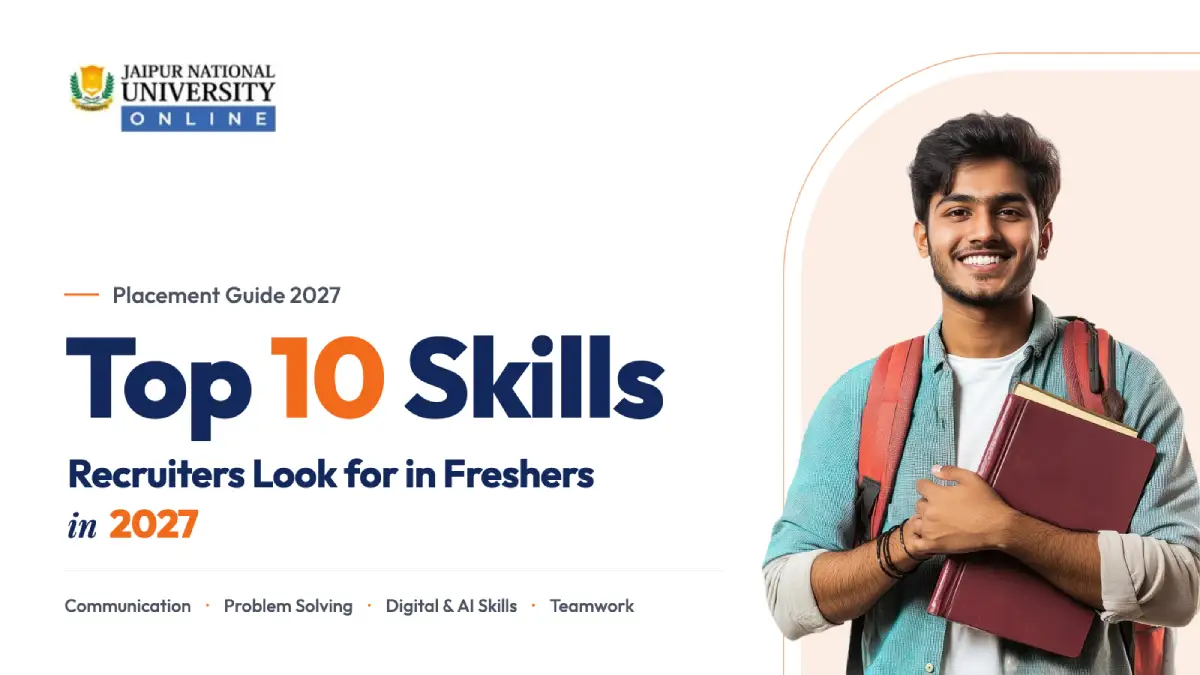
Every placement season, recruiters meet hundreds of freshers who look almost identical on paper. Same degree, similar marks, the same three certificates from the same free platforms. So how do they choose? They look for proof of a small set of behaviours that predict whether a new hire will be useful by month three rather than month twelve.
This guide breaks down the 10 skills recruiters look for in freshers, the stage of the fresher hiring process where each one gets tested, the red flags that quietly end an application, and what you can do over the next few months to close any gaps. Final-year student, recent graduate or someone studying online while working, you can use it as a checklist.
The skills recruiters look for in freshers are communication, problem-solving, teamwork, learning agility, strong domain fundamentals, digital and AI fluency, initiative, reliability, professional maturity, and practical exposure through internships or projects. Recruiters test them through the resume, aptitude test, group discussion and interviews, and they trust evidence far more than claims.
Why Recruiters Now Hire Freshers on Skills, Not Just Degrees
Entry-level hiring has moved steadily towards what employers call skills-based hiring. In the NACE Job Outlook 2026 survey, 70% of employers said they use it for entry-level roles, up from 65% a year earlier. The same research found that when two candidates look equally qualified, an internship in the employer’s own organisation or industry is the factor most likely to decide the offer.
India shows the same pattern. The India Skills Report 2026 puts overall graduate employability at 56.35%. That number has been climbing, but it still means a large share of the graduates assessed were not yet seen as job-ready. Students feel the gap too: 92.8% of those surveyed said they wanted more practical exposure.
The list of skills employers look for has also widened. The World Economic Forum’s Future of Jobs Report 2025 names analytical thinking as the top core skill, considered essential by roughly seven in ten companies, and NACE reports that about one in ten entry-level job posts now asks for some AI skills. Your degree still gets you in the door. What happens after that depends on what you can show.
The Fresher Hiring Process: Which Skill Gets Tested at Each Stage
Most students prepare for ‘the interview’ as if it were one event. In practice, campus and off-campus hiring in India runs through four or five filters, and each one is built to check something different. Once you know which filter tests what, you can prepare in the right order.
| Stage | What happens | Skills under the lens | Why freshers get dropped |
|---|---|---|---|
| Resume and application screening | A recruiter or applicant tracking system scans for role keywords, projects and internships | Domain fundamentals, written communication, practical exposure | Generic resume, no projects, skills listed with no proof |
| Online aptitude or technical test | Timed test on quant, logic, verbal ability and role basics | Problem-solving, analytical thinking, fundamentals | Weak basics, poor time management during the test |
| Group discussion or assignment | Group task, case study or take-home assignment | Teamwork, communication, initiative | Dominating the room or staying silent throughout |
| Technical or functional interview | Questions on your projects, core subjects and tools | Fundamentals, digital fluency, learning agility | Cannot explain own project, memorised answers |
| HR and final round | Behavioural questions, expectations, location, fit | Professional maturity, reliability, attitude | Vague goals, blaming others, no questions to ask |
Look at how often communication appears in that table. It is the one skill you cannot hide at any stage, which is why it sits first in the list below.
Top 10 Skills Recruiters Look for in Freshers (With How Each Is Tested)
This list draws on large employer surveys and on what campus recruiters consistently report. For each skill you will find what the recruiter is actually checking and a practical way to prove it.
1. Communication, written and spoken
Recruiters start judging your communication well before the interview. The email you send with your resume, your LinkedIn summary and the way you answer a call from HR all count. Written communication has consistently ranked among the attributes employers most want to see on a graduate’s resume.
What recruiters check: Can you explain an idea in two minutes without drifting? Can you write a short, tidy email with a clear request?
How to show it: Write a 150-word summary of your best project and ask someone outside your field to read it. Record your answer to ‘Tell me about yourself’ and listen back. If you study online, speak in live sessions instead of only typing in the chat.
2. Problem-solving and analytical thinking
This sits at the top of almost every employer survey. In NACE’s 2025 data, close to nine in ten employers said they look for problem-solving ability on a resume. Nobody expects a fresher to know every answer. They do expect a method.
What recruiters check: Whether you break a problem into parts, ask a clarifying question, and reason out loud instead of guessing.
How to show it: Do one aptitude set a day for a month. In interviews, walk through a simple structure: the problem, what you tried, what worked, and what you would change. A project where something broke and you fixed it is better evidence than one that went perfectly.
3. Teamwork and collaboration
Most entry-level work happens in teams, which is exactly why group discussions exist. Recruiters care less about who talks most and more about who helps the group reach a conclusion.
What recruiters check: Do you build on other people’s points, give credit, and handle disagreement calmly?
How to show it: In a GD, summarise the discussion at least once and invite a quieter member in. On your resume, name your exact role in a team project, such as ‘handled data cleaning for a four-member team’, rather than writing ‘team player’.
4. Learning agility and coachability
Every company knows it will have to train a fresher. What it wants to know is how fast you will pick things up and how you react to correction. Tools and processes in most roles now change every year or two, so the speed at which you learn often matters more than what you already know.
What recruiters check: Things you taught yourself recently, and how you respond when an interviewer points out a mistake.
How to show it: Keep a short learning log of the courses, tools and books from the last six months. If you get an answer wrong in an interview, admit it and correct it. That moment often tells the interviewer more than any right answer.
5. Strong fundamentals in your own subject
Recruiters do not expect deep expertise from a fresher, but they do expect the basics of your own degree to be solid. A commerce graduate who cannot read a balance sheet, or a BCA graduate who struggles with loops and SQL joins, raises doubts straight away.
What recruiters check: Core concepts from your degree, applied to a simple real-world situation.
How to show it: Revise the five or six subjects closest to the role you want and prepare one example for each. Commerce students can connect theory to Tally and GST; IT students can point to a small coding project they built themselves.
6. Digital and AI fluency
Comfort with spreadsheets, shared documents and video calls is now taken for granted. The newer expectation is AI. Interviewers increasingly ask how you use AI tools for research, coding or writing, and whether you check the output or simply paste it.
What recruiters check: Excel or Google Sheets basics, familiarity with the tools used in the role, and sensible, honest use of AI assistants.
How to show it: Learn pivot tables, XLOOKUP and charts properly. Build one small project with an AI tool and be ready to explain what you changed in its output and why. Only list tools such as Power BI, Canva, Git or a CRM if you have genuinely used them.
7. Initiative and ownership
The initiative was named by nearly three in four employers in NACE’s 2025 resume research. For a fresher, it means starting something nobody asked you to do and carrying it through to the end.
What recruiters check: Examples of things you started, organised or improved on your own.
How to show it: A college fest you ran, a blog you kept updating, a freelance gig you found yourself, a process you improved during an internship. Attach a number wherever you can: attendees, followers, hours saved, rupees raised.
8. Work ethic and reliability
Managers remember who delivers on time and who needs chasing. Recruiters try to predict this early by looking at consistency in your record and at small details during the selection itself.
What recruiters check: Punctuality for tests and interviews, prompt replies, completed internships, and steady academic performance without long unexplained gaps.
How to show it: Treat every step of recruitment as part of the evaluation, because it is. Join video interviews five minutes early, reply within a day, and finish what you start. A short recommendation from an internship supervisor is strong proof here.
9. Professional maturity and emotional intelligence
The HR round is largely a test of how you handle pressure, feedback and uncertainty. Recruiters want someone who can take criticism without getting defensive and work well with people who are different from them.
What recruiters check: Self-awareness in answers to questions such as ‘What is your biggest weakness?’, composure under stress questions, and respect for everyone in the room.
How to show it: Prepare an honest story about a failure and what it taught you. Never criticise a former college, teacher or teammate in an interview. End with a thoughtful question about the team or the role.
10. Practical exposure through internships and projects
This is the skill that ties the other nine together. An internship or a substantial project proves you have already behaved like an employee. As the NACE research above shows, it is often what separates two otherwise equal candidates.
What recruiters check: What you did, what you delivered and what you learned, explained in your own words.
How to show it: Aim for at least one internship of six to eight weeks and one project you can demonstrate live. A flexible online programme makes this far easier, because you can intern during the week without missing classes.
Here are all ten skills recruiters look for as a quick reference. Use the last column to check which proof you already have and which you still need to build.
| Skill | What impresses recruiters | Red flag that costs you | Proof to bring |
|---|---|---|---|
| Communication | Clear, concise answers and a clean resume | Rambling answers, typos in emails | Writing sample, recorded presentation |
| Problem-solving | Thinking aloud with a structure | Guessing or freezing | Project write-up showing the problem you solved |
| Teamwork | Building on others’ ideas in a GD | Interrupting, or saying nothing | A defined role in a team project |
| Learning agility | Skills picked up on your own recently | Nothing new learned since exams | Learning log, short-course certificates |
| Domain fundamentals | Explaining basics with examples | Memorised definitions, no application | Subject notes, assignment work |
| Digital and AI fluency | Real use of Excel and AI tools | Listing tools you have never used | Dashboard, spreadsheet or AI-assisted project |
| Initiative | Things you started yourself | Only coursework on the resume | Event, club or side-project results |
| Reliability | Punctual, responsive, consistent | Late to interviews, slow replies | Internship completion letter, references |
| Professional maturity | Honest answers about failure | Blaming others, defensiveness | Prepared behavioural answers |
| Practical exposure | Internship or live project | No hands-on work at all | Certificate, GitHub or portfolio link |
Which Skills Matter Most for Your Target Role?
All ten skills apply everywhere, but the weighting changes with the job. A software company and an accounting firm will read the same resume differently. The table below shows the skills employers look for first in common fresher roles in India, along with the tools worth learning and a study route that builds them.
| Fresher role | Top 3 skills recruiters weigh | Tools worth knowing | Relevant JNU Online route |
|---|---|---|---|
| Software developer or QA tester | Fundamentals, problem-solving, learning agility | Python or Java, SQL, Git | Online BCA, Online MCA |
| Data analyst | Analytical thinking, digital fluency, communication | Excel, SQL, Power BI, Python | Diploma in Data Science, Online MCA |
| Accounts or finance executive | Fundamentals, reliability, attention to detail | Tally, Excel, GST portal | Online B.Com, Online MBA |
| Sales or business development | Communication, initiative, resilience | CRM software, Excel, LinkedIn | Online BBA, Online MBA |
| Content, social media or PR | Communication, initiative, digital fluency | Canva, WordPress, analytics tools | MA (JMC), MA English |
| Cyber security or cloud support | Fundamentals, learning agility, reliability | Linux, networking basics, AWS or Azure | Diploma in Cyber Security, Diploma in Cloud Computing |
| Management trainee or operations | Teamwork, problem-solving, professional maturity | Excel, project tools, ERP basics | Online MBA, Online BBA |
If you are still choosing between undergraduate options, our comparison of BBA vs B.Com explains which roles each degree leads to. IT students can follow the roadmap on how to become an AI engineer after BCA.
How to Show These Skills on a Fresher Resume
Writing ‘excellent communication skills’ on a resume tells a recruiter nothing. Employers in the NACE surveys repeatedly say they want candidates to demonstrate skills through examples. A few rules make that easier:
- Lead with projects and internships. With little work experience, put them above your skills section, not below your hobbies.
- Turn every claim into a result. Replace ‘good at teamwork’ with ‘coordinated a five-member team to deliver a sales dashboard two days early’.
- Mirror the job description. Use the exact skills employers look for in that posting wherever they honestly apply, since many companies screen resumes through software first.
- Keep it to one page. Freshers rarely need more, and a tight page is itself a test of communication.
- Add links recruiters can click. A GitHub profile, portfolio, published article or complete LinkedIn profile turns claims into evidence in seconds.
Want a structured way to build these abilities from scratch? Our companion guide on skills for freshers to build before your first job includes a 90-day plan.
How JNU Online Helps You Build Job-Ready Skills While You Study
You can build all of this on your own, but it moves faster with structure, faculty feedback and a degree recruiters trust. JNU Online, the Centre for Distance and Online Education at Jaipur National University, is built for students who want to study and gain real-world exposure at the same time.
Jaipur National University is NAAC A+ accredited and recognised by the UGC under Section 2(f), and its online programmes are UGC-DEB entitled. The university has also been placed second in Rajasthan by the India Today Group. That recognition matters at the very first step of the fresher hiring process, where recruiters check whether your degree meets their eligibility criteria.
Here is how the online format supports the skills covered above:
- Room for internships. Lectures, study material and assessments sit on a learning management system you can open whenever it suits you, so a weekday internship or part-time job does not clash with classes. You can read more about how online classes and exams are conducted.
- Degree plus a technical diploma. Pair your degree with a one-year diploma in Data Science, AI & ML, Cyber Security, Cloud Computing or UI/UX, or a PGDCA after graduation, to strengthen fundamentals and digital fluency.
- Assessment that builds communication. Regular assignments and project work give you writing practice and real examples to discuss in interviews.
- Placement support. JNU Online lists more than 100 hiring partners, which gives you a clear route to apply what you learn.
- Affordable fees. Programmes are priced well below many private universities, as the table shows, with a 10% early-bird scholarship for students who apply on time.
Each programme below maps to at least two of the skills recruiters look for, which also gives you a ready answer when an interviewer asks why you chose it.
| Programme | Duration | Total fee (as listed) | Recruiter skills it strengthens |
|---|---|---|---|
| Online BCA | 3 years | ₹1,04,160 | Programming fundamentals, problem-solving, digital fluency |
| Online BBA | 3 years | ₹1,04,160 | Business communication, teamwork, initiative |
| Online B.Com | 3 years | ₹67,200 | Accounting fundamentals, analytical thinking, reliability |
| Online MBA | 2 years | ₹1,11,550 | Decision-making, leadership, communication |
| Online MCA | 2 years | ₹1,06,400 | Advanced technical skills, problem-solving, learning agility |
| MA (JMC) | 2 years | ₹78,400 | Writing, media literacy, digital content skills |
| MA English | 2 years | ₹67,200 | Written and spoken communication, research |
| Diploma in Data Science | 1 year | See website | Data analysis, Python, analytical thinking |
| Diploma in AI & ML | 1 year | See website | AI fluency, machine learning basics, problem-solving |
Admissions run in two sessions, January and July. The registration process is entirely online: register, upload your documents, complete verification and receive your LMS login by email. Planning a postgraduate step first? Read our guide on how to choose the right online MBA, or compare data science courses if you are leaning towards analytics.
Mistakes That Quietly Get Freshers Rejected
- Sending the same resume everywhere. Ten minutes of tailoring per application makes a visible difference to shortlisting.
- Listing skills you cannot defend. If Python is on your resume, expect a Python question in the first ten minutes.
- Ignoring the small things. An unprofessional email ID, a noisy background on a video call or joining late all register with the interviewer.
- Treating the group discussion as a debate to win. Recruiters reward the person who moves the group forward, not the loudest voice.
- Having no questions at the end. It signals low interest. Prepare two questions about the team or the first six months in the role.
- Going silent after the interview. A two-line thank-you email within a day is a simple reliability signal that most candidates skip.
Conclusion
None of the skills recruiters look for in freshers are mysterious. Clear communication, structured thinking, teamwork, a willingness to learn and some proof of real work will carry you through most entry-level selections in India. The people who get offers are rarely the most gifted in the room. They are the ones who prepared evidence for each skill before anyone asked.
Pick the two weakest skills from the table above and give them the next 60 days. If you also want a recognised degree that leaves room to build job-ready skills through internships and projects, explore the programmes at JNU Online. For more career guidance, browse the JNU Online blog.
Frequently Asked Questions
What are the top skills recruiters look for in freshers?
Communication, problem-solving, teamwork, learning agility, strong domain fundamentals, digital and AI fluency, initiative, reliability, professional maturity and practical exposure through internships or projects. Communication, problem-solving and teamwork carry the most weight across almost every role.
What do recruiters check first in a fresher’s resume?
They look for relevant projects and internships, the core subjects and tools named in the job description, and a clean one-page layout. Many companies screen resumes through an applicant tracking system first, so matching the wording of the job posting (honestly) matters.
How many rounds are there in the fresher hiring process?
Usually three to five: resume screening, an online aptitude or technical test, a group discussion or assignment, a technical or functional interview, and a final HR round. Smaller companies often combine the last two into one conversation.
Which soft skills matter most for freshers in interviews?
Clear communication, teamwork, composure under pressure and the ability to accept feedback. Group discussions test how you work with others, while HR rounds test self-awareness and maturity.
How can I build job-ready skills without work experience?
Take a short internship, build one project you can demonstrate, run a club or college event, freelance on small tasks, and study through a programme with assignments and project work. Recruiters accept all of these as evidence because each one shows real behaviour, not just knowledge.
Is an online degree accepted by recruiters in India?
Yes, when it comes from a university whose online programmes are UGC-DEB entitled. UGC regulations treat these degrees as equivalent to conventional ones. For government jobs, always check the eligibility clause in the specific notification.
What skills employers look for will matter most in 2027?
Analytical thinking, communication and teamwork remain at the top, with growing weight on AI and data fluency. Employers increasingly ask freshers how they use AI tools and how they check the output.
Related Blogs
Advantages and Disadvantages of Online Education in India (2026): A Complete Guide for Students and Working Professionals
You get flexibility, a lower fee, no daily travel, the freedom to learn at your…

Diploma Subjects List That Lead to High-Demand IT Jobs in India
India’s boom of the IT sector under the evolution of artificial intelligence is making headlines…

Why Diploma in Cloud Computing Is Trending in India in 2026
If you go into practically any business today, whether it’s a bank, a hospital, an…

High-Paying Skills to Learn in 2026
Introduction Let’s be honest for a second. You probably know someone — a friend, cousin,…
UGC Approved Online University List After NEP 2020: How Online Degrees Are Going Mainstream
Breaking the barriers of traditional education norms, online degrees are emerging to improve educational accessibility…

Claude Fable 5 vs ChatGPT Astra 6: Which Is Better? Features, Performance and Pricing Compared
Claude Fable 5 vs ChatGPT Astra 6 is the AI face-off everyone is talking about…