
BBA vs B.Com: Which Is Better After 12th? Subjects, Fees, Salary and Career Scope (2026)
Home / Online BBA / BBA vs B.Com: Which Is Better After 12th? Subjects, Fees, Salary and Career Scope (2026)
It depends on the work you want to do every day. Go for a BBA if you see yourself managing people, products or projects, probably with an MBA later. Go for a B.Com if you’re comfortable with numbers and want to work in accounts, tax, audit or banking, or you have CA, CMA, CS or ACCA in mind. Either way it’s a three-year degree you can join from any Class 12 stream, first salaries sit in roughly the same ₹2.5–5 LPA band, and both can be studied online through UGC-DEB entitled programmes. So the BBA vs B.Com question is really a question about you.
What Are BBA and B.Com? Simple Definitions
A BBA (Bachelor of Business Administration) is a three-year undergraduate degree about how organisations are run. You study marketing, human resource management, organisational behaviour, business law, research methods and strategy, and you pick up working knowledge of accounts and finance along the way. It’s management, taught from the ground up.
A B.Com (Bachelor of Commerce) is a three-year undergraduate degree about money: how it is recorded, costed, taxed, audited and reported. Financial, corporate and cost accounting, taxation, auditing, business statistics and economics form its backbone. If you’re heading towards chartered accountancy or a finance job, it’s the usual starting point.
Picture a mid-sized FMCG company launching a new namkeen. The BBA graduate sits in the meeting that decides the price, the launch cities and the distributor incentives. The B.Com graduate works out what each packet costs to make, how GST applies and whether the launch budget is running over. The company needs both. During a launch like that, they’ll probably argue every week, and that’s how it should be.
BBA vs B.Com at a Glance
Short on time? Start with this table.
| Basis | BBA | B.Com |
|---|---|---|
| Full form | Bachelor of Business Administration | Bachelor of Commerce |
| Duration | 3 years (6 semesters); some universities offer a 4-year honours option under NEP 2020 | 3 years (6 semesters); 4-year honours option at some universities |
| Eligibility | 10+2 in any stream (40% marks at JNU Jaipur) | 10+2 in any stream (40% marks at JNU Jaipur) |
| Core focus | Management, people, marketing, operations, strategy | Accounting, taxation, auditing, finance, economics |
| Learning style | Case studies, presentations, surveys, projects, field visits | Numericals, journal entries, statutory formats, problem-solving |
| Maths load | Moderate: business maths, statistics, quantitative techniques | Higher: accounts, costing, statistics |
| Typical first roles | Management trainee, marketing, sales, HR, operations executive | Accounts executive, audit assistant, tax associate, banking associate |
| Natural next step | MBA or PGDM | M.Com, CA, CMA, CS, ACCA or MBA (Finance) |
| Total fee at JNU Jaipur (online) | ₹1,04,160 | ₹67,200 |
Difference Between BBA and B.Com: Six Points That Actually Matter
A table flattens things, though. These six points are where the BBA vs B.Com comparison actually gets decided.
- What you’re trained to think about. A BBA keeps asking, “What should we do next?” A B.Com keeps asking, “What does it cost, and is it recorded correctly?” Decisions on one side; accuracy and compliance on the other.
- How deep the finance goes. Both start with Financial Accounting in Semester I. After that, a B.Com goes much further: corporate accounting, cost accounting, auditing and business budgeting are compulsory. In a BBA, auditing, GST and corporate tax are electives you take only if you choose the finance track.
- How you’re assessed. Expect more numericals and fixed formats in a B.Com, and more reports, presentations, surveys and case analysis in a BBA.
- Where professional courses fit. A B.Com sits comfortably alongside CA, CMA, CS and ACCA because the syllabi overlap. A BBA lines up with the MBA and entrance exams such as CAT, XAT and CMAT.
- How wide the job market is on day one. BBA graduates can be placed in almost any department. B.Com graduates are hired mostly into accounts, finance and banking, but with more technical depth.
- What it costs. A B.Com is usually the cheaper of the two. At JNU, the online B.Com comes to about ₹37,000 less than the online BBA over three years.
If the management side appeals to you but the terms feel fuzzy, our explainer on the difference between management and administration is a good primer.
BBA Subjects vs B.Com Subjects: The JNU Jaipur Syllabus Side by Side
Most comparison articles stop at a generic subject list. We wanted to show a real one, so the table below sets the compulsory core papers of JNU’s online BBA and online B.Com next to each other, semester by semester.
| Semester | BBA core papers | B.Com core papers |
|---|---|---|
| I | Financial Accounting; Managerial Economics; Business Organization and Ethics | Financial Accounting; Micro Economics; Principles and Practices of Management |
| II | Principles and Practices of Management; Entrepreneurship & Skill Development; Business Environment | Regulatory Framework of Business; Business Organization; Cost Accounting |
| III | Business Mathematics and Logical Reasoning Skills; Marketing Management; Legal Framework | Corporate Accounting; Business Statistics; Company Law |
| IV | Research Methods; Financial Management; Management Accounting | Management Accounting; Financial Management; Tax Management |
| V | Organizational Behavior; Company Law; Tax Management | Business Ethics; Auditing – Theory & Practice |
| VI | Strategic Management; Quantitative Techniques; Leadership Skills & Change Management | Business Budgeting; Entrepreneurship & Skill Development |
Core papers only. Each semester also has a lab (Management Lab in the BBA, Commerce Lab in the B.Com), discipline electives and open electives. Source: programme pages on online.jnujaipur.ac.in, October 2026.
One thing surprised us when we laid them out. Seven core papers appear in both programmes with exactly the same title: Financial Accounting, Principles and Practices of Management, Financial Management, Management Accounting, Company Law, Tax Management, and Entrepreneurship & Skill Development. In other words, a BBA isn’t “no accounts”, and a B.Com isn’t “no management”.
Where they split is everything else. The BBA adds marketing, organisational behaviour, research methods, strategy and leadership. The B.Com adds cost, corporate and budget accounting, statistics, auditing and business ethics.
Electives push each degree further in its own direction. In Semesters V and VI, JNU’s BBA lets you lean towards finance (security analysis, auditing, GST, corporate tax, financial reporting), marketing (digital marketing, consumer behaviour, retail, advertising, brand management) or HR (training and development, performance management, HRIS, global HR). B.Com electives include security analysis and portfolio management, public finance, project management, supply chain management and integrated marketing communication.
The BBA also builds in some field work: an MSME industry visit in Semester II, a consumer behaviour survey in Semester IV and a training project (STPR) in Semester V. Small things, but they’re what ends up on a CV and comes up in interviews, which matters when you’re studying online.
Which Degree Suits Your Strengths? A Quick Self-Check
Ignore which degree sounds more impressive at a family function. The honest answer to BBA or B.Com, which is better, depends on which of these two lists sounds more like you.
You’ll probably enjoy a BBA if you:
- like talking to people, pitching ideas and working in teams
- would rather plan a campaign than reconcile a ledger
- see yourself in marketing, HR, sales, operations or your family business
- are fairly sure an MBA is in your future
You’ll probably enjoy a B.Com if you:
- are comfortable with numbers and like getting details exactly right
- found Class 11 and 12 accountancy satisfying rather than tedious
- want to work in accounts, tax, audit, banking or financial analysis
- are thinking about CA, CMA, CS or ACCA
Nodding along to both lists? Plenty of students do. Then let the next step decide: does an MBA or a CA/CMA sound more exciting to you? That’s where each degree really pays off.
Is BBA or B.Com the Best Course After 12th Commerce?
Your Class 12 stream changes where you start. It doesn’t decide where you end up.
From commerce with accountancy. You have a head start in a B.Com, because Semester I picks up where Class 12 accountancy left off. That doesn’t make it automatic. If you loved business studies but dreaded balance sheets, a BBA may suit you better. For most students, the best course after 12th commerce is the one built around the subject they actually enjoyed.
From science. Both degrees are open to you. PCM students usually handle the numbers in a B.Com comfortably, while many PCB students find the case-based style of a BBA easier to settle into. If CA is on your mind, note that the ICAI direct entry route lets B.Com graduates register for CA Intermediate with 55% marks, while graduates from most other streams need 60%.
From arts or humanities. A BBA is usually the gentler start, since management concepts don’t assume any prior accounting. A B.Com is still possible; just plan to spend your first semester catching up on accounting basics.
Already working? An online degree lets you study without giving up your income. Choose by the job you want next: a BBA for team-lead and management roles, a B.Com for accounts and finance roles. Our guide on finding internships during an online BBA shows how to build experience alongside.
Career Options After BBA and B.Com
Both degrees lead to good jobs. They just lead to different desks.
Jobs after a BBA
- Management Trainee: a rotational role across departments, common in FMCG, retail and banking
- Business Development or Sales Executive: finds and manages clients, often with incentives on top of salary
- Marketing or Digital Marketing Executive: runs campaigns, social media and performance marketing
- HR or Talent Acquisition Executive: handles hiring, onboarding and employee engagement
- Operations or Supply Chain Executive: keeps stock, vendors and deliveries moving
- Entrepreneur or family-business successor: uses the whole toolkit at once
Our BBA career guide covers each of these in depth, and if a bank appeals to you, read bank jobs after BBA. Worried that AI will shrink management roles? This look at the future of BBA jobs in the AI era covers the skills that still matter.
Jobs after a B.Com
- Accounts Executive or Junior Accountant: maintains the books and runs the month-end close
- Audit Assistant: checks records and controls, often at a CA firm
- Tax or GST Associate: prepares returns and handles compliance
- Financial Analyst: builds budgets, forecasts and reports for management
- Banking and Insurance Associate: works in operations, credit or relationship roles
- Finance roles in global capability centres: accounts payable, receivables and record-to-report teams
For the full list, see online B.Com career opportunities. If the company-accounts side interests you, our guide to corporate accounting shows what that work involves day to day.
Government jobs
Most posts filled through SSC CGL, bank PO and clerk exams, and state PSC exams need only a bachelor’s degree from a recognised university, so both degrees qualify. A B.Com helps in accounts and audit posts, where the exam syllabus overlaps with what you studied. A BBA graduate’s training in communication and group work tends to show in interviews and group discussions.
BBA vs B.Com Salary in India (2026)
Now the question everyone actually asks. Neither degree comes with a guaranteed salary, and at the start the gap between them is small. Two classmates with the same degree can land very different offers, because role, city, employer and skills move the number far more than the name on the certificate.
| Role | Usual degree | Indicative fresher salary (per year) | With 5+ years’ experience |
|---|---|---|---|
| Management Trainee | BBA | ₹3–5 LPA | ₹8–15 LPA |
| Business Development Executive | BBA | ₹3–5 LPA plus incentives | ₹7–14 LPA |
| Marketing / Digital Marketing Executive | BBA | ₹2.5–4.5 LPA | ₹6–12 LPA |
| HR Executive | BBA | ₹2.5–4 LPA | ₹6–10 LPA |
| Accounts Executive | B.Com | ₹2–4 LPA | ₹5–8 LPA |
| Tax or Audit Associate | B.Com | ₹2.5–4 LPA | ₹6–10 LPA |
| Financial Analyst | B.Com (or BBA with finance electives) | ₹3–5.5 LPA | ₹8–15 LPA |
Indicative ranges compiled from AmbitionBox, Glassdoor India and 2026 university salary guides. Actual pay varies by city, employer and skills.
So what does lift pay? Mostly two things. One is a professional or postgraduate qualification. Newly qualified chartered accountants have averaged ₹12–13 LPA through ICAI campus placements (our CA salary in India guide has the details), and an MBA is usually what opens manager-level roles, where pay climbs fastest. The other is plain, practical skill. A BBA graduate who can run a Google Ads campaign, or a B.Com graduate who is quick with Tally Prime, Excel and GST filing, will usually out-earn a classmate who only has the certificate.
Higher Studies After BBA and B.Com
After a BBA, the MBA or PGDM is the obvious next step, through CAT, XAT, MAT or CMAT, or an online MBA if you want to keep working. Other routes include a master’s in management abroad, a law degree, or a postgraduate diploma in digital marketing or business analytics.
After a B.Com, you can take an M.Com, the professional route (CA, CMA, CS or ACCA), the CFA if investments interest you, or an MBA in Finance. Our guide to the B.Com pathway to CA, CS and CMA lays out the timelines, and this comparison of a regular B.Com and a B.Com with an ACCA-aligned curriculum explains the global option.
And no, you don’t need a BBA to do well in an MBA. Admissions are open to graduates from any stream, and B.Com graduates often shine in finance electives because they already know the accounting.
BBA or B.Com, Which Is Better? It Depends on Your Goal
If you already know roughly what you want, this is how it usually shakes out.
- You want to become a CA, CMA or CS: choose a B.Com. The overlap with professional syllabi saves you real study time.
- You want an MBA from a good B-school: either works. A BBA gives you a head start in coursework; a B.Com gives you an edge in finance.
- You want to start or run a business: a BBA, ideally with accounting electives or a short course in Tally and GST.
- You want a bank job: either. Bank exams accept any graduate; a B.Com helps with the finance sections and a BBA with the interview.
- You want to work in marketing, HR or sales: a BBA.
- You want a finance role at a Big 4 firm or a global capability centre: a B.Com, plus Excel, an ERP and, ideally, some ACCA papers.
Four Myths Students Still Believe
- “B.Com is only for future CAs.” Banks, insurers, fintech firms, global capability centres and tax practices hire plenty of B.Com graduates who never sit the CA exam.
- “A BBA has no accounts.” JNU’s BBA includes Financial Accounting, Cost Accounting, Management Accounting, Financial Management and Tax Management.
- “One degree pays far more than the other.” Starting pay is close. The gap opens later, and it depends on what you add.
- “An online degree won’t count.” Under the UGC (Open and Distance Learning Programmes and Online Programmes) Regulations, 2020, a degree from an entitled online programme is equivalent to one earned on campus.
Is an Online BBA or B.Com Valid in India?
Yes, as long as two things are true: the university is recognised by the UGC, and the specific programme is entitled by the UGC’s Distance Education Bureau (UGC-DEB) for the session you join. Search for both on the UGC-DEB portal before you pay any fee.
Online study works well if you have a job, live far from a good college, are preparing for CA or CMA alongside, or can’t stretch to a campus fee. It’s harder if you need a teacher in the room to stay on track. Our honest look at the advantages and disadvantages of online education and this UGC-DEB verification checklist will help you decide.
Study BBA or B.Com Online at Jaipur National University
Jaipur National University (JNU Jaipur) was established in 2007 and is recognised by the UGC under Section 2(f). It holds an A+ grade from NAAC and is a member of the Association of Indian Universities. Through its Centre for Distance and Online Education (CDOE), it offers both degrees in online and distance modes, with UGC-DEB entitlement and NAAC A+ accreditation.
The Online BBA and the Online B.Com each run for three years across six semesters, with the core papers shown in the syllabus table above. If budget matters most, the distance versions follow the same syllabus at a lower fee. And when you’re ready for the next step, the Online MBA accepts graduates of either degree.
| Programme | Duration | Eligibility | Total fee (India) | Per semester |
|---|---|---|---|---|
| Online BBA | 3 years, 6 semesters | 10+2 with 40% marks | ₹1,04,160 | ₹17,360 |
| Online B.Com | 3 years, 6 semesters | 10+2 with 40% marks | ₹67,200 | ₹11,200 |
| Distance BBA | 3 years, 6 semesters | 10+2 with 40% marks | ₹60,000 | ₹10,000 |
| Distance B.Com | 3 years, 6 semesters | 10+2 with 40% marks | ₹42,000 | ₹7,000 |
| Online MBA (next step) | 2 years, 4 semesters | Bachelor’s degree with 40% marks | ₹1,11,550 | ₹27,888 |
Fees and eligibility as listed on online.jnujaipur.ac.in in October 2026. International fees differ. Please confirm the current fee before applying.
Why learners choose JNU Jaipur
- Recognised degrees. UGC-DEB entitled programmes from a NAAC A+ accredited university.
- Practical work built in. A Management Lab or Commerce Lab every semester, plus an industry visit, a survey and a training project in the BBA.
- Fees you can plan for. Fees are charged per semester and can be paid online.
- Study on your schedule. The learning platform is open round the clock on web and mobile.
- More choice. Open electives can be taken through SWAYAM and NPTEL courses.
- Career support. The university works with a placement network of 100+ hiring partners.
- Two intakes a year. Admissions open for the January and July sessions.
Admission takes four steps: register for a session, fill in the application and upload your documents, wait for verification, then complete the final registration to receive your LMS login. The registration process page lists the documents you’ll need. When you’re ready, you can apply online or call the admission helpline on +91 88239 99275.
Conclusion: Making the BBA vs B.Com Call
Nobody gets extra marks for picking the tougher degree or the trendier one. If people, plans and building things are what pull you in, a BBA will feel right. If you’d rather be the person who knows exactly where the money went, take the B.Com. Settle the BBA vs B.Com question by picturing your workday five years from now, then add the qualification that gets you there.
If you’d like to start without leaving your job or your city, explore the UGC-DEB entitled online BBA and online B.Com at Jaipur National University and start your application for the next session.
Frequently Asked Questions
BBA or B.Com, which is better for my career?
Neither is better for everyone. Choose a BBA if you want a career in management, marketing, HR or entrepreneurship and plan to do an MBA. Choose a B.Com if you want to work in accounting, tax, audit, banking or finance, or plan to pursue CA, CMA, CS or ACCA.
What is the difference between BBA and B.Com?
A BBA focuses on managing a business: marketing, HR, operations, strategy and leadership. A B.Com focuses on the financial side: accounting, taxation, auditing, costing and economics. Both are three-year undergraduate degrees and share several core papers, such as Financial Accounting and Financial Management.
Which is the best course after 12th commerce?
For most commerce students, the best course after 12th commerce is a B.Com if they enjoy accountancy and want a finance career, or a BBA if they prefer business studies and want a management career. Students set on chartered accountancy can also register for CA Foundation straight after Class 12 and take a B.Com alongside.
Which pays more, BBA or B.Com?
Starting salaries are similar, usually ₹2.5–5 LPA for BBA graduates and ₹2–4 LPA for B.Com graduates. Long-term pay depends far more on the qualification you add later, such as an MBA after a BBA or CA after a B.Com, and on your skills, city and employer.
Is B.Com harder than BBA?
A B.Com is more numbers-heavy, with corporate and cost accounting, statistics and auditing as compulsory papers. A BBA involves more writing, presentations and project work. Which feels harder depends on whether you are stronger with numbers or with communication.
Can a B.Com graduate do an MBA?
Yes. MBA programmes accept graduates from any stream, so a B.Com graduate is fully eligible. Many B.Com graduates choose an MBA in Finance, where their accounting background is an advantage.
Can I do a BBA or B.Com without maths in Class 12?
Yes. At Jaipur National University, both degrees need only 10+2 with 40% marks in any stream. You will still study business mathematics and statistics at a basic level, so be ready to practise.
Are JNU Jaipur’s online BBA and B.Com degrees valid?
Yes. They are UGC-DEB entitled online programmes from a NAAC A+ accredited university. Under the UGC regulations of 2020, a degree from an entitled online programme is equivalent to one earned in the conventional mode for jobs and higher studies.
Related Blogs

From Virtual Learning to Corporate Success: A Glimpse of Online BBA Trends in 2026!
Just imagine that you are sitting in a small town or a village with a…

Can an Online BBA Course in India Help You Start Your Own Business?
Tech buzzwords like Internet of Things, AI, Big Data, APIs are not just phrases we…

Business Evolution In The Era Of Industry 5.0: How Online BBA Helps In Future?
According to recent sources, the transformative vision of the era of Industry 5.0 is driven…
Top BBA Specializations in Demand After 12th in 2026
Every year, thousands of students who finish Class 12 have to answer the same important…
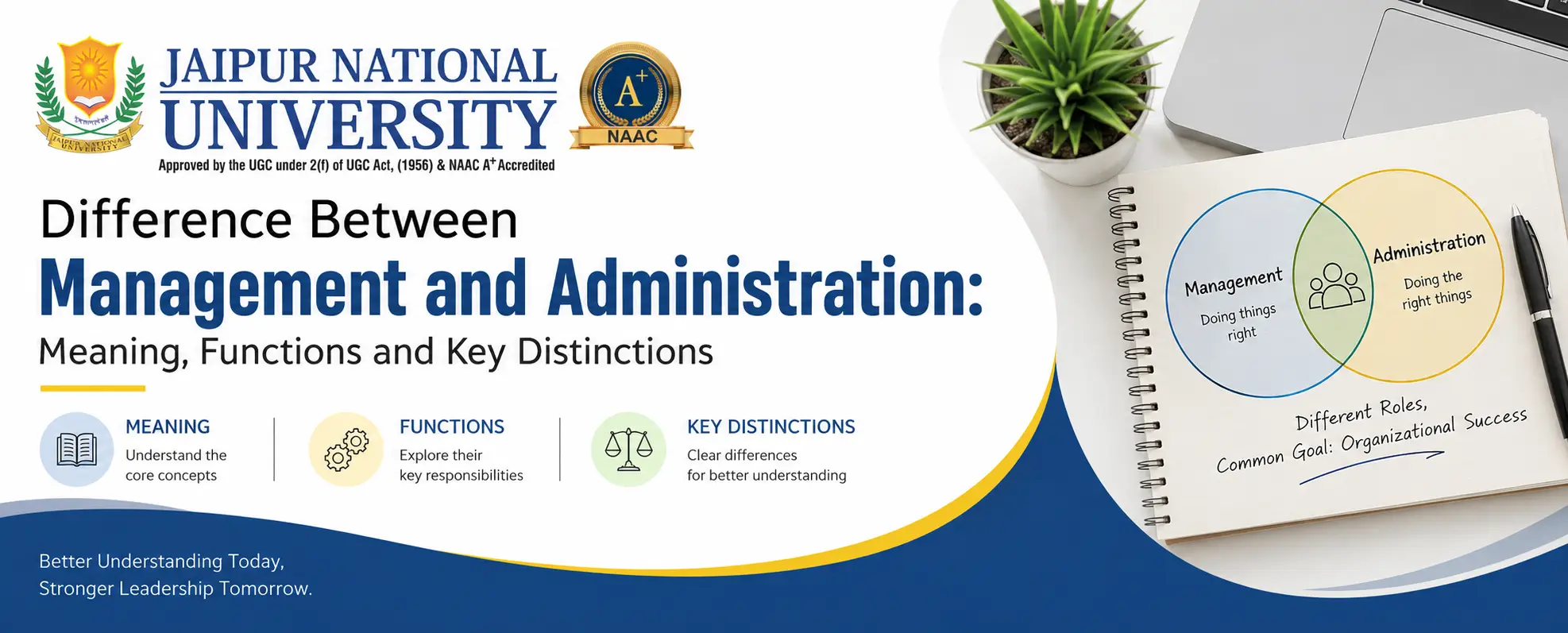
Difference Between Management and Administration: Meaning, Functions and Key Distinctions
The terms management and administration are used interchangeably so often that the difference between them…

How To Get Internships While Doing An Online BBA Degree Course: A 6-Step Guide For Working Students
The economy of India is witnessing rapid change with the rise of digital transformation and…