
Data Science Courses in India (2026): Types, Eligibility, Fees, Syllabus and Salary
Home / Online BCA / Data Science Courses in India (2026): Types, Eligibility, Fees, Syllabus and Salary
The most useful data science courses in India in 2026 fall into five levels: short certificates (3–6 months), one-year diplomas, three-year degrees such as a BCA, two-year master’s degrees such as an MCA or an MBA in Business Analytics, and 6–12 month PG diplomas. Class 12 students usually start with a diploma or a BCA; graduates and working professionals move to an MCA, an MBA with analytics or a postgraduate diploma. Every serious programme teaches the same core: statistics, Python or R, SQL, data visualisation and machine learning.
What Is Data Science? A Simple Definition
Data science is the practice of collecting, cleaning and analysing data to find patterns, make predictions and guide decisions. It draws on three subjects at once: statistics, computer programming and knowledge of the business or field the data comes from.
Think about the last time a food-delivery app showed you an estimated delivery time. Behind that number sits a model trained on lakhs of past orders: distance, traffic, time of day, how busy the restaurant was, even the weather. A data scientist built that model, tested it against real deliveries and keeps improving it. The same thinking powers UPI fraud alerts, the win-probability graphic during a cricket match and the “customers also bought” row on a shopping site.
Data science, data analytics and AI: what’s the difference?
You’ll see these terms used almost interchangeably. Data analytics looks backwards: what happened and why. Data science goes a step further and predicts what is likely to happen next. Artificial intelligence and machine learning are the techniques that let systems learn from data and act on their own. Most entry-level jobs sit on the analytics side, which is why good programmes teach SQL, Excel and visualisation before they get to machine learning.
Why Data Science Is Worth Studying in 2026
- Demand is running ahead of supply. A parliamentary report in March 2026 projected India’s AI talent pool growing from about 6–6.5 lakh professionals to more than 12.5 lakh by 2027, and still warned that demand is rising faster than that.
- Global companies are hiring in India. India now hosts more than 2,100 GCCs employing over 23 lakh people, per the Nasscom-Zinnov 2026 report, and data roles are the fastest-growing function inside them.
- Every industry uses it. Banks use it for credit scoring and fraud detection, hospitals for patient risk, retailers for demand forecasting and governments for targeting welfare schemes.
- The skills travel well. Python, SQL and statistics stay useful whether you end up as an analyst, a product manager or a founder.
- Pay follows skill, not just years. People who add machine learning or cloud skills on top of analytics tend to move up faster than those who stop at spreadsheets.
Types of Data Science Courses: Certificate, Diploma, Degree and PG
Data science courses in India come in five broad levels. The right one depends less on the course title and more on where you are starting from.
| Level | Duration | Who Can Join | Best For | What You Come Out With |
|---|---|---|---|---|
| Short certificate | 3–6 months | Anyone; basic maths helps | Testing your interest or adding one skill, such as Python or Power BI | A skill certificate to add to a degree |
| Diploma | 1 year (2 semesters) | 10+2 from a recognised board | Class 12 students and career switchers who want a structured, credit-based start | A university diploma with a capstone project |
| Bachelor’s degree (BCA, B.Sc, BBA with analytics) | 3 years | 10+2 | Students who want a full degree and a broad tech or business base | A graduate degree that opens jobs and PG study |
| Master’s degree (MCA, M.Sc, MBA in Business Analytics) | 2 years | Bachelor’s degree (MCA usually needs maths) | Graduates and professionals aiming for data scientist or analytics manager roles | A PG degree for senior and specialist roles |
| PG diploma or PG certificate | 6–12 months | Bachelor’s degree | Professionals who want depth without a two-year commitment | A focused credential to pair with experience |
Data Science Course After 12th: Your Best Options
Picking a data science course after 12th comes down to two questions: how much time you can give, and whether you want a full degree straight away. Here are the three routes most students take.
1. A one-year diploma
A diploma is the quickest structured route. In two semesters you cover statistics, Python, databases and visualisation, and you finish with a capstone project. It suits students who want job-ready skills fast, and students doing a B.Com or BA alongside who want a technical edge.
2. A BCA (Bachelor of Computer Applications)
A BCA gives you three years of programming, databases and software fundamentals. Look for a syllabus that includes data warehousing, data mining and Python or R in the later semesters. Didn’t take maths in Class 12? Many universities still admit you, and our guide on doing a BCA without maths explains how.
3. B.Com, BBA or BA plus a data skill
Commerce and arts students don’t have to switch streams. A B.Com or BBA plus a diploma in analytics is a strong mix for business analyst, financial analyst and marketing analyst roles, where knowing the business matters as much as the code. You will need to get comfortable with basic statistics and learn Python step by step, but plenty of good analysts come from commerce because they already understand sales, costs and customers.
Still comparing technology degrees in general? Our round-up of online IT courses after 12th sets out the fees and eligibility side by side.
Postgraduate Options for Graduates and Working Professionals
- MCA (Master of Computer Applications). The natural next step after a BCA or any degree with maths. A good MCA deepens programming and databases and adds AI, machine learning and big data analytics. It suits people aiming for data scientist or ML engineer roles.
- MBA with Business Analytics. If you would rather lead analytics than write all the code, this specialisation teaches statistics for decision-making, machine learning for business, data visualisation and data mining alongside core management subjects.
- M.Sc in Mathematics or Statistics. Strong in maths? An M.Sc builds the theory behind every model (probability, linear algebra, optimisation) and pairs well with a short programming course.
- PG diploma (such as a PGDCA). A one-year route for graduates from non-technical backgrounds who want to add computing skills before they specialise.
Not sure which fits you? Match by background:
- Class 12, any stream: a data science diploma or a BCA
- B.Com, BBA or BA graduate: an MBA with Business Analytics, or a diploma alongside your job
- BCA or B.Sc graduate: an MCA
- Working IT professional: a diploma in AI and ML, or a short certificate in one tool
- Maths or statistics graduate: an M.Sc plus Python practice
For a fuller comparison of the three most popular computing routes, see BBA vs BCA vs MCA.
What You Will Study: A Typical Data Science Syllabus
Course names vary from one university to the next, but the building blocks don’t. The table below shows what a well-designed one-year programme covers, using the Online Diploma in Data Science at JNU Jaipur as the reference.
| Subject | What You Learn | Tools You Are Likely to Use |
|---|---|---|
| Mathematics and Statistics for Data Science | Probability, distributions, hypothesis testing and the basics of regression | Excel, Python (NumPy, SciPy) |
| Introduction to Python, with lab | Variables, loops, functions, files and working with libraries | Python, Jupyter Notebook |
| Database Management Systems, with lab | Designing tables, writing SQL queries, joins and indexes | MySQL or a similar database |
| Data Visualisation, with lab | Choosing the right chart and building dashboards that tell a story | Matplotlib, Seaborn, Power BI or Tableau |
| R Programming for Data Science, with lab | Statistical computing and reshaping data | R, RStudio |
| Data Analysis Using Python | Cleaning, merging and summarising real datasets | pandas, NumPy |
| Big Data Analytics, with lab | Handling data too large for one machine | Hadoop and Spark concepts |
| Data Analytics | Turning analysis into business recommendations | Python, SQL, BI tools |
| Capstone Project | An end-to-end project on a real-world dataset | Your full toolkit |
Subjects are from JNU’s online data science diploma (Semesters I and II, 34 credits). Tools are typical examples; the exact software can vary by batch.
Two topics deserve extra attention. SQL is the skill recruiters test first, so learn indexing and query tuning early (our guide to types of indexes in SQL Server is a good start). Machine learning usually begins with regression, and our explainer on regression algorithms in machine learning walks through the ten you will meet most often.
Skills and Tools Employers Look For
Job descriptions for data roles look long, but they keep asking for the same handful of things.
- Programming: Python first, R as a bonus, and SQL without exception.
- Statistics: sampling, distributions, correlation, hypothesis tests and regression.
- Visualisation and BI: Excel, Power BI or Tableau, and the judgement to pick the right chart.
- Machine learning basics: supervised and unsupervised models with scikit-learn, and how to check whether a model is any good.
- Working practices: Git for version control, and a first look at a cloud platform such as AWS, Azure or Google Cloud.
- Business sense and communication: the ability to explain a finding to a manager who has never heard of a p-value.
In practice, a small portfolio of three or four well-documented projects on GitHub often says more about you than another certificate. Pick datasets you care about, such as IPL scores, local air quality or your own monthly spending, and explain what you found in plain English.
Career Paths and Job Roles
Data careers branch out quickly once you are in. These are the roles most people move through:
- Data Analyst: cleans data, builds reports and dashboards, and answers business questions.
- Business Analyst: translates between business teams and data teams, and writes requirements.
- BI Developer: builds and maintains dashboards and data models in tools like Power BI.
- Data Scientist: builds predictive models and runs experiments.
- Data Engineer: designs the pipelines and warehouses that move and store data.
- Machine Learning Engineer: puts models into production and keeps them running.
- Analytics Manager or Head of Data: leads the team and sets the data strategy.
Hiring is strongest in banking and financial services, IT services and GCCs, e-commerce, healthcare and pharma, telecom, consulting and, increasingly, government departments. If you are leaning towards the computing side, our guide to careers after an online MCA maps the routes in more detail.
Data Scientist Salary in India (2026)
The data scientist salary in India depends on your skills, your city and the kind of company you join far more than on the name of your course. Glassdoor India puts average base pay for a data scientist at about ₹11 LPA, with people at product companies and GCCs earning well above that. Analysts start lower, but many move up to data scientist within three to five years if they keep building their skills.
| Role | Typical Experience | Indicative Annual Salary |
|---|---|---|
| Data Analyst (fresher) | 0–2 years | ₹3.5–6 LPA |
| Data Analyst | 2–5 years | ₹5–10 LPA |
| Senior Data Analyst | 5+ years | ₹9–20 LPA |
| Data Scientist | 2–6 years | ₹7–16 LPA |
| Senior Data Scientist | 6+ years | ₹16–28 LPA |
| Data Science Manager | 8+ years | ₹20–30 LPA |
Indicative ranges based on Glassdoor India title-level salary data, October 2026. Experience bands are approximate. Actual pay varies by city, employer and skills.
Metro tech hubs such as Bengaluru, Hyderabad, Pune and Delhi NCR generally pay more than smaller cities, and product companies and GCCs generally pay more than service firms. The skills that most often move the number are machine learning, cloud platforms and the ability to present results to senior management.
Degree, Diploma or Certificate: Which Gives Better Value?
There is no single answer, but there is a sensible order. A degree gives you the broadest base and is required for many government jobs and for postgraduate study. A diploma is the fastest structured route and carries university credits, so it works well either on its own after Class 12 or alongside another degree. A certificate is the cheapest option and the best add-on once you already have a degree or a job in tech.
So: if you are just out of Class 12, start with a diploma or a degree. If you already have a degree, a diploma or a PG programme makes more sense. If you already work in tech, a short certificate in the one tool you are missing may be all you need. Studying online changes the cost and the timetable, not the logic; our look at the advantages and disadvantages of online education covers the trade-offs honestly.
Read More: Best Degree Courses for Science Students After 12th
Are Online Data Science Courses Valid in India?
Yes, as long as the university is recognised and the specific programme is entitled by the UGC’s Distance Education Bureau (UGC-DEB) for the session you enrol in. Under the UGC (Open and Distance Learning Programmes and Online Programmes) Regulations, 2020, a degree earned through an entitled online programme is treated as equivalent to one earned in the conventional mode.
Before you pay a fee anywhere, run these quick checks:
- Search for the university and the programme on the UGC-DEB portal.
- Check the university’s NAAC grade and whether it is a member of the Association of Indian Universities (AIU).
- Make sure exams are conducted and graded by the university itself.
- Be wary of anyone promising a full degree in a few months.
Some analytics programmes also advertise industry accreditation. Our explainer on IoA accreditation tells you what that kind of badge does and doesn’t mean.
How to Choose the Right Programme: A 7-Point Checklist
- Recognition. UGC approval for the university and UGC-DEB entitlement for online programmes.
- Syllabus depth. Statistics, Python, SQL, visualisation and at least an introduction to machine learning.
- Hands-on work. Labs in every semester and a capstone project you can show employers.
- Eligibility fit. Check minimum marks and whether maths is required.
- Total cost. Look at the full programme fee, not just the first semester, and ask about scholarships.
- Flexibility. A learning platform you can use on your phone, recorded lectures and sensible exam schedules.
- Career support. Placement help, internships and access to hiring partners.
Study Data Science Online at Jaipur National University
Jaipur National University (JNU Jaipur) was established in 2007 and is recognised by the UGC under Section 2(f). It holds an A+ grade from NAAC and is a member of the Association of Indian Universities. Its Centre for Distance and Online Education (CDOE) runs programmes with UGC-DEB entitlement and NAAC A+ accreditation, which you can verify on the UGC-DEB portal.
Whatever stage you are at, there is a route in. If you have just finished Class 12, the Online Diploma in Data Science covers statistics, Python, R, SQL, visualisation and big data across two semesters, and ends with a capstone project. The Diploma in AI and ML goes further into machine learning, deep learning with TensorFlow, natural language processing and generative AI.
Want a full degree? The Online BCA builds up from databases and MySQL to data warehousing and data mining in Semester V, and R and Python programming in Semester VI. Graduates can take the Online MCA, where Introduction to AI and Machine Learning and an AI lab using Python are core papers in Semester III, with Big Data Analytics as an elective, or the Online MBA with the Business Analytics specialisation. Budget is tight? The Distance MCA costs ₹56,000 in total.
| Programme | Duration | Eligibility | Total Fee (India) | Data Science Papers |
|---|---|---|---|---|
| Online Diploma in Data Science | 1 year, 2 semesters | 10+2 with 40% marks | On the programme page | Maths and Statistics, Python, DBMS, Data Visualisation, R, Big Data Analytics, Capstone |
| Online Diploma in AI and ML | 1 year, 2 semesters | 10+2 with 40% marks | On the programme page | Python, Maths for AI and ML, Machine Learning, Deep Learning (TensorFlow), NLP and Generative AI |
| Online BCA | 3 years, 6 semesters | 10+2 with 40% marks | ₹1,04,160 (₹17,360 per semester) | DBMS, MySQL, Data Warehousing and Data Mining, R and Python Programming, Cloud Computing |
| Online MCA | 2 years, 4 semesters | Bachelor’s with 40% and maths (bridge course otherwise) | ₹1,06,400 (₹26,600 per semester) | AI and ML, AI Lab using Python, Big Data Analytics, Advanced Database Concepts, Industrial Training |
| Online MBA (Business Analytics) | 2 years, 4 semesters | Bachelor’s in any stream with 40% | ₹1,11,550 (₹27,888 per semester) | Data Management and Analytics, ML for Business, Statistical Methods, Big Data, Data Visualisation, Data Mining |
Fees and eligibility as listed on online.jnujaipur.ac.in in October 2026. Diploma fees are shared on the programme pages and by the admissions team. Please confirm the current fee before applying.
Why learners choose JNU Jaipur
- Recognised qualifications. UGC-DEB entitled programmes from a NAAC A+ accredited university.
- Practical from the start. Python, R, database and visualisation labs run alongside the theory, and the diplomas end with a capstone project.
- Study on your schedule. The learning platform is open round the clock on web and mobile, so classes fit around a job or college.
- Fees you can plan for. Fees are charged per semester and can be paid online.
- Career support. The university works with a placement network of 100+ hiring partners.
- Two intakes a year. Admissions open for the January and July sessions.
Admission takes four steps: register for a session, fill in the application and upload your documents, wait for verification, then complete the final registration to receive your LMS login. The registration process page lists the documents you will need. When you’re ready, you can apply online or call the admission helpline on +91 88239 99275.
Tips for Studying Data Science Online While You Work
- Block fixed hours. Five focused hours a week beat one long weekend session.
- Code every week. Watching a lecture is not the same as typing the code yourself.
- Use your day job. Spreadsheets at work are a ready-made source of practice problems (keep confidential data private).
- Build in public. Put each lab and project on GitHub with a short write-up.
- Join a study group. Explaining a concept to someone else is the fastest way to find the gaps in your own understanding.
Conclusion
The best data science courses are the ones that match where you are today and leave you with skills you can prove: statistics, Python, SQL, visualisation and a few projects you are proud of. Start with a diploma or a BCA if you are just out of school, move to an MCA or an MBA with analytics if you already have a degree, and keep practising in between.
If you would like to build those skills without leaving your job or your city, take a look at the online programmes at Jaipur National University and start your application for the next session.
Frequently Asked Questions
Which is the best data science course after 12th?
For most students, a one-year data science diploma or a three-year BCA is the best data science course after 12th. The diploma gets you job-ready skills in Python, SQL, statistics and visualisation quickly, while the BCA gives you a full graduate degree. Commerce and arts students can also pair a B.Com, BBA or BA with a diploma.
Can I learn data science without maths or coding?
Yes, you can start without a coding background, and you do not need advanced maths on day one. You will need school-level algebra, some statistics and a willingness to learn Python step by step. Good programmes teach statistics and programming from the basics in the first semester.
What is the data scientist salary in India for freshers?
Most freshers enter as data analysts at about ₹3.5–6 LPA. Data scientists with a few years of experience typically earn ₹7–16 LPA, senior data scientists ₹16–28 LPA and data science managers ₹20–30 LPA, based on Glassdoor India data from October 2026. City, employer and skills cause wide variation.
What is the difference between a diploma in data science and a degree?
A diploma takes one year and focuses only on data skills such as statistics, Python, SQL, visualisation and a capstone project. A degree such as a BCA or MCA takes two or three years and covers broader computing or management subjects as well. The diploma is faster; the degree is required for many government jobs and for postgraduate study.
Is an online data science degree valid for jobs in India?
Yes, if the university is recognised and the programme is entitled by UGC-DEB for the session you enrol in. Under the UGC regulations of 2020, a degree from an entitled online programme is treated as equivalent to one earned in the conventional mode. Check the UGC-DEB portal before you apply.
How long does it take to learn data science?
Basic analytics skills take about six months of steady practice. A structured diploma takes one year, a bachelor’s degree three years and a master’s degree two years. Most people need one to two years of study and project work before they are ready for an entry-level data role.
Which is better for data science: MCA or MBA in Business Analytics?
Choose an MCA if you want to build models and write code as a data scientist or ML engineer. Choose an MBA with Business Analytics if you want to use data to make business decisions and move into analytics management. The MCA usually requires maths at graduation level; the MBA accepts graduates from any stream.
Does JNU Jaipur offer data science courses online?
Yes. Jaipur National University offers an online data science diploma and a Diploma in AI and ML that you can join after Class 12, along with an online BCA, MCA and an MBA with a Business Analytics specialisation that include data science papers.
Related Blogs
BCA or BTech: Which Course Should You Choose After Class 12?
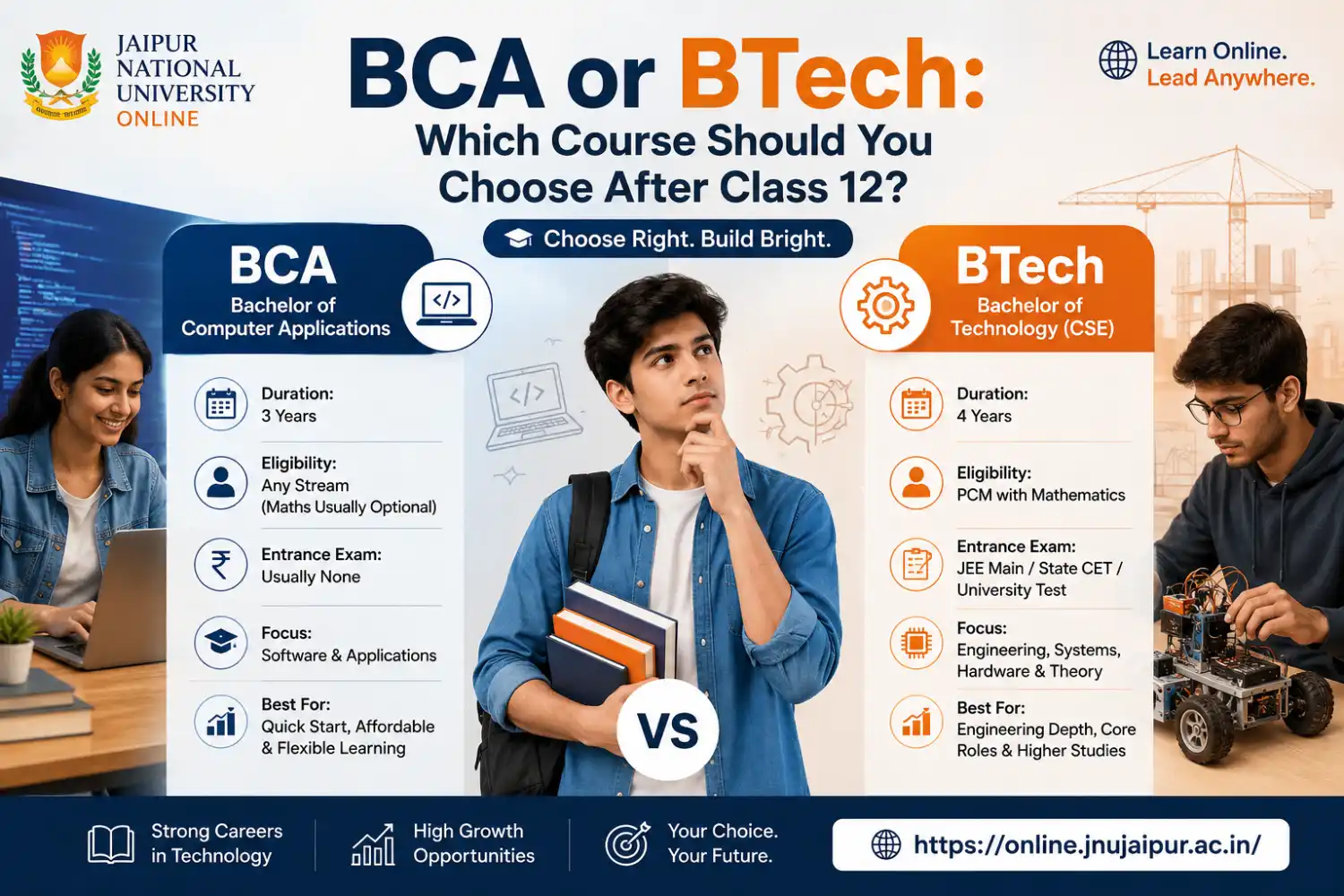
Choose a BCA if you want a three-year, software-focused degree that is affordable, flexible, and…

Exploring Employability: What Jobs Can You Expect After An Online BCA Degree?
Introduction The global digital evolution has left a significant impact on the educational sector, and…
Online BCA vs Regular BCA: Which Is Better for Your Career in 2026?
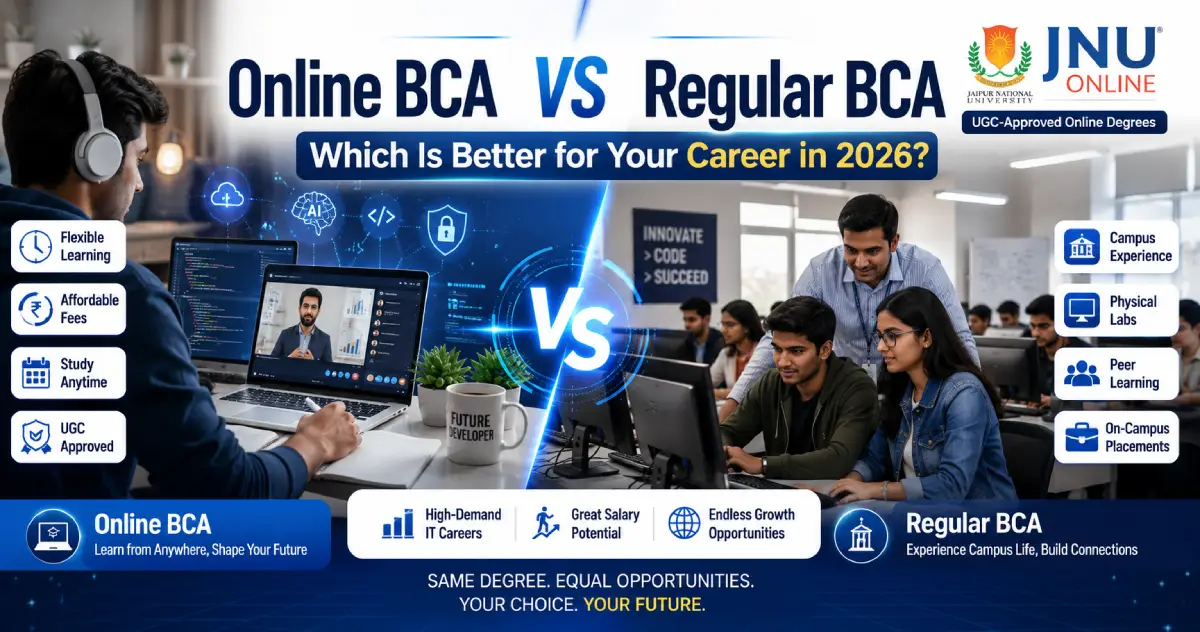
Quick Answer The choice between online BCA vs regular BCA depends entirely on your situation….

AI and Cloud Computing in BCA: How Online Programs Are Future-Proofing the Degree in 2026
In 2026, the Bachelor of Computer Applications is no longer a basic programming degree. Leading…

Best Degree Courses for Science Students After 12th: 2026 Guide to Programs, Careers & Fees
The best degree courses for science students in 2026 fall into four tracks: professional degrees…

How to Become a Software Developer After BCA: Skills, Courses, and Career Path
To become a software developer after a BCA, master at least one programming language such…