
Difference Between a Regular BCom and a BCom with ACCA-Aligned Curriculum
Home / Online B.Com / Difference Between a Regular BCom and a BCom with ACCA-Aligned Curriculum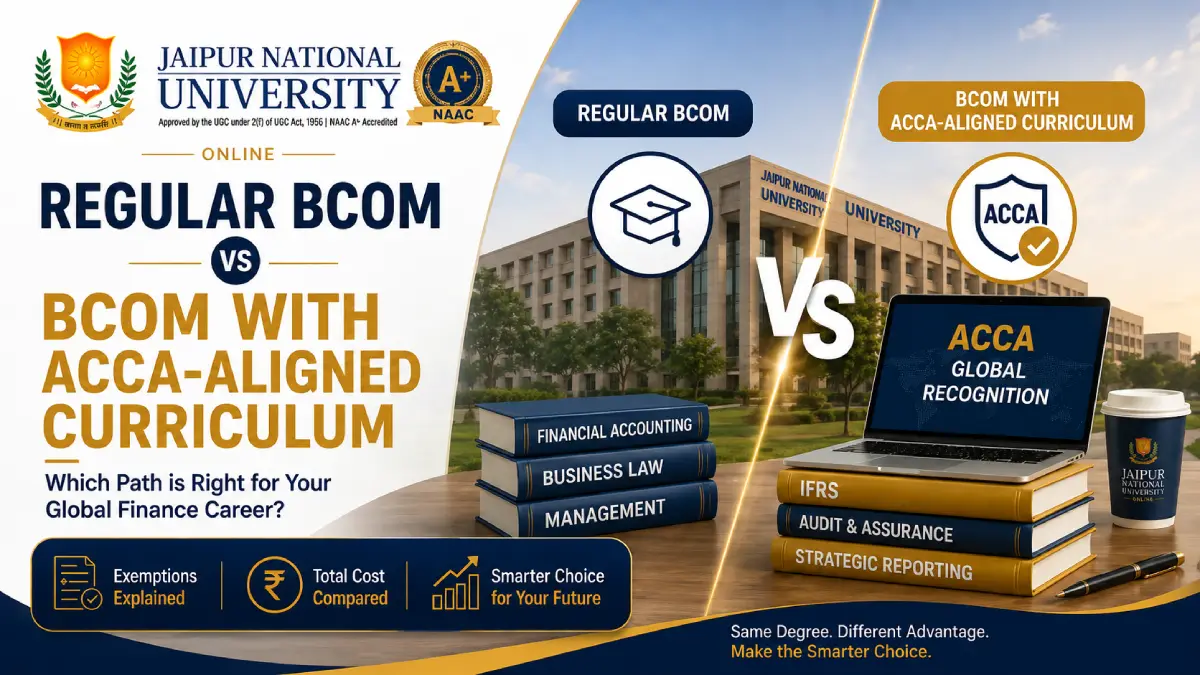
| Both routes award the same three-year Bachelor of Commerce degree. The real difference is how much of the professional accounting syllabus is embedded before you graduate. A regular commerce degree from a UGC-recognised Indian university typically earns three to four ACCA paper exemptions. A programme holding formal ACCA accreditation can earn up to nine. Neither route makes you an ACCA member on graduation day, because membership additionally requires four Strategic Professional exams, an ethics module and 36 months of verified work experience. |
What an “ACCA Aligned Curriculum” Actually Means
Admissions pages across India use “ACCA-aligned”, “ACCA-integrated” and “ACCA-accredited” as if they were interchangeable. They describe three genuinely different arrangements, and the distinction decides how many exams you will actually skip. Understanding these tiers before you compare fees is the single most useful thing a commerce applicant can do.
Tier 1: Formally accredited programmes
The Association of Chartered Certified Accountants reviews the university’s syllabus paper by paper under its own accreditation framework, then publishes a specific exemption award tied to that named degree. Only programmes at this tier reach the upper end of the exemption range. Critically, the award attaches to an exact degree title and intake year, not to the university as a whole. A university can hold accreditation for one BCom variant while its other commerce degrees receive standard treatment.
Tier 2: “Aligned” or “integrated” programmes
Here the institution has written its syllabus to mirror ACCA content and usually bundles coaching from a training partner into the programme fee. This is genuinely useful preparation and often includes mock exams and mentoring. But an ACCA aligned curriculum is a description the university has chosen for itself, not a status ACCA has conferred. Your exemptions still come from ACCA’s own assessment of your transcript, and the number can be lower than the brochure implies.
Tier 3: Recognised commerce degrees
Any BCom from a UGC-recognised Indian university is assessed on its own merit, either through ACCA’s exemption calculator or through its Accreditation of Prior Learning route for institutions not yet listed. This commonly returns exemptions covering Business and Technology, Management Accounting and Financial Accounting, and sometimes Corporate and Business Law as well. Put plainly, ACCA exemptions for BCom holders are the default position, not a bonus that only a premium programme can unlock.
Regular BCom vs BCom with ACCA: The Honest Comparison
The table below strips out the marketing language and compares what each route actually delivers. Figures are indicative ranges observed across Indian providers in 2026 and should be verified against the specific programme you are considering.
| Parameter | Regular BCom | BCom with ACCA-Aligned Curriculum |
|---|---|---|
| Degree awarded | Bachelor of Commerce, 3 years | Bachelor of Commerce, 3 years (identical award) |
| Typical ACCA exemptions | 3–4 papers at Applied Knowledge level | Up to 9, only if formally ACCA-accredited |
| Papers still to sit | 9–10 of 13 | 4 of 13 at best |
| Syllabus emphasis | Indian accounting standards, company law, direct and indirect tax | Adds IFRS, international audit standards, strategic reporting |
| ACCA coaching | Arranged and paid for separately | Usually bundled with a training partner |
| Indicative programme fee | ₹40,000 – ₹1.5 lakh | ₹2.5 lakh – ₹6 lakh |
| ACCA body fees | Paid directly to ACCA by the student | Paid directly to ACCA; occasionally part-bundled |
| Flexibility to change direction | High — the degree stands alone | Lower — fees committed to one professional track |
| Commitment required at 18 | Low | High |
| Best suited to | Budget-conscious learners, working students, and those still deciding | Students certain about a global finance career from day one |
Table 1: Structural comparison of the two routes. Fee ranges are indicative and vary by provider.
Know More: How AI is Changing Accounting Jobs — What Online BCom Students Must Learn Now in 2026
The Exemption Maths That Landing Pages Leave Out
The ACCA qualification comprises 13 exams across three levels, plus an ethics module and a practical experience requirement. Exemptions stop dead at the Applied Skills level. No prior qualification on earth, including a fully qualified Indian CA, exempts anyone from the Strategic Professional stage. This is deliberate: it is what keeps the final credential meaning the same thing globally.
| Stage | Papers | Exemption possible? | Typical outcome for a recognised BCom |
|---|---|---|---|
| Applied Knowledge | BT, MA, FA (3) | Yes | Usually all three exempted |
| Applied Skills | LW, PM, TX, FR, AA, FM (6) | Only via an accredited programme | LW sometimes exempted; the rest sat |
| Strategic Professional | SBL, SBR + 2 Options (4) | Never | All four must be sat |
| Ethics & Professional Skills | 1 module | Never | Compulsory for every candidate |
| Practical Experience | 36 months | Never | Compulsory for every candidate |
Table 2: Where exemptions can and cannot apply across the ACCA qualification.
Exemptions are not free
This is the detail almost no Indian blog states plainly. When ACCA awards you an exemption, you still pay an exemption fee for that paper. Published rates work out to roughly ₹11,000 to ₹12,500 for each Applied Knowledge paper and ₹14,200 to ₹15,700 for each Applied Skills paper. Claiming the full nine exemptions therefore generates a bill in the region of ₹1.25 lakh — not far below what sitting some of those exams would have cost. The saving from claiming ACCA exemptions for BCom holders is real, but it is a saving of study time and tuition, not a saving of fees.
Know More: The Rise of FinTech in India: Why Online BCom Students Should Care About FinTech Careers in 2026
The Cost Comparison Nobody Publishes
This is where the two routes genuinely diverge, and where the decision should actually be made. Route A pairs an affordable recognised degree with independent ACCA registration. Route B buys the packaged experience. Both end at the same destination.
| Cost component | Route A: Regular BCom + independent ACCA | Route B: Packaged BCom with ACCA |
|---|---|---|
| Degree fee | ₹42,000 – ₹67,200 (JNU Online B.Com, distance or online mode) | ₹2.5 lakh – ₹6 lakh typical |
| ACCA registration | ≈ ₹11,400 one-time | ≈ ₹11,400 one-time |
| Annual subscription | ≈ ₹17,900 per year while registered | ≈ ₹17,900 per year while registered |
| Exemption fees | 3–4 papers at Applied Knowledge rate | 3 at Knowledge rate plus up to 6 at Skills rate |
| Exam fees | 9–10 papers at standard entry | 4 papers at standard entry |
| Coaching | Chosen and paid for separately, at your pace | Usually included in the programme fee |
| Ethics module | ≈ ₹10,600, compulsory | ≈ ₹10,600, compulsory |
| Where the money goes | Low degree cost, more exam fees over time | High degree cost, fewer exam fees |
| Risk if you change your mind | Low — you still hold a full degree | High — the premium is already spent |
Table 3: Rupee amounts are converted from ACCA’s published pound rates at approximately ₹128 to the pound. ACCA bills in pounds and revises fees annually, so confirm current figures before budgeting.
Run the arithmetic and something uncomfortable emerges. A packaged programme charging a five-lakh premium to save you six Applied Skills exams is charging far more than those six exams and their tuition would cost you independently. The premium buys structure, mentoring and peer accountability — all of which have genuine value for some students. It is not, by itself, a financial saving.
Where an Online BCom Degree Changes the Calculation
For a large share of Indian commerce students, the constraint is not ambition but budget and time. This is where the recognised-degree-plus-independent-ACCA route becomes genuinely competitive, and where mode of study matters more than most applicants realise.
Under the UGC (Open and Distance Learning Programmes and Online Programmes) Regulations, 2020, degrees awarded through online or distance mode by recognised institutions are treated as equivalent to the corresponding degrees offered through conventional mode. In plain terms: a UGC-DEB entitled online BCom degree is, in regulatory substance, a BCom. It goes into ACCA’s transcript assessment on the same footing as a campus degree.
Jaipur National University, Jaipur delivers its Bachelor of Commerce through the Centre for Distance and Online Education in both modes. The university holds UGC Section 2(f) recognition, NAAC A+ accreditation and AIU membership, and the programmes are UGC-DEB entitled. The online BCom degree is priced at ₹67,200 across six semesters, and the distance-mode B.Com at ₹42,000 — figures that leave substantial room in a student’s budget for ACCA registration, exemption fees and quality coaching.
What makes the JNU Online B.Com particularly workable as an ACCA base is the composition of its core papers. The syllabus is unusually accounting-dense for a general commerce degree, which is precisely what ACCA’s assessors look for when mapping prior learning.
| JNU Online B.Com subject (semester) | Closest ACCA paper | Foundation it builds |
|---|---|---|
| Financial Accounting (I) | FA – Financial Accounting | Double entry, trial balance, final accounts |
| Principles of Management (I), Business Organization (II) | BT – Business and Technology | Organisational structure, governance, business environment |
| Cost Accounting (II), Management Accounting (IV) | MA – Management Accounting | Costing methods, budgeting, variance analysis |
| Regulatory Framework of Business (II), Company Law (III) | LW – Corporate and Business Law | Contract, agency and company law foundations |
| Corporate Accounting (III) | FR – Financial Reporting | Group accounts and consolidation basics |
| Tax Management (IV) | TX – Taxation | Direct and indirect tax computation |
| Financial Management (IV), Business Budgeting (VI) | FM – Financial Management | Working capital, investment appraisal |
| Auditing – Theory & Practice (V) | AA – Audit and Assurance | Audit planning, evidence, internal control |
| Business Statistics (III), Quantitative Techniques (V) | PM – Performance Management | Analytical and decision-support techniques |
Table 4: Subject-level relevance mapping based on the published JNU Online B.Com programme structure.
| Important clarification
This mapping demonstrates syllabus relevance, not an exemption guarantee. JNU Online’s B.Com is a UGC-DEB entitled commerce degree; it is not marketed as an ACCA-accredited programme, and no Indian university can promise exemptions on ACCA’s behalf. Confirm your own award using ACCA’s official exemption calculator, or apply through the Accreditation of Prior Learning route, before assuming any paper is waived. |
The Timeline Reality: Nobody Graduates ACCA-Qualified
Marketing copy frequently implies that three years of study produces a qualified professional. It does not, and understanding why protects you from a badly built plan.
ACCA membership requires three things completed in parallel or sequence: all 13 exams (less exemptions), the Ethics and Professional Skills Module, and 36 months of relevant, supervised work experience signed off by a qualified accountant. That practical experience requirement is the binding constraint. Even a student who clears every remaining paper by graduation cannot be admitted as a member without three years of documented workplace experience.
The useful implication is the reverse of what most students assume: experience can be accrued before or during your exams, and it counts. A working student on a flexible online BCom degree who is already employed in an accounts, audit or finance function may reach membership faster than a full-time campus student on a premium programme, simply because the experience clock started earlier.
Know More: BBA or B.Com: Which Undergraduate Degree Should You Choose?
Who Should Choose Which Route
Choose a packaged BCom with ACCA if
- You are certain at 18 that international accounting is your career, not a possibility you are exploring.
- Your family can absorb the programme premium without loan pressure.
- You learn best with structure, fixed deadlines and a cohort around you.
- You have verified in writing that the specific degree title holds current ACCA accreditation.
Choose a recognised degree plus independent ACCA if
- Budget is a real constraint, or you would need a loan to cover a premium programme.
- You are working, or intend to work, while you study.
- You want the option to pivot toward an MCom, MBA, CA or a government-sector route without stranded costs.
- You are self-directed enough to manage your own ACCA exam calendar.
Five Checks Before You Pay for Any BCom with ACCA
- Ask for the exemption award in writing. Request the ACCA accreditation letter naming the exact degree title and the intake year. “Aligned” and “designed with ACCA in mind” are not accreditation.
- Run the exemption calculator yourself. ACCA publishes an official tool that returns the ACCA exemptions for BCom applicants against a named university and degree. Check it before you rely on a counsellor’s figure.
- Ask what is excluded from the fee. ACCA registration, annual subscription, exemption fees, exam entry and the ethics module are usually paid separately to ACCA. Get this itemised.
- Confirm the UGC-DEB status of the degree itself. A strong professional overlay on a degree without valid entitlement is a poor trade. Verify the programme approval on the DEB portal.
- Ask about the four papers nobody can exempt. Find out exactly what support exists for Strategic Professional, because that is the stage where most candidates stall.
Career Outcomes: Separating the Degree Effect From the ACCA Effect
Salary tables comparing “regular BCom” with “BCom with ACCA” tend to conflate two different variables. What lifts earnings is progress through the ACCA qualification and relevant experience, not the label on the undergraduate degree. Two graduates who have cleared the same number of papers and hold comparable experience will be assessed similarly, whichever route brought them there.
Where the ACCA credential genuinely moves the needle is in roles governed by international reporting standards: audit and assurance in firms with cross-border clients, financial reporting in Global Capability Centres, and finance functions in multinational subsidiaries. India’s GCC expansion across Bengaluru, Hyderabad, Pune and Gurugram has made IFRS-literate finance staff structurally scarce, and that scarcity — not the degree title — is what employers are paying for.
Meanwhile the underlying commerce degree still does work that the professional qualification does not. It establishes eligibility for postgraduate study, for UGC-NET in commerce after a master’s, and for government and banking recruitment where a recognised bachelor’s degree is the stated requirement. Because UGC-DEB entitled online and distance degrees carry equivalence with conventional-mode degrees, a JNU Online commerce graduate retains all of those pathways alongside the ACCA track.
Frequently Asked Questions
Is a BCom with ACCA better than a regular BCom?
Neither is universally better. A packaged programme delivers deeper exemptions and bundled coaching at a substantially higher fee; a recognised degree with independent ACCA registration reaches the same credential at lower upfront cost with more exams to sit. The right answer depends on your budget, your certainty about a finance career, and whether you learn better with imposed structure.
How many ACCA exemptions can a regular BCom get?
Most recognised Indian commerce degrees earn three exemptions covering Business and Technology, Management Accounting and Financial Accounting, with Corporate and Business Law sometimes added. The exact award depends on your university’s syllabus, so verify it on ACCA’s official exemption calculator rather than relying on a general figure.
Can I claim ACCA exemptions with an online or distance BCom?
Yes. UGC regulations state that degrees awarded through online and distance mode by recognised institutions are equivalent to conventional-mode degrees. ACCA assesses the syllabus content of your degree, not the delivery format. Ensure your programme carries valid UGC-DEB entitlement and that your transcript itemises subjects clearly.
Are ACCA exemptions free if my university is ACCA-accredited?
No. ACCA charges an exemption fee for every paper waived — roughly ₹11,000 to ₹12,500 at Applied Knowledge level and ₹14,200 to ₹15,700 at Applied Skills level. Exemptions save study time and tuition costs, not body fees. Budget for them explicitly, and remember ACCA bills in pounds, so the rupee amount moves with the exchange rate.
Will I be a qualified ACCA member when I finish my degree?
No. Membership requires all remaining exams, the Ethics and Professional Skills Module, and 36 months of relevant supervised work experience signed off by a qualified accountant. No three-year undergraduate programme can deliver the experience component, though experience gained while studying does count toward it.
Does JNU Online offer a BCom with an ACCA-integrated curriculum?
Jaipur National University offers a UGC-DEB entitled Bachelor of Commerce in both online and distance modes, priced at ₹67,200 and ₹42,000 respectively. It is not marketed as an ACCA-accredited programme. Its accounting-dense core — Financial Accounting, Cost and Management Accounting, Corporate Accounting, Company Law, Taxation and Auditing — makes it a practical and affordable base degree for students planning to register with ACCA independently.
Is ACCA recognised for government jobs in India?
ACCA is a professional qualification, not a degree, so it does not by itself satisfy graduation requirements for Indian government recruitment. Your underlying bachelor’s degree does that. This is a strong argument for ensuring the degree half of your plan carries proper UGC recognition rather than treating it as a formality.
The Bottom Line
The difference between a regular BCom and a BCom with ACCA aligned curriculum is narrower than the marketing suggests and more expensive than the brochures admit. Both award the same degree. Both end at the same professional credential. What separates them is whether you buy the professional syllabus bundled into your tuition or assemble it yourself as you go.
For students who are certain, well-funded and want the structure, a packaged programme is a reasonable purchase. For the much larger group balancing cost, work and a career decision still being made, a UGC-DEB entitled degree from a NAAC A+ institution paired with independent ACCA registration reaches the same destination with less financial risk and more room to change course.
Whichever route you choose, verify three things before you pay: that the degree carries valid UGC-DEB entitlement, that any exemption claim is confirmed by ACCA rather than by the seller, and that you have budgeted for the four Strategic Professional papers that nobody can exempt you from.
Explore the JNU Online B.Com programme structure, semester-wise fees and eligibility, or speak to an admissions counsellor about the January and July intake sessions.
Key Takeaways
- The degree certificate is identical. Both routes award a Bachelor of Commerce. Only the embedded professional-syllabus content differs.
- Exemptions are capped at nine of ACCA’s 13 papers. The four Strategic Professional exams can never be waived, whatever a brochure implies.
- A plain BCom does not start from zero. Most recognised Indian commerce degrees already earn exemptions at the Applied Knowledge level without any special programme.
- Exemptions are not free. ACCA charges roughly ₹11,000–₹12,500 per Applied Knowledge paper and ₹14,200–₹15,700 per Applied Skills paper waived, so nine exemptions is a real invoice.
- Mode of study is not a disqualifier. UGC-DEB regulations treat online and distance degrees as equivalent to conventional-mode degrees, so mode of study does not remove you from ACCA’s assessment.
- Compare total cost to qualify, not exemption count. Exemption count is a marketing metric. Total spend to reach membership is the number that decides value.
Related Blogs
What Is IoA Accreditation and Why Does It Matter for Students?
A student finishes an analytics or data science course. The marks are good. The projects…

BBA or B.Com: Which Undergraduate Degree Should You Choose?
Choose a BBA if you want a broad management foundation that opens roles in marketing,…

Online B.Com Career Opportunities: SEO Blog for JNU Online
Online B.Com career opportunities are wider than most students think. With an online commerce degree,…

The Rise of FinTech in India: Why Online BCom Students Should Care About FinTech Careers in 2026
India has quietly become the world’s third-largest FinTech ecosystem behind only the United States and…
ACCA Salary in India: How Much Can You Really Earn?
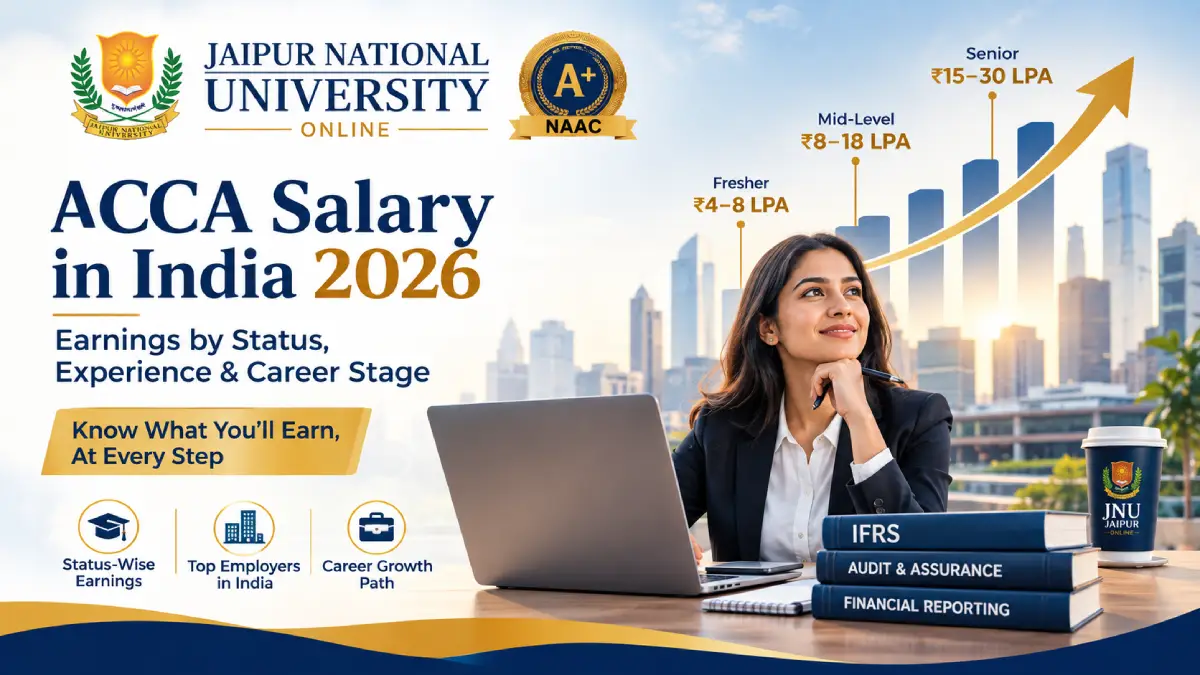
A newly qualified ACCA member in India typically earns ₹4–8 LPA, rising to ₹8–18 LPA…

Career Pathways & Timelines: How Online B.Com Classes Prepare You For CA/CS/CMA?
Introduction Amid the economic expansion of India, the country is witnessing a surge in skilled…