
The Rise of FinTech in India: Why Online BCom Students Should Care About FinTech Careers in 2026
Home / Online B.Com / The Rise of FinTech in India: Why Online BCom Students Should Care About FinTech Careers in 2026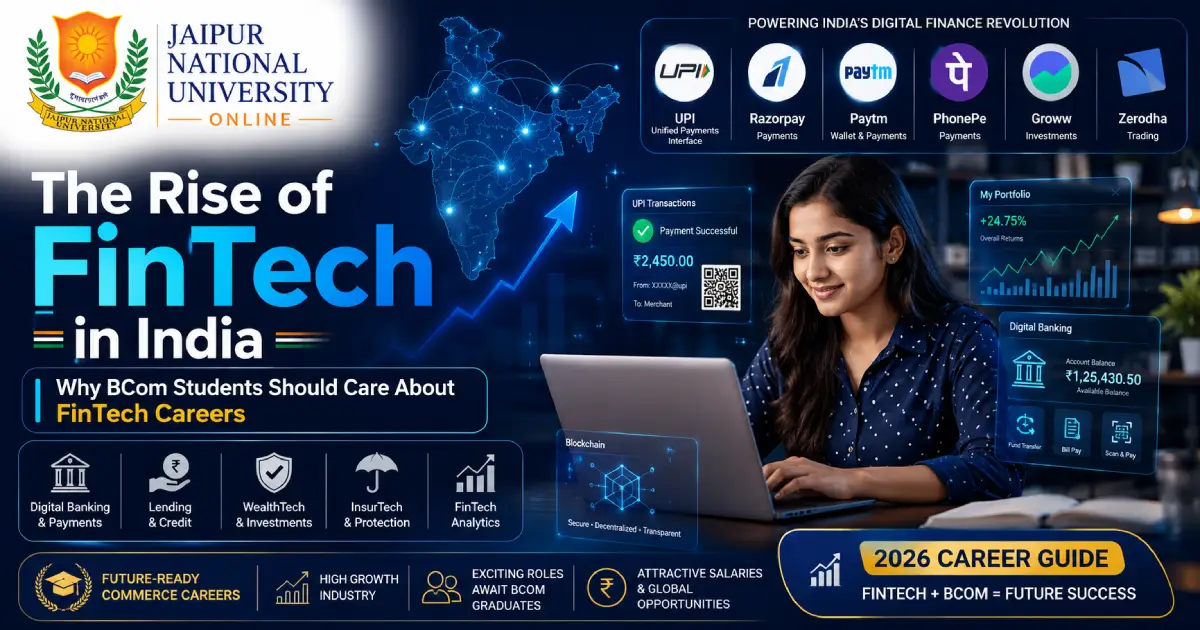
India has quietly become the world’s third-largest FinTech ecosystem behind only the United States and the United Kingdom. UPI alone processes more transactions every month than Visa and Mastercard combined globally. Paytm, Razorpay, PhonePe, CRED, Groww, and Zerodha did not exist a decade ago. Today, they hire thousands of commerce graduates every year. If you are a BCom student in 2026, exploring BCom in FinTech career options India is no longer a niche interest; it is the single most important career conversation you can have before graduation.
This guide breaks down India’s FinTech boom in plain terms: what FinTech actually is, the five fast-growing sub-sectors hiring BCom graduates, the top 10 career options with realistic salaries, the skills you need to build during your degree, and how an online BCom from Jaipur National University (JNU Online) positions you for this industry without taking a loan or moving cities.
Quick Answer: Should BCom Students Care About FinTech?
Yes — strongly. India’s FinTech market is projected to cross USD 150 billion by 2025 and USD 420 billion by 2029, creating over 12 lakh new jobs across digital payments, lending, wealth management, and insurance technology. BCom graduates who combine commerce fundamentals with FinTech-specific skills (UPI ecosystems, data analytics, blockchain basics, and regulatory compliance) earn 40 to 90 percent higher starting salaries than traditional BCom graduates and dominate the hiring pipelines at Razorpay, Paytm, PhonePe, HDFC, ICICI, and the Big Four.
India’s FinTech Boom: Why It Matters for Commerce Students in 2026
Let us start with the numbers, because the scale of India’s FinTech revolution is genuinely difficult to grasp without them.
- UPI Dominance: India processes over 18 billion UPI transactions every month in 2026 — more than the combined monthly volume of Visa, Mastercard, and American Express globally. Source: NPCI.
- Market Size: India’s FinTech market reached USD 110 billion in 2024 and is projected to cross USD 420 billion by 2029, growing at a CAGR of 30 percent.
- FinTech Unicorns: India has 26 FinTech unicorns — second only to the United States — including Razorpay, PhonePe, Paytm, CRED, Groww, Zerodha, BharatPe, Pine Labs, Slice, and Cred.
- Job Creation: NASSCOM projects over 12 lakh new FinTech jobs in India by 2028, with commerce graduates being the largest hiring pool after engineering.
- Government Push: RBI’s Regulatory Sandbox, the Account Aggregator framework, ONDC, e-RUPI, and the Digital India initiative have created the world’s most active FinTech regulatory environment.
Translation for a BCom student: every year you spend without exploring BCom in FinTech career options in India is a year your peers are spending learning UPI integrations, blockchain basics, and Power BI dashboards and walking into ₹6–10 LPA jobs straight out of college.
What is FinTech? A Simple Explanation for BCom Students
FinTech (Financial Technology) is the use of technology to deliver financial services, such as payments, lending, investing, insurance, accounting, and regulatory compliance, faster, cheaper, and more accessible than traditional banks ever could.
If you have ever paid through Google Pay, taken a personal loan on Navi, invested through Groww, bought insurance through Acko, or used CRED to pay your credit card bill, you have used FinTech. The companies behind these apps are some of India’s largest employers of BCom graduates today.
FinTech sits at the exact intersection of two things you already understand as a commerce student: finance and business. The technology layer is learnable. Your commerce foundation is the harder skill, and it is the one FinTech companies value most.
5 FinTech Sub-Sectors Every BCom Student Should Know
FinTech is not one industry; it is five distinct subsectors, each hiring different kinds of BCom graduates. Pick the one that aligns with your interests early.
1. PayTech (Digital Payments)
UPI apps, payment gateways, QR code systems, and contactless payment infrastructure. Examples: Razorpay, PhonePe, Paytm, Pine Labs, BharatPe. Roles: Payment Operations Specialist, Settlement Analyst, Merchant Onboarding Executive.
2. LendingTech (Digital Lending)
Online loans, BNPL (Buy Now Pay Later), digital credit scoring, and instant personal loans. Examples: Navi, KreditBee, Slice, Cred, MoneyTap. Roles: Credit Analyst (Digital Lending), Risk Underwriter, Collection Analyst.
3. WealthTech (Digital Investments)
Discount brokerages, mutual fund apps, robo-advisors, and stock trading platforms. Examples: Zerodha, Groww, Upstox, INDmoney, Smallcase. Roles: Investment Analyst, Mutual Fund Operations, Equity Research Associate.
4. InsurTech (Digital Insurance)
Online insurance platforms, claim automation, and policy aggregation. Examples: Acko, PolicyBazaar, Digit Insurance, Coverfox. Roles: Underwriting Analyst, Claims Operations, Policy Servicing Executive.
5. RegTech (Regulatory Technology)
KYC automation, AML compliance, fraud detection, and regulatory reporting. Examples: HyperVerge, Signzy, IDfy, ClearTax. Roles: Compliance Analyst, KYC Operations, Fraud Risk Analyst.
This is one of the most overlooked but rewarding pathways in the entire BCom in FinTech career options India landscape. RegTech roles often pay better than payment roles because regulatory expertise is harder to replace.
Top 10 BCom in FinTech Career Options in India (with Salary)
Here is the most comprehensive list of FinTech roles open to BCom graduates in India in 2026, with realistic Indian salary ranges based on data from NASSCOM, Glassdoor India, AmbitionBox, and LinkedIn Talent Insights.
| FinTech Role | What You’ll Do | Salary Range (Entry to Mid) |
|---|---|---|
| FinTech Analyst | Market research, product evaluation, competitor analysis, and digital finance model assessment | ₹4 – 12 LPA |
| Financial Data Analyst | Analyse transaction data, build dashboards, identify trends, support business decisions | ₹4.5 – 11 LPA |
| Credit Analyst (Digital Lending) | Evaluate creditworthiness for online lenders and NBFCs using AI-based scoring models | ₹4 – 10 LPA |
| Blockchain Associate | Help organisations adopt blockchain for payments, smart contracts, and crypto operations | ₹5 – 14 LPA |
| Risk & Compliance Analyst | Ensure digital transactions follow RBI, SEBI, and cybersecurity regulations | ₹4.5 – 12 LPA |
| Payment Operations Specialist | Handle settlement cycles, reconciliation, and merchant disputes for payment companies | ₹3.5 – 9 LPA |
| WealthTech Operations Analyst | Support mutual fund, broking, and robo-advisory operations at Zerodha, Groww, and Upstox | ₹4 – 10 LPA |
| InsurTech Claims Analyst | Automate claim verification, policy processing, and customer servicing | ₹3.5 – 9 LPA |
| FinTech Product Manager (after 2-3 yrs) | Own product roadmap, work with engineering teams, drive feature launches | ₹15 – 45 LPA |
| KYC / AML Compliance Officer | Verify customer identity, prevent money laundering, and ensure regulatory reporting | ₹3.5 – 8 LPA |
Notice the pattern: every role values a commerce foundation (accounting, finance, or taxation) combined with one specialised skill, data analytics, regulatory knowledge, or product thinking. That combination is exactly what the BCom in FinTech career options India is built around.
Skills Every BCom Student Needs for a FinTech Career
FinTech recruiters consistently rate the following six skills as ‘must-haves’ in their 2026 hiring rubrics. You do not need all six on day one, but build at least four before graduation.
- Advanced Excel + Financial Modeling: Pivot tables, VLOOKUP, INDEX-MATCH, Power Query, and DCF / ratio analysis. The most-tested skill in any FinTech interview.
- Data Visualisation (Power BI or Tableau): FinTech companies generate massive transaction data. Whoever can turn it into a clear dashboard wins the analyst seats.
- SQL Basics: The single most underrated skill. Two weeks of SQL learning separates a ₹4 LPA candidate from a ₹7 LPA candidate.
- Understanding of Indian Financial Regulations: RBI guidelines, SEBI norms, GST, Income Tax basics, IRDAI for insurance, and FEMA. This is where commerce graduates beat engineers.
- Digital Payments Ecosystem Knowledge: How UPI works, settlement cycles, payment gateway architecture, NEFT/RTGS/IMPS flow. You can learn most of this through NPCI’s free resources.
- Communication & Stakeholder Management: FinTech is cross-functional. Your ability to explain a regulatory rule to an engineer or a financial concept to a marketing manager is the skill that gets you promoted.
Top Recruiters Hiring BCom Graduates in FinTech (India 2026)
Here is where the BCom in FinTech career options India search becomes actionable. These are the companies actively running graduate trainee programs and entry-level hiring drives for commerce students:
| Category | Top Recruiters in India |
|---|---|
| FinTech Unicorns | Razorpay, Paytm, PhonePe, CRED, Groww, Zerodha, BharatPe, Pine Labs, Slice, Navi |
| Digital Banks & NBFCs | HDFC Bank, ICICI Bank, Axis Bank, Kotak Mahindra, Bajaj Finserv, Tata Capital, Aditya Birla Capital |
| WealthTech Platforms | Zerodha, Groww, Upstox, INDmoney, Smallcase, ET Money, 5paisa, Angel One |
| InsurTech Companies | Acko, PolicyBazaar, Digit Insurance, Coverfox, Turtlemint, Onsurity |
| Big Four & Consulting | Deloitte, PwC, EY, KPMG, BCG, McKinsey, Accenture; FinTech advisory teams |
| Global Payment Networks | Visa, Mastercard, American Express, PayU, Stripe India |
| RegTech & Compliance | ClearTax, Signzy, IDfy, HyperVerge, Perfios, Karza Technologies |
How JNU Online BCom Prepares You for a FinTech Career
Jaipur National University (JNU Jaipur) Online is one of the few NAAC A+ accredited universities in India that has actively integrated FinTech, Data Analytics, and AI in Business modules into its online BCom curriculum. For students serious about pursuing a BCom in FinTech career options India without spending ₹3-4 lakhs on a private FinTech-specific degree, JNU Online offers a smarter alternative.
- FinTech-Integrated BCom Curriculum: JNU Online’s BCom includes value-added courses in AI in Business, e-commerce, Digital Marketing, and Data Analytics, directly mapping to FinTech hiring requirements.
- NAAC A+ and UGC-Entitled: Your degree is fully valid for jobs at all FinTech companies, banks, NBFCs, and government departments and is accepted for CA, CMA, CS, ACCA, and MBA admissions.
- Flexible Self-Paced Learning: Live classes, recorded lectures, mobile-first LMS. Perfect if you want to simultaneously pursue CFA Level 1, FinTech certifications from Coursera or Razorpay Academy, or an internship at a startup.
- Affordable Fees: JNU Online’s BCom is significantly cheaper than comparable private, deemed-university online programs, with EMI options and a 10 percent early-bird scholarship.
- Real-World Case Studies: JNU’s BCom curriculum is hands-on case studies on e-commerce predictions, UPI ecosystem, GST compliance, and digital payments, the exact knowledge FinTech recruiters look for.
- Career & Placement Support: JNU’s career cell connects online learners with virtual job fairs and industry mentorship across IT, BFSI, FinTech, and consulting sectors.
Ready to build a FinTech career through an online BCom? Apply to JNU Online BCom for the upcoming session with flexible fees,10% early-bird scholarship, and NAAC A+, UGC-entitled.
See More: https://online.jnujaipur.ac.in/blogs/ai-in-accounting-for-bcom-students/
5-Step Roadmap to Land Your First FinTech Job
Here is the exact roadmap that consistently lands BCom graduates in FinTech offers in the ₹4-8 LPA range, based on real placement patterns from 2024-26:
- Year 1 — Build the Foundation: Enroll in a UGC-entitled online BCom like JNU Online. Master core commerce (accounting, taxation, financial management). Spend the first six months building advanced Excel skills. Complete a free NPCI UPI ecosystem course.
- Year 2 — Add One Specialised Skill: Pick either data analytics (Power BI or Tableau) OR Indian financial regulations (RBI, SEBI, IRDAI basics). Do not try both in the same year. Complete a free Razorpay Academy or Groww Educate certification.
- Year 2 (Late) — Start a Personal Project: Build a UPI transaction analysis dashboard, a mutual fund SIP calculator in Excel, or a credit risk scoring model in Google Sheets. Upload to LinkedIn and GitHub.
- Year 3 — Land an Internship: Apply for FinTech internships at Razorpay, Paytm, PhonePe, Groww, ClearTax, or your local CA firm with FinTech clients. Even a 3-month unpaid internship beats a college project on your resume.
- Final Semester — Convert or Apply Externally: Either convert your internship to a full-time offer (50 percent of FinTech interns do) or apply to 50+ companies using your project portfolio + degree + certifications. Average BCom + 1 internship + 1 certification = 4-7 LPA offers in 2026.
Will FinTech Replace Traditional Banking Jobs?
Short answer: No, but it is reshaping them. India’s largest private banks (HDFC, ICICI, Axis, and Kotak) are themselves becoming FinTech companies; they spent over ₹15,000 crores combined on technology in 2024. The future commerce graduate will not choose between banking and FinTech. They will work at the intersection of both.
What is being replaced is the manual, repetitive layer of banking, physical KYC, paper-based loan processing, and branch-based customer service. What is growing is the analytical, advisory, and product layer, exactly where BCom graduates with FinTech literacy thrive.
This is why understanding BCom in FinTech career options India early in your degree is so valuable. You are not betting against banking. You are betting on the version of banking and finance that India is actively building.
Frequently Asked Questions
What are the best BCom in FinTech career options in India?
The top FinTech career options for BCom graduates in India in 2026 are FinTech Analyst (₹4-12 LPA), Financial Data Analyst (₹4.5-11 LPA), Credit Analyst in Digital Lending (₹4-10 LPA), Blockchain Associate (₹5-14 LPA), Risk & Compliance Analyst (₹4.5-12 LPA), Payment Operations Specialist (₹3.5-9 LPA), and WealthTech Operations Analyst (₹4-10 LPA).
What is the salary of a BCom FinTech graduate in India?
Entry-level BCom FinTech graduates in India earn ₹4-7 LPA in 2026. With 2-3 years of experience and skills in data analytics, blockchain, or product management, salaries climb to ₹7-15 LPA. Specialist roles like FinTech Product Manager can reach ₹40+ LPA.
Do I need a special BCom FinTech degree, or is a regular online BCom enough?
A regular UGC-entitled online BCom (like JNU Online) plus 2-3 FinTech-specific certifications and one internship is sufficient for 90% of entry-level FinTech roles in India. A specialised BCom FinTech degree is helpful but not necessary. FinTech recruiters care about skills and project portfolios more than degree titles.
Which companies hire BCom graduates for FinTech roles in India?
Top recruiters include FinTech unicorns (Razorpay, Paytm, PhonePe, CRED, Groww, and Zerodha); digital banks and NBFCs (HDFC, ICICI, and Bajaj Finserv); WealthTech platforms (Upstox and INDmoney); InsurTech firms (Acko and PolicyBazaar); the Big Four (Deloitte, PwC, EY, and KPMG); and global payment networks (Visa, Mastercard, and PayU).
Is JNU Online BCom valid for FinTech jobs?
Yes, JNU Online BCom is UGC-entitled and NAAC A+ accredited, making it valid for all FinTech companies, banks, NBFCs, government jobs, and postgraduate studies. Major recruiters like TCS, Infosys, Wipro, HDFC Bank, and Bajaj Finserv accept JNU Online degrees on par with regular campus degrees.
Can I do CA or CFA along with an online BCom for a FinTech career?
Yes, and it is highly recommended. The flexibility of JNU Online’s BCom lets you simultaneously prepare for CA Foundation, CFA Level 1, FRM, or ACCA. This combination—a BCom, a professional certification, and FinTech skills is the most powerful resume profile for FinTech analyst and advisory roles.
What skills do FinTech companies expect from BCom freshers?
FinTech recruiters look for (1) advanced Excel and financial modelling, (2) data visualisation with Power BI or Tableau, (3) basic SQL, (4) understanding of Indian financial regulations (RBI, SEBI, and IRDAI), (5) digital payments and UPI ecosystem knowledge, and (6) clear communication. Building 4 of these 6 during your BCom puts you ahead of most peers.
Is FinTech a stable long-term career for BCom graduates?
Yes. India’s FinTech market is projected to grow from USD 110 billion (2024) to USD 420 billion by 2029, with over 12 lakh new jobs forecasted by NASSCOM. Even during 2023-24 market corrections, FinTech hiring stayed positive — the sector is structurally growing because India’s digital financial infrastructure is still being built out.
Final Thoughts
India’s FinTech industry is a rare sector where commerce graduates are not just welcome, they are essential. The understanding of accounting, taxation, regulations, and financial markets that BCom builds is exactly what FinTech founders cannot easily find in engineering graduates. Add data literacy, digital payment ecosystem knowledge, and one internship, and you walk into an industry that pays 40-90 percent more than traditional commerce roles.
The students who treat BCom in FinTech career options India as a serious area of study during their degree, not after, will define the next decade of Indian finance. The good news: you do not need an expensive private FinTech program to get there. A flexible, affordable, UGC-entitled online BCom from a NAAC A+ institution is more than enough — provided you actively build the supporting skills.
Start with the right BCom. Explore JNU Online’s UGC-entitled, NAAC A+ accredited online BCom designed to prepare commerce students for the FinTech era without sacrificing flexibility, recognition, or affordability.
👉 Apply for JNU Online BCom Today: https://apply-online.jnujaipur.ac.in/
Related Blogs

ACCA Salary in India: How Much Can You Really Earn?
A newly qualified ACCA member in India typically earns ₹4–8 LPA, rising to ₹8–18 LPA…
How AI is Changing Accounting Jobs — What Online BCom Students Must Learn Now in 2026
Artificial Intelligence is no longer a buzzword in the accounting world; it has become the…
Difference Between a Regular BCom and a BCom with ACCA-Aligned Curriculum
Both routes award the same three-year Bachelor of Commerce degree. The real difference is how…

BBA or B.Com: Which Undergraduate Degree Should You Choose?
Choose a BBA if you want a broad management foundation that opens roles in marketing,…

Career Pathways & Timelines: How Online B.Com Classes Prepare You For CA/CS/CMA?
Introduction Amid the economic expansion of India, the country is witnessing a surge in skilled…

What Is IoA Accreditation and Why Does It Matter for Students?
A student finishes an analytics or data science course. The marks are good. The projects…