
What Are the 7Ps of Marketing Mix? A Complete Guide to the Extended Marketing Mix
Home / Online MBA / What Are the 7Ps of Marketing Mix? A Complete Guide to the Extended Marketing Mix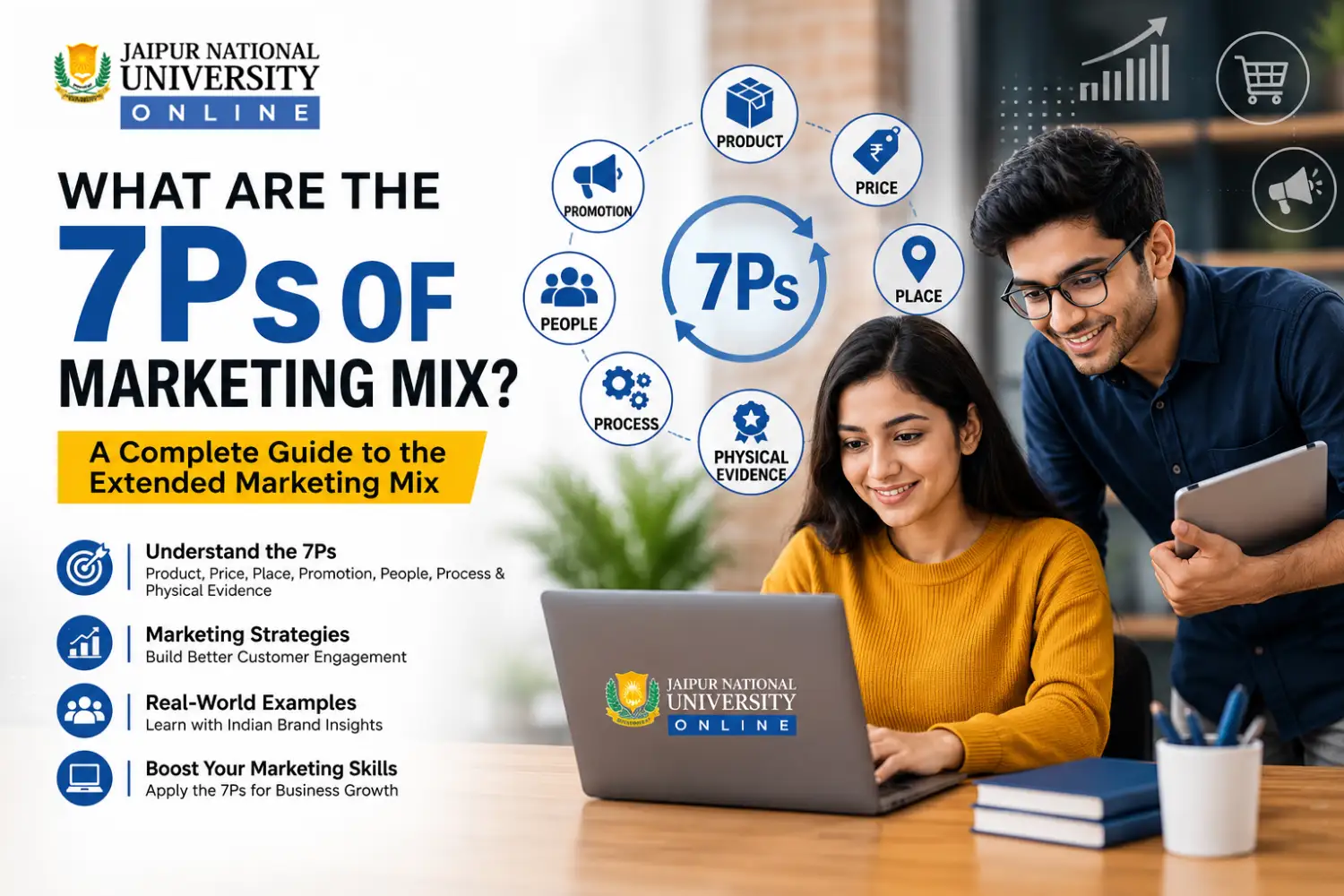
The 7Ps of Marketing Mix are Product, Price, Place, Promotion, People, Process and Physical Evidence. They are the seven controllable decisions a business makes when it puts an offer in front of a customer.
The first four came from E. Jerome McCarthy in 1960. They were built around physical goods on a shelf. Bernard H. Booms and Mary Jo Bitner added the last three in 1981. Services cannot be inspected before purchase. They are delivered by people, not pulled off a shelf. That is why the seven-part model is also called the extended marketing mix.
Treat the seven as an audit, not a theory. Score each one out of ten. The lowest score is usually where the next quarter of growth is hiding.
A customer today judges a brand by the person who answers the phone. By the speed of the checkout. By the design of the app, and by the confidence the website inspires. Every one of those moments belongs to the 7Ps of Marketing Mix.
This guide explains each of the seven components of marketing mix in plain language. It uses comparison tables, named Indian examples with published data, and a practical audit any brand can run this week. Whether you are preparing for an MBA examination, writing a marketing plan, or fixing a campaign that is not converting, the 7Ps of Marketing Mix gives you a checklist that rarely fails.
What Is the Marketing Mix?
The marketing mix is the set of controllable decisions a business makes to place its offer in front of the right customer. At the right price. In the right place. With the right message.
The idea began with a metaphor. In 1948, James Culliton described the marketing executive as a mixer of ingredients, much like a chef. Professor Neil Borden of Harvard Business School credited Culliton for that image and built the marketing mix concept around it through the 1950s and 1960s. E. Jerome McCarthy then organised those ingredients into four memorable headings in 1960: Product, Price, Place and Promotion.
The word “mix” carries the whole idea. No single element wins on its own. A superb product priced wrongly fails. A fair price promoted to the wrong audience fails. The 7Ps of Marketing Mix works because it forces a business to check every ingredient before it blames the market.
What Do the 7Ps of Marketing Mix Include?
The 7Ps of Marketing Mix are Product, Price, Place, Promotion, People, Process and Physical Evidence. The table below sets out all seven components of marketing mix in one view.
| Element | What it covers | The core question | Example decision |
|---|---|---|---|
| Product | Features, quality, design, variety, packaging, warranty, after-sales support | What are we actually selling, and why would anyone want it? | Launching a lighter, cheaper variant for first-time buyers |
| Price | List price, discounts, credit terms, subscriptions, perceived value | What will the customer pay, and does that price signal the right thing? | Moving from a one-time fee to a monthly plan |
| Place | Channels, coverage, logistics, inventory, marketplaces, storefronts | Where does the customer expect to find and receive this? | Adding quick-commerce listings alongside an own-brand website |
| Promotion | Advertising, public relations, sales promotion, personal selling, content, influencers | How does the right audience hear about us and act? | Shifting budget from print to regional-language video |
| People | Employees, sales teams, support staff, partners, the customer community | Who represents the brand at the moment of truth? | Retraining the support team on complaint recovery |
| Process | Ordering, delivery, onboarding, service recovery, billing, refunds | How easy is it to buy from us and stay with us? | Cutting a seven-step checkout down to three steps |
| Physical Evidence | Store ambience, packaging, uniforms, website, app interface, reviews, certificates | What tangible proof tells the customer this is a safe choice? | Publishing verified reviews and accreditation badges |
The seven components of marketing mix are also written as the Marketing Mix 7Ps. The first four Ps came from product marketing. The last three came from services marketing. That is why the model is often called the extended marketing mix or the services marketing mix.
How Did the 4Ps Become the 7Ps?
The move from four elements to seven was not cosmetic. It happened because economies changed shape.
| Year | Contributor | Contribution | Why it mattered |
|---|---|---|---|
| 1948 | James Culliton | Described the marketing executive as a mixer of ingredients | Gave the field the metaphor the whole model rests on |
| 1949 to 1964 | Neil H. Borden | Built and popularised the marketing mix concept | Established that marketing is a blend of decisions, not a single tactic |
| 1960 | E. Jerome McCarthy | Grouped the mix into 4Ps: Product, Price, Place, Promotion | Gave managers a simple, teachable structure |
| 1981 | Bernard H. Booms and Mary Jo Bitner |
Added People, Process and Physical Evidence | Made the model usable for banks, hospitals, airlines, education and every other service |
| 1990 | Robert Lauterborn | Proposed the 4Cs as a buyer-side counterpart | Reframed the same decisions from the customer’s point of view |
Services behave differently from goods. That is the founding insight of service marketing. The three added elements of the 7Ps of Marketing Mix exist to handle those differences.
| Service characteristic | What it means | Which P answers it |
|---|---|---|
| Intangibility | The customer cannot touch or test the offer before buying | Physical Evidence |
| Inseparability | Production and consumption happen at the same time | People |
| Heterogeneity | Quality varies from one delivery to the next | Process |
| Perishability | Unused capacity cannot be stored for later | Price and Process together |
This matters more in India every year. According to the Economic Survey 2025-26, the services share of gross value added reached a historic high of 56.4 per cent under the FY26 first advance estimates. Services grew by 9.1 per cent in FY26, up from 7.2 per cent the year before. When most of an economy sells experiences rather than objects, the extended marketing mix stops being optional theory. It becomes daily practice.
What Does Each of the 7Ps of Marketing Mix Cover?
Here is each element, with what to decide, a named example, and the questions to ask yourself.
1. Product: What Are You Actually Selling?
Product is the first element of the 7Ps of Marketing Mix. Product strategy covers everything the customer receives, whether tangible or intangible. It includes the core benefit, the features, the quality level, the design, the packaging, the brand name, the warranty and the after-sales support.
A strong product strategy starts with the job the customer is hiring the product to do. People do not buy a drill because they want a drill. They want a hole in the wall. Increasingly, they may prefer to hire someone to make that hole instead.
Key product decisions
- Core benefit and the problem being solved
- Features, quality tier and design language
- Product range, variants and bundles
- Branding, packaging and labelling
- Warranty, guarantee and after-sales service
- Lifecycle stage, and when to refresh or retire
Example: boAt built its business on a good, better, best ladder aimed at first-time buyers. Counterpoint Research recorded boAt as India’s leading true wireless brand for fourteen consecutive quarters up to Q1 2025. In that same quarter, the segment above ₹5,000 grew by more than 1.4 times, led by Apple, Noise and Samsung. There is the product ladder problem in one line. Volume leadership at the entry level does not automatically carry a brand into the tier above it.
Ask yourself: What does the customer really buy from us? Which feature could we remove without anyone noticing? Which missing feature costs us sales every month?
Students who want to work through this in practice will find plenty of scope in these MBA marketing project topics.
2. Price: What Will the Customer Pay?
Pricing strategy is the only element of the 7Ps of Marketing Mix that earns revenue directly. Every other element costs money. Price also carries meaning. A customer reads price as a signal of quality, exclusivity and risk.
| Pricing strategy | How it works | Best suited to |
|---|---|---|
| Penetration pricing | Enter low to win volume and market share fast | New entrants in crowded, price-sensitive categories |
| Price skimming | Launch high, then reduce over time | Innovative or status products with early adopters |
| Competitive pricing | Anchor to what rivals charge | Commodity categories with little differentiation |
| Value-based pricing | Price against the outcome delivered, not the cost incurred | Consulting, education, healthcare, premium services |
| Freemium | Free basic tier, paid upgrade | Software, apps and content platforms |
| Bundle pricing | Combine several items at one attractive price | Retail, hospitality, telecom and food delivery |
| Dynamic pricing | Adjust by demand, time or segment | Airlines, hotels, ride hailing and events |
Example: Indian telecom and streaming brands built enormous subscriber bases on mobile-only and prepaid tiers. The product was broadly the same. The pricing architecture matched how the market actually pays, which is in small, frequent, mobile-first instalments.
The same logic applies in education. Semester-wise fees convert better than a single upfront figure, which is one reason the online MBA for working professionals is usually priced per semester.
Ask yourself: Do we know our customers’ willingness to pay, or are we guessing from cost? What does our discount habit teach customers to do? Are we competing on price because we have failed to differentiate anywhere else?
3. Place: Where and How Do You Sell?
Place is the third element of the 7Ps of Marketing Mix. Place strategy is about availability. It answers where the customer discovers, buys and receives the offer. It now covers physical shelves and digital shelves alike.
Key place decisions
- Direct-to-customer website and application
- Marketplaces and aggregator platforms
- Retail distribution, wholesalers and dealers
- Quick commerce and hyperlocal delivery
- Geographic coverage and market intensity
- Warehousing, logistics and returns handling
Distribution intensity is a useful lens. Intensive distribution puts the product everywhere, which suits low-cost daily items. Selective distribution limits outlets to protect positioning. Exclusive distribution restricts the offer to a few partners to preserve prestige.
Example: India is now a global leader in quick commerce adoption. Bain and Company reports that 16 to 17 per cent of Indian e-retail gross merchandise value flows through quick commerce platforms. That value has doubled every year since 2023, reaching 10 to 11 billion dollars in 2025, and is projected to hit 65 to 70 billion dollars by 2030. A brand that plans distribution around one route alone loses sales it never sees.
The same shift applies to education. Learners now compare online and distance programmes across search, social feeds and comparison portals before they ever reach a university website.
Ask yourself: Where does our customer look first? Which step in the buying journey creates friction? Are we present where the decision is actually made?
4. Promotion: How Do You Communicate?
Promotion strategy is the communication engine of the 7Ps of Marketing Mix. It carries the message, the proof and the reason to act now.
| Promotion tool | What it does | Typical use |
|---|---|---|
| Advertising | Paid, one-to-many reach | Building awareness at scale |
| Public relations | Earned credibility through third parties | Trust, reputation and crisis management |
| Sales promotion | Short-term incentive to act | Clearing stock, driving trial, seasonal spikes |
| Personal selling | One-to-one persuasion | High-value or complex purchases |
| Direct and digital marketing | Targeted, measurable contact | Search, social, email, messaging and remarketing |
| Content and influencer marketing | Useful or trusted third-party voice | Education-led categories and community building |
A promotion strategy works hardest when it is integrated. Every channel repeats one consistent promise. A festive offer that is loud on television and invisible on the website teaches customers that the brand is disorganised.
Example: Regional language creative usually outperforms translated national creative in Indian markets. The IAMAI and Kantar Internet in India Report found that 98 per cent of Indian internet users access content in Indic languages. Fifty-seven per cent of urban internet users prefer regional language content outright. Rural India accounts for 55 per cent of the country’s 886 million active internet users. Promotion is judged in the language the customer thinks in.
Ask yourself: What single idea should the audience remember? Which channel earns its budget, and which one survives out of habit? Is the call to action specific enough to be followed today?
5. People: Who Delivers the Experience?
People is the fifth element of the 7Ps of Marketing Mix. People in marketing means everyone the customer meets, hears or reads before, during and after the purchase. It includes frontline staff, sales teams, support agents, delivery partners, faculty, technicians and, increasingly, the customer community itself.
In a service business, people are the product. Two customers can buy the same package and rate the brand very differently, based purely on who served them.
Key people decisions
- Recruitment profile and attitude fit
- Training, scripts and product knowledge
- Authority to resolve complaints on the spot
- Incentives that reward retention, not only acquisition
- Internal communication, so staff hear campaigns before customers do
- Community, reviews and word of mouth
Example: In education, admissions counsellors and faculty shape enrolment far more than advertising does. Jaipur National University runs a four-step admission process: registration, application and document upload, document verification, then final registration with LMS credentials issued by email. Every one of those four steps is a human handover. A single unanswered query at step three can undo a campaign that took months to plan.
Ask yourself: Does the person at the moment of truth know what our advertising promised? What happens when a customer complains at nine in the evening?
6. Process: How Is the Service Delivered?
Process is the sixth element of the 7Ps of Marketing Mix. Process in marketing covers the sequence of steps a customer moves through, from first enquiry to repeat purchase. It includes enquiry handling, onboarding, delivery timelines, billing, refunds, escalation and service recovery.
Process is invisible when it works. It is unforgettable when it fails. Customers rarely praise a smooth refund. They will tell everyone about a difficult one.
Run this walkthrough on your own funnel:
- Count the steps between first interest and payment. Write down every click, form and phone call.
- Set a response time standard for each channel, then measure against it for two weeks.
- Find the step with the largest drop-off. That single step is usually worth more than a new campaign.
- Test the complaint path yourself. Raise a real query and see how long resolution takes.
- Ask whether you would enjoy being your own customer.
Example: Two universities may offer the same programme, the same fee and the same faculty quality. The one that confirms admission within forty-eight hours converts far more applicants than the one that takes three weeks. If a prospective student must move between an enquiry form, a registration portal, a payment gateway and a document upload before anyone speaks to them, the process is doing the losing, not the price.
7. Physical Evidence: What Makes the Intangible Tangible?
Physical evidence completes the 7Ps of Marketing Mix. It is the proof a customer can see, hold or verify. Services cannot be inspected in advance, so buyers look for tangible cues that reduce risk.
Physical evidence includes
- Premises, ambience, signage and cleanliness
- Packaging, uniforms, vehicles and equipment
- Website design, application interface and page speed
- Certificates, accreditations, rankings and licences
- Reviews, ratings, testimonials and case studies
- Invoices, contracts, brochures and welcome kits
In modern service marketing, digital physical evidence carries most of the weight. For an online service, the website is the showroom. The reviews are the word of mouth. The accreditation badge is the signature on the wall. A dated website with broken links will lose a customer who never speaks to a single member of staff.
Example: BrightLocal’s Local Consumer Review Survey 2026 found that 95 per cent of consumers read reviews before buying. The share who always read reviews rose from 29 per cent to 41 per cent in a single year. In online education, a published approval document, a visible grievance policy and genuine learner testimonials often settle the enquiry before a counsellor is ever involved. This is exactly why online degree validity and recognition in India matters more to applicants than any advertisement, and why universities publish their recognitions and approvals in full.
Ask yourself: What can a first-time visitor verify about us in sixty seconds? Does our evidence match our price positioning?
Why Are the 7Ps of Marketing Mix Important?
The importance of 7Ps in marketing lies in coverage. The framework stops a business from over-investing in one visible element while it quietly fails at another.
| Benefit | What it looks like in practice |
|---|---|
| Complete diagnosis | A drop in sales is traced to a broken process, not blamed on advertising |
| Better resource allocation | Budget moves to the element with the weakest score, not the loudest owner |
| Consistent customer experience | Advertising, staff behaviour and delivery tell the same story |
| Sharper differentiation | Rivals can copy a price overnight, but rarely a trained team or a smooth process |
| Stronger retention | Process and people protect the customers that promotion worked hard to win |
| Faster launches | New products are checked against seven elements before release |
| A shared language | Sales, operations, human resources and marketing debate the same checklist |
Used well, the 7Ps of Marketing Mix is less a theory and more an audit tool. Score each element out of ten. The lowest score is usually where the next quarter of growth is hiding.
How Have the 7Ps of Marketing Mix Changed in the Age of AI Search?
The marketing mix has survived more than sixty years, and the extended seven-part model for more than forty. The elements are structural rather than technological. What changes is how each one is expressed.
| Element | The shift in 2026 |
|---|---|
| Product | Products increasingly ship as services, with subscriptions, updates and personalisation built in |
| Price | Dynamic and segment-specific pricing is normal, so price transparency becomes a trust decision |
| Place | Discovery now happens inside search engines, marketplaces, social feeds and AI assistants |
| Promotion | Brands optimise to be summarised and cited by AI answers, not only to be clicked |
| People | Human contact becomes the premium differentiator as routine queries move to automation |
| Process | Automation is judged by how gracefully it hands over to a human when it fails |
| Physical Evidence | Reviews, verified credentials and site experience act as the new shopfront |
The Numbers Behind the Shift
| Data point | Figure | Which P it evidences |
|---|---|---|
| Services share of India’s gross value added, FY26 first advance estimates | 56.4 per cent, a historic high | Framework relevance |
| Services sector growth, FY26 | 9.1 per cent, up from 7.2 per cent | Framework relevance |
| Indian e-retail value flowing through quick commerce | 16 to 17 per cent | Place |
| Quick commerce value in India, 2025 | 10 to 11 billion dollars | Place |
| Indian internet users accessing Indic language content | 98 per cent | Promotion |
| Urban internet users preferring regional language content | 57 per cent | Promotion |
| Consumers reading reviews before buying | 95 per cent | Physical Evidence |
| Consumers who always read reviews | 41 per cent, up from 29 per cent | Physical Evidence |
The practical takeaway is simple. When a customer asks an AI assistant which provider to choose, the answer is assembled from your physical evidence, your reviews, your clarity of information and your published proof. The 7Ps of Marketing Mix now shapes what machines say about you, as well as what customers see.
Where Can You Learn the 7Ps of Marketing Mix Formally?
Reading about the Marketing Mix 7Ps builds awareness. Applying it under supervision, across live cases and assessed projects, builds capability. That is the difference a structured management qualification makes.
The Online MBA at Jaipur National University teaches the marketing mix inside a full management curriculum, rather than as an isolated topic. Jaipur National University is approved by the UGC under Section 2(f) and accredited with NAAC A+. Its online programmes are offered through the Centre for Distance and Online Education, with UGC-DEB approval published on the university website.
| Element of the 7Ps | Where it is developed in the Online MBA curriculum |
|---|---|
| Product and Price | Marketing Management, Managerial Economics, Management Accounting |
| Place | Sales and Distribution Management, Retail Management, Supply Chain electives |
| Promotion | Advertising and Brand Management, Digital Marketing Strategies and Analytics |
| People | Human Resource Management, Organisation Behaviour and Design |
| Process | Operations and Production Management, Project Management |
| Physical Evidence | Marketing of Services, Customer Relationship Management |
| All seven together | Industrial Summer Training Project and Sectoral Project |
The programme runs for two years across four semesters. The eligibility requirement is a bachelor’s degree of at least three years’ duration from a recognised university, with a minimum of 40 per cent marks. Specialisation options include Marketing Management, Digital Marketing, Human Resource Management, Finance, Business Analytics, Supply Chain Management, Fintech, and Hospital and Healthcare Management.
If you are ready to move from theory to practice, review the online MBA registration process, browse the full range of online degree programmes, or speak to the admissions team about which specialisation matches your career plan.
Before you pay any fee, confirm that your chosen programme appears on the UGC-DEB approved list for your intake year, and record the DEB identification number issued to you.
Frequently Asked Questions About the 7Ps of Marketing Mix
Q1. What are the 7Ps of marketing mix?
The 7Ps of Marketing Mix are Product, Price, Place, Promotion, People, Process and Physical Evidence. The first four apply to any offer, and the last three were added to make the framework work for services.
Q2. Who developed the 7Ps of marketing mix?
1960, Jerome McCarthy introduced the 4Ps in 1960. Bernard H. Booms and Mary Jo Bitner added People, Process and Physical Evidence in 1981 in their work on marketing strategies and organisational structures for service firms.
Q3. What is the difference between the 4Ps and the 7Ps?
The 4Ps cover Product, Price, Place and Promotion, and were designed with physical goods in mind. The 7Ps add People, Process and Physical Evidence, which address the human delivery, the service journey and the tangible proof that service buyers rely on.
Q4. What is the extended marketing mix?
The extended marketing mix is another name for the 7Ps. It refers to the original four elements plus the three service-oriented additions of People, Process and Physical Evidence.
Q5. Why is physical evidence important in service marketing?
Services cannot be inspected before purchase, so customers judge risk using visible cues such as premises, packaging, website quality, accreditations and reviews. Physical evidence converts an intangible promise into something a buyer can verify.
Q6. What is the importance of 7Ps in marketing?
The importance of 7Ps in marketing is that the framework audits every controllable decision a business makes, which prevents strong promotion from hiding a weak process, an unclear price or an untrained team.
Q7. Are the 7Ps of marketing mix still relevant?
Yes. The elements describe structural business decisions rather than specific channels, so the framework adapts to digital commerce, subscription models and AI-assisted search without losing its logic.
Q8. Is there an 8th P of marketing?
Some practitioners add Productivity and Quality as an 8th P, and others propose Partners, Performance or Purpose. The seven-element model remains the standard version used in academic syllabi and most business planning.
Q9. What is the difference between the 7Ps and the 4Cs?
The 7Ps describe marketing decisions from the seller’s side. The 4Cs, proposed by Robert Lauterborn in 1990, restate the same ground from the buyer’s side as Customer value, Cost, Convenience and Communication. Most marketing plans use the 7Ps to organise decisions and the 4Cs to sense-check whether those decisions look reasonable to the customer.
Q10. Where can I study the 7Ps of marketing mix in depth?
Marketing mix theory is taught in management degrees such as a BBA or an MBA. An online MBA with a marketing or digital marketing specialisation covers the 7Ps of Marketing Mix alongside consumer behaviour, brand management, services marketing and analytics.
Related Blogs

A Student’s Comprehensive Guide: How To Choose The Best Online MBA Courses In India?
Amid the digital evolution in the Indian corporate houses, employers are looking for candidates who…

The Best Jobs You Can Get After Getting an Online MBA in India
Introduction Imagine getting a degree in two years that suits your schedule and leads to…

How Do the Top Online MBA Colleges in India Help Shape Your Career?
Thinking about an MBA but can’t step away from your job or family? You’re not…

A Comprehensive List of Online Universities in India offering MBA Programmes in 2025: How JNU Is Changing The Online MBA Landscape?
Table of Contents 1. Introduction 2. Why Should You Choose An Online MBA Programme? 3. …
Top 20 MBA Marketing Project Topics for Final Year Students (2026 Guide)
What are the best MBA marketing project topics for final year students? The top MBA…

MBA Case Studies with Solutions: 20 Real Business Examples, Frameworks & How to Solve Them
MBA case studies are real business situations, such as a turnaround, a failed product or…