
Difference Between Management and Administration: Meaning, Functions and Key Distinctions
Home / Online BBA / Difference Between Management and Administration: Meaning, Functions and Key Distinctions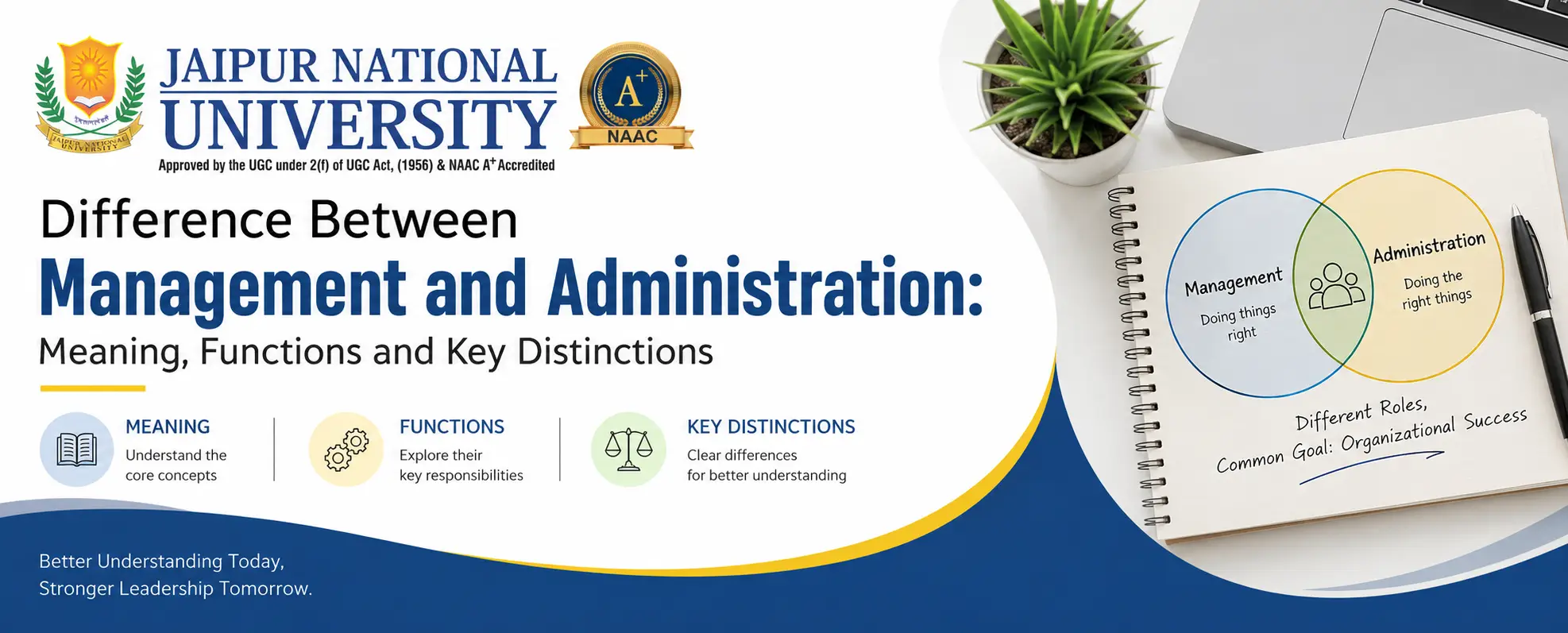
The terms management and administration are used interchangeably so often that the difference between them is easily overlooked. Yet they describe two distinct dimensions of how an organisation is run, and even experienced professionals occasionally blur the line. The point is not merely academic. The world’s most popular business qualification, the Master of Business Administration, carries the word administration in its name, while its curriculum is devoted largely to management. That overlap is precisely why a clear grasp of the difference between management and administration is valuable for every student, aspiring leader, and working professional.
In simple terms, administration is concerned with setting the policies, objectives, and overall direction of an organisation, whereas management is concerned with executing those policies and achieving the stated objectives efficiently. This guide explains what each term means, how their functions differ, where the two overlap, and why the distinction is relevant to your career.
In short
- Administration sets the policies, objectives, and overall direction of an organisation; management executes those policies to achieve results.
- Administration is a top-level, thinking function, while management is a middle-level and lower-level, doing function.
- In practice the two overlap heavily, and the same senior professionals often perform both.
- A business qualification such as an MBA or BBA develops the skills needed for both functions.
What Is Management?
Management is the process of planning, organising, directing, and controlling the resources of an organisation, including people, finance, materials, and information, in order to achieve defined goals efficiently and effectively. It is fundamentally an executive, or doing, function. Managers translate broad organisational objectives into actionable plans, allocate resources, coordinate teams, and monitor performance so that day-to-day operations run smoothly.
Management operates primarily at the middle and lower levels of an organisation. A manager is responsible for getting work done through others, which calls for a blend of technical knowledge, interpersonal ability, and sound judgement. The classical functions of management are commonly summarised as planning, organising, leading, and controlling, a framework that continues to underpin most management education today.
Core responsibilities typically associated with management include:
- Converting policies and objectives into operational plans and targets.
- Allocating human, financial, and material resources to teams and tasks.
- Directing, motivating, and supervising employees to achieve results.
- Monitoring performance, correcting deviations, and maintaining workflow.
What Is Administration?
Administration is the process of determining the policies, objectives, and major plans that govern an organisation. It is a determinative, or thinking, function concerned with the what and the why of organisational activity rather than the how and the when. Administration sits at the highest level of an organisation and is typically the responsibility of owners, boards of directors, trustees, and senior executives who hold ultimate accountability for the enterprise.
Where management is preoccupied with implementation, administration is preoccupied with direction. Administrators define the mission, frame broad policies, set long-term goals, and establish the overall framework within which managers operate. The administrative function is especially prominent in government bodies, public institutions, military organisations, educational establishments, and non-profit organisations, where adherence to policy and regulation is central.
Principal responsibilities associated with administration include:
- Formulating the vision, mission, and long-term objectives of the organisation.
- Establishing broad policies, rules, and the governance framework.
- Making strategic decisions on matters such as finance, expansion, and direction.
- Coordinating major functions and overseeing organisational performance at a strategic level.
What Is the Difference Between Management and Administration?
The central difference between management and administration lies in the nature of the work and the level at which it is performed. Administration is a top-level, determinative function that decides what is to be done and why. Management is a middle-level and lower-level executive function that decides who will do it and how. Put simply, administration sets the destination, while management charts and drives the route.
Management theory has long debated this relationship, and three broad schools of thought exist. Theorists such as Oliver Sheldon and Theo Haimann treated administration as superior to management, viewing administration as the function that frames policy and management as the function that executes it. A second view holds that management is the wider term and that administration is merely a part of it. A third perspective, associated with thinkers such as Henri Fayol and Peter Drucker, regards the two terms as essentially interchangeable in practice, since the same individual often performs both functions. In most modern organisations the boundary is fluid, and senior professionals routinely move between administrative and managerial responsibilities.
The following table summarises the key differences between management and administration across the parameters most often examined:
| Basis of Comparison | Management | Administration |
|---|---|---|
| Meaning | The act of executing policies and managing resources to achieve organisational goals. | The act of determining policies, objectives, and the overall direction of the organisation. |
| Nature | An executive, or doing, function. | A determinative, or thinking, function. |
| Core Question | Concerned with how and when work is carried out. | Concerned with what is done and why. |
| Level of Authority | Middle and lower levels of the organisation. | Top level of the organisation. |
| Primary Role | Implementation and execution of plans. | Formulation of policy and objectives. |
| Key Functions | Planning, organising, directing, and controlling operations. | Goal setting, policy framing, and strategic planning. |
| Decision-Making | Decisions are guided by the policies set by administration. | Decisions are influenced by public opinion, government policy, and external factors. |
| Skills Required | Technical and interpersonal (human) skills. | Conceptual and analytical skills. |
| Represents | Employees who work for remuneration. | Owners, who receive a return on the capital invested. |
| Typical Settings | Business and corporate enterprises. | Government, military, religious, educational, and non-profit bodies. |
| Scope | Operates within the framework set by administration. | Frames the overall framework and exercises broad authority. |
Nature and Function
Administration is a determinative function that involves thinking, strategic planning, and policy formulation. Management is an executive function that involves implementing those policies and ensuring that resources are used productively. Administration decides the broad course of action, and management gives effect to it.
Level of Authority
Administrators occupy the apex of the organisational hierarchy. They include owners, board members, trustees, and directors whose decisions affect the organisation as a whole. Managers operate at the middle and lower levels, converting strategic intent into operational plans and supervising the teams that deliver them.
Scope of Decision-Making
Administrative decisions are strategic, long-term, and far-reaching, covering matters such as objectives, policies, and major investments. Managerial decisions are tactical and operational, focused on achieving targets, maintaining productivity, and resolving day-to-day issues within the limits set by administration.
Skills Required
Administration calls for strong conceptual and analytical skills, because the role centres on vision, judgement, and the ability to anticipate change. Management calls for a combination of technical competence and interpersonal skill, because the role centres on directing people and coordinating work.
Field of Application
The administrative function is most visible in government, defence, public services, education, and non-profit organisations, where policy and regulation are paramount. The managerial function is most visible in commercial enterprises, where efficiency, competitiveness, and profitability are the priorities. In practice, both functions coexist within almost every organisation.
What Are the Functions of Management and Administration?
Although their emphasis differs, both management and administration draw on a shared set of organisational functions. Administration concentrates on the planning and organising functions that establish direction, while management concentrates on the directing and controlling functions that deliver results.
The functions most closely associated with administration are:
- Goal setting: defining the mission, vision, and long-term objectives.
- Policy formulation: establishing the rules and principles that govern conduct.
- Strategic planning: determining the broad course of action and resource priorities.
- Structural organising: shaping the framework of authority and responsibility.
The functions most closely associated with management are:
- Planning: translating objectives into specific operational plans and targets.
- Organising: arranging resources and tasks to execute those plans.
- Directing: leading, motivating, and guiding employees towards goals.
- Controlling: measuring performance, correcting deviations, and ensuring efficiency.
What Are the Similarities Between Management and Administration?
Despite their differences, management and administration are closely interdependent and share several characteristics. Both are goal-oriented activities that exist to advance the objectives of the organisation. Both rely on planning, decision-making, and the effective use of resources, including people, finance, and infrastructure. Both require leadership, coordination, and the ability to guide individuals towards a common purpose.
Crucially, the two functions are complementary rather than competing. Administration provides the vision and the framework, and management provides the execution that turns that vision into reality. Neither functions effectively in isolation, and in many organisations the same senior professionals discharge both responsibilities at once.
What Are Examples of Management and Administration in Practice?
The distinction becomes clearer through everyday examples:
- In a university: the governing body, vice-chancellor, and senior officials perform an administrative role when they set academic policy, approve new programmes, and define institutional strategy. Heads of department and programme coordinators perform a managerial role when they schedule classes, allocate faculty, and ensure that teaching is delivered effectively.
- In a business: the board of directors and promoters perform an administrative role when they decide to enter a new market or approve an annual budget. Departmental and operational managers perform a managerial role when they implement that decision through sales targets, staffing, and daily coordination.
- In government: senior policymakers perform an administrative role when they frame regulations and public programmes. Operational officers perform a managerial role when they implement those programmes and oversee delivery on the ground.
These examples illustrate a consistent pattern: administration determines policy and direction, while management ensures that policy is executed efficiently.
Which Career Path Is Right for You: Management or Administration?
For students and working professionals, the distinction between management and administration carries practical career implications. Roles weighted towards administration, such as those of directors, policy advisers, and senior public officials, reward strong conceptual thinking, strategic judgement, and the ability to shape long-term direction. Roles weighted towards management, such as those of team leaders, project managers, and operations managers, reward strong execution, people skills, and the ability to deliver results under pressure.
In reality, most successful careers require competence in both. A capable leader must be able to set direction and to mobilise people to achieve it. This is why structured business education matters. A well-designed programme develops the analytical capability associated with administration alongside the operational and interpersonal skills associated with management. Foundational subjects such as strategic management, organisational behaviour, finance, marketing, and human resource management equip learners to perform across both dimensions.
What Are the Career Options and Salaries in Management and Administration in India?
In the Indian job market, the distinction between management and administration maps onto a wide range of roles. Management-oriented positions tend to focus on operations, projects, and people, while administration-oriented positions tend to focus on policy, coordination, and governance. The table below sets out representative roles and indicative annual salary ranges.
| Representative Role | Function Emphasis | Indicative Annual Salary |
|---|---|---|
| Operations Manager | Management | INR 6 to 12 lakh |
| Project Manager | Management | INR 9 to 18 lakh |
| Human Resource Manager | Management | INR 5 to 11 lakh |
| Administrative Officer | Administration | INR 3 to 7 lakh |
| Administrative or Office Manager | Administration | INR 4 to 9 lakh |
| Business or General Manager (Senior) | Both Functions | INR 15 lakh and above |
These figures are indicative and vary considerably by experience, city, industry, and employer. Senior roles and positions in metropolitan areas, particularly in sectors such as information technology and consulting, command significantly higher salaries. The ranges above are drawn from public salary aggregators, including PayScale, Glassdoor, AmbitionBox, and Naukri, as of 2026.
What these roles share is a need for both strategic understanding and operational capability. This is precisely the combination that a structured business qualification is designed to build, which is why a relevant degree can open doors across both management and administration.
How Can JNU Online Help You Pursue a Career in Management?
For learners who wish to build the strategic and operational skills described above, the online MBA from JNU and the online BBA programme offered through the Centre for Distance and Online Education at Jaipur National University provide a flexible and accessible route. Jaipur National University is a NAAC A+ accredited institution, and its online degrees are designed to be recognised, career-focused, and suited to the needs of working professionals.
The online MBA is structured to develop leadership, strategic thinking, and decision-making, with specialisations in areas such as finance, human resource management, digital marketing, and business analytics. The online BBA builds a strong foundation in business and management principles for those at an earlier stage of their careers. Both programmes are delivered through a flexible digital learning platform that allows learners to study at their own pace, without interrupting their professional commitments.
By combining the conceptual grounding associated with administration and the practical, people-centred skills associated with management, these programmes prepare graduates to take on greater responsibility and to progress into leadership roles. To learn more about eligibility, curriculum, and admissions, explore the programme pages on JNU Online.
Conclusion
Management and administration are distinct yet deeply interconnected functions. Administration determines the policies, objectives, and direction of an organisation and operates at the highest level, whereas management executes those policies and operates at the middle and lower levels to achieve results efficiently. Understanding the difference between management and administration helps professionals appreciate how strategy and execution combine to drive organisational success.
For anyone aspiring to a leadership role, developing capability across both dimensions is essential. A structured, industry-relevant qualification such as an online MBA or BBA from JNU Online can provide the knowledge, skills, and recognised credential needed to advance with confidence.
Frequently Asked Questions
What is the main difference between management and administration?
Administration determines the policies, objectives, and overall direction of an organisation, while management executes those policies and coordinates resources to achieve the stated goals. Administration is a determinative function at the top level, and management is an executive function at the middle and lower levels.
Is administration higher than management?
According to the most widely taught view in management theory, administration operates at a higher level than management, because it sets the policies and goals that management then implements. Some theorists, however, treat the two terms as interchangeable, and in many modern organisations the same individuals perform both roles.
Which comes first, administration or management?
Administration generally comes first, because it establishes the objectives, policies, and framework of the organisation. Management follows by translating those policies into operational plans and ensuring that the goals are achieved.
Is an MBA a management or an administration qualification?
A Master of Business Administration develops both. Although the word administration appears in its title, the curriculum focuses heavily on management functions such as planning, organising, leading, and controlling, alongside the strategic and analytical skills associated with administration.
Do all organisations have both management and administration?
Yes. Every organisation requires administration to set direction and management to deliver results, even though the two terms are often used interchangeably and the same people may perform both functions.
What skills are required for management and administration?
Management primarily requires technical and interpersonal (human) skills to direct people and coordinate work. Administration primarily requires conceptual and analytical skills to formulate policy, plan strategically, and anticipate change.
Can one person work in both management and administration?
Yes. In practice, senior professionals frequently move between administrative and managerial responsibilities, and the most effective leaders are competent both in setting direction and in executing it.
How can I build a career in management or administration?
A structured qualification such as an online MBA or BBA helps develop the strategic, operational, and interpersonal skills required for both fields. Programmes such as the online MBA and online BBA offered by JNU Online are designed to prepare learners for management and leadership roles.
Related Blogs

Is Digital Marketing a Good Career in 2026? Salary & Job Trends
Introduction In 2026, digital marketing is not just trendy, but it’s also necessary. Every brand…

UGC-Approved Online Degree Courses in India: The 2026 DEB-ID & Verification Checklist Most BBA Applicants Skip
Yes, UGC-approved online degree courses in India are fully valid in 2026, legally equal to…

India’s New Labour Codes Rewrote HR’s Job Description Overnight — Does Your Skillset Match?
On 21 November 2025, the rulebook that governs every payslip, provident fund deduction and termination…

The Future of Digital Payments in India: UPI, CBDC and the FinTech Careers of 2030
The future of digital payments in India rests on four layers: UPI for instant retail…

What Are the 7Ps of Marketing Mix? A Complete Guide to the Extended Marketing Mix
The 7Ps of Marketing Mix are Product, Price, Place, Promotion, People, Process and Physical Evidence….

Why JNU Online BBA Is the Smarter Choice for Your Business Degree in 2025–26
So, you’ve been Googling “online BBA course” for the past few days. Maybe you’ve already…