
UGC-Approved Online Degree Courses in India: The 2026 DEB-ID & Verification Checklist Most BBA Applicants Skip
Home / Online BBA / UGC-Approved Online Degree Courses in India: The 2026 DEB-ID & Verification Checklist Most BBA Applicants Skip
Yes, UGC-approved online degree courses in India are fully valid in 2026, legally equal to a campus degree for jobs, government exams, and higher studies but only if the university holds current-year UGC-DEB approval for that specific programme. What changed in 2026 is not whether online degrees count; it is how you prove your degree will count. A new verification layer (DEB-ID linked to your ABC-ID) is now mandatory, and the University Grants Commission has actively debarred several universities from online mode. Most applicants read a list of “top” universities, enrol, and never run a single verification check. This guide is the checklist they skip.
Whether you are a Class 12 pass-out weighing an online BBA, or a working professional comparing options, treat the five checks below as non-negotiable before you pay a rupee. We will use Jaipur National University (JNU) Online as a worked example of what a clean, verifiable record looks like.
Online Degree Validity in India 2026: The Debate Is Over
For years the top query was simple: are online degrees real? That question is now settled. In 2022 the Supreme Court held that employers cannot reject a candidate solely because a degree was earned through distance or online mode, provided the awarding institution is UGC-recognised. UGC-DEB approved online degrees are legally equivalent to conventional on-campus degrees for employment, competitive examinations, and postgraduate admission.
So when people search for online degree validity in India 2026, the honest answer is that validity is no longer the risk; verification is. The 2020 Open and Distance Learning and Online Programmes Regulations opened the gates, the National Education Policy 2020 accelerated adoption, and today over 100 higher-education institutions are entitled to run fully online programmes across streams such as BBA, BCA, B.Com, MBA, and MCA. The catch: approval is granted programme-by-programme and reviewed every academic session. A university approved last year may not be approved for your intake, and a course listed on a glossy brochure may not appear on the official list at all.
This is why the smartest way to shortlist UGC-approved online degree courses in India is to reverse the usual order. Instead of picking a university and then hoping it is approved, start from the official approval list and work backwards to the universities that genuinely appear on it for your session. It takes minutes and removes almost all of the downside risk that ruins a small number of enrolments every year.
What “UGC-Approved” Actually Means: Entitled vs Recognised vs Eligible
The phrase “UGC-approved” is used loosely in marketing, but the official portal uses precise categories. Knowing the difference is the first defence against a degree that is technically not valid for your admission year. When people compare their options, they usually read the university’s brand, the sharper readers read its status column instead.
| Category | What it means | What to check |
|---|---|---|
| Entitled | The institution has full UGC-DEB entitlement to offer fully online programmes for the current cycle. | Confirm your exact programme (e.g. online BBA) is named in the entitlement list for your session. |
| Recognised | The institution is recognised to offer online programmes but under a narrower or separate scope. | Verify the programme and level (UG/PG) are both covered, not just the university name. |
| Eligible / Applied | The institution has applied and may be eligible, but approval for the session is not yet final. | Do not enrol on “applied” status alone — wait for confirmed entitlement. |
| Debarred / Banned | UGC has withdrawn or suspended the institution’s permission to offer online or ODL programmes. | Cross-check the public list of debarred and fake universities before paying fees. |
Reference point: roughly 113 institutions are currently entitled to offer online programmes, together covering around 756 programmes at UG and PG levels, with a further set recognised under separate scope. The list is live and updated at deb.ugc.ac.in. Always read the current-year entry, not a cached blog table.
The New Gatekeeper: DEB-ID and ABC-ID (The Step Most Applicants Skip)
This is the single biggest change for 2026-27 admissions, and it is exactly what the generic “top universities” lists leave out. Every student enrolling in an online or ODL programme must now generate a DEB-ID (Distance Education Bureau ID), linked to their ABC-ID (Academic Bank of Credits ID).
- DEB-ID: A unique identifier that ties your enrolment to an approved institution and an approved course, so your credits and degree are traceable end-to-end.
- ABC-ID: Your digital credit locker under the Academic Bank of Credits, which lets you accumulate and transfer credits across modes and universities under the NEP 2020 framework.
Why it matters to you: if a university cannot help you generate a DEB-ID at admission, that is a red flag that the programme may not be on the approved list. Conversely, a smooth DEB-ID process is quiet proof that the institution and the course are genuinely entitled. Do not treat this as paperwork, it is your receipt that the degree will hold up later. Keep a screenshot of your DEB-ID and the university’s entitlement entry on record from day one; if a future employer or admissions office ever queries your degree, that small folder settles the question instantly.
How to Check a UGC-DEB Approved University in Under 10 Minutes
If you learn only one skill from this guide, make it this one. Here is exactly how to check a UGC-DEB approved university before you enrol, the same five-minute routine an admissions counsellor should be happy to walk you through. Run it once and you can separate the genuine providers from the ones that only sound official.
- Open the official DEB portal at deb.ugc.ac.in — never a third-party “verification” site.
- Search the university name and open its entitlement record for the current academic session (2026-27), not an older cycle.
- Confirm your exact programme is listed — e.g. an online BBA must appear by name and level, not just “management programmes.”
- Cross-check the institution is not on the UGC list of fake universities or the list of debarred / banned online providers.
- Confirm the university can issue you a DEB-ID at admission and that the programme runs in genuine online mode (not a subject barred from online delivery).
Your 6-point verification checklist
| Verify before you enrol | Where | Pass / fail |
|---|---|---|
| University holds current-year UGC-DEB entitlement | deb.ugc.ac.in | Must be listed |
| Your exact programme (online BBA) is named for this session | deb.ugc.ac.in | Must be named |
| NAAC accreditation grade | naac.gov.in | A / A+ preferred |
| AIU membership (for global equivalence) | aiu.ac.in | Should be a member |
| Not on fake / debarred university list | ugc.gov.in | Must be absent |
| DEB-ID can be generated at admission | University admission desk | Must be yes |
Know More: Will AI Replace Managers? The Future of BBA Jobs in the AI Era (and How to Win It)
Red Flags: Fake and Debarred Universities Are Real
This is the part no self-promotional listicle wants to print. UGC actively polices online education. It publishes a list of fake universities (22 currently, with ten in Delhi alone), and it has debarred or suspended real, well-known institutions from online or ODL mode for specific periods among them Suresh Gyan Vihar University in Jaipur, Periyar University in Tamil Nadu, and NMIMS in Maharashtra. Students enrolled in a programme that was later debarred can face degree invalidation. That is precisely the risk verification removes.
| Trustworthy signals | Warning signs to walk away from |
|---|---|
| Named in the current UGC-DEB entitlement list | Promises of “instant” or backdated degrees |
| Issues a DEB-ID linked to your ABC-ID | Cannot or will not generate a DEB-ID |
| NAAC-accredited and AIU-recognised | Unrealistically low fees or “admission via agent only” |
| Transparent, on-record fee structure | Programme absent from deb.ugc.ac.in despite bold claims |
| Operates through the official university, not a franchise | Runs through unauthorised study / franchise centres |
None of this should scare you away from online study, the vast majority of UGC-approved online degree courses in India are completely legitimate. It should simply move you from trusting a claim to confirming a record. The check costs ten minutes; skipping it can cost years.
Who Should Choose UGC-Approved Online Degree Courses in India?
Online study is not a compromise format it is a deliberate fit for specific situations. UGC-approved online degree courses in India work best for four groups: working professionals who cannot pause an income to study on campus; Class 12 pass-outs who want a recognised degree without relocating to a metro; career switchers moving into management, tech, or finance; and homemakers or returners rebuilding a professional profile. In each case the value is the same, the same academic weight as a campus degree, earned around real life instead of on hold.
What ties these learners together is that the stakes of a wrong choice are high and personal. A professional who loses two years to a debarred programme cannot easily start over. That is exactly why the verification routine in this guide matters more for online learners than for anyone else and why a transparent, clearly entitled provider is worth more than a louder brand.
Not Every Subject Can Go Fully Online — Why BBA Is a Safe Choice
A quietly important 2026 rule: UGC has barred certain practical-heavy disciplines such as medical and allied fields from being delivered fully online or through ODL, because they require hands-on training. This is where management degrees have a structural advantage. Business administration is theory-, case- and project-driven, which maps cleanly onto online delivery. That is one reason a UGC-approved online BBA is among the most reliable, fully-online-eligible degrees you can pursue in India today.
The demand side backs this up. Employers continue to struggle with talent shortages in sales, marketing, and management functions, and specialised tracks — Business Analytics, Digital Marketing, Finance, and Human Resource Management are consistently the highest-growth BBA pathways. A UGC-approved online BBA lets you build these skills without pausing income or relocating.
Know More: Top 20 MBA Marketing Project Topics for Final Year Students (2026 Guide)
Online BBA in Focus: Why JNU Online Is a Clean, Verifiable Example
Apply every check above to Jaipur National University (JNU) Online and it holds up — which is exactly why it belongs on a shortlist of genuinely UGC-approved online degree courses in India. JNU Online is UGC-DEB entitled, NAAC-accredited, and a recognised member of the Association of Indian Universities (AIU), the three signals that together confirm both domestic validity and global equivalence for further study abroad.
| JNU Online BBA — at a glance | Detail |
|---|---|
| Approval | UGC-DEB entitled; degree legally equivalent to an on-campus BBA |
| Accreditation | NAAC-accredited university |
| Global recognition | AIU member — supports credential evaluation for study/work abroad |
| Programme | 3-year online BBA with career-focused specialisations |
| Approx. total fee | Around ₹1,04,160 for the full programme (confirm current fee on the programme page) |
| Best for | Class 12 pass-outs, working professionals, and career switchers seeking a flexible, verifiable degree |
The practical takeaway: JNU can generate your DEB-ID at admission, its entitlement is verifiable on the official portal, and its fee structure is on record — no agents, no “instant degree” promises. When you compare it against thin program pages that skip verification entirely, the difference in transparency is the whole point. Explore the JNU Online BBA programme and run the six checks yourself before you decide. When a provider makes verification this easy, it belongs at the top of your shortlist, not because of the marketing, but because of the record behind it.
Final Pre-Admission Checklist
Before you enrol in any of the UGC-approved online degree courses in India you are considering, confirm every line below. If even one fails, pause.
- The university appears as Entitled (not merely “applied”) for the 2026-27 session on deb.ugc.ac.in.
- Your exact programme — e.g. online BBA — is named for your intake and level.
- The institution is NAAC-accredited and, ideally, AIU-recognised.
- It is absent from the UGC fake-university and debarred lists.
- A DEB-ID linked to your ABC-ID can be generated at admission.
- Fees are transparent and on record, with no agent-only admission.
Frequently Asked Questions
Is an online degree valid in India in 2026?
Yes. Online degree validity in India 2026 is settled: a UGC-DEB approved online degree is legally equivalent to a campus degree for jobs, government exams, and higher studies. The 2022 Supreme Court ruling confirmed employers cannot reject candidates solely for studying in online mode, as long as the university is UGC-recognised.
How do I check if a UGC-DEB approved university is genuine?
To check a UGC-DEB approved university, open the official portal at deb.ugc.ac.in, search the university, and confirm your exact programme is listed as entitled for the current session. Then cross-check the UGC fake-university and debarred lists, and confirm the institution can issue a DEB-ID at admission.
What is a DEB-ID and do I need one?
A DEB-ID is a Distance Education Bureau identifier, linked to your ABC-ID, that every online/ODL student must now generate. It ties your enrolment to an approved institution and course. If a university cannot help you create one, treat the programme as unverified.
Is a UGC-approved online BBA good for jobs and an MBA later?
Yes. A UGC-approved online BBA carries the same academic weight as a campus BBA. It qualifies you for corporate roles and for postgraduate admission, including an MBA, and an AIU-recognised university additionally supports credential evaluation for study abroad.
Are all subjects available in fully online mode?
No. UGC bars certain practical-heavy disciplines, such as medical and allied fields, from fully online or ODL delivery. Management degrees like BBA are eligible for genuine online mode, which is one reason they are among the safest UGC-approved online degree courses in India.
The Bottom Line
In 2026, choosing among UGC-approved online degree courses in India is less about picking a famous name and more about running a five-minute verification routine — entitlement, programme listing, NAAC and AIU status, the fake/debarred lists, and your DEB-ID. Do that, and an online degree is a confident, career-building choice rather than a gamble. Institutions like JNU Online pass those checks openly, which is exactly what you want to see before you enrol in an online BBA or any other online programme.
Related Blogs

Bank Jobs After BBA: Complete 2026 Guide to Government & Private Banking Careers
Yes, you can get excellent bank jobs after BBA. A BBA degree makes you eligible…
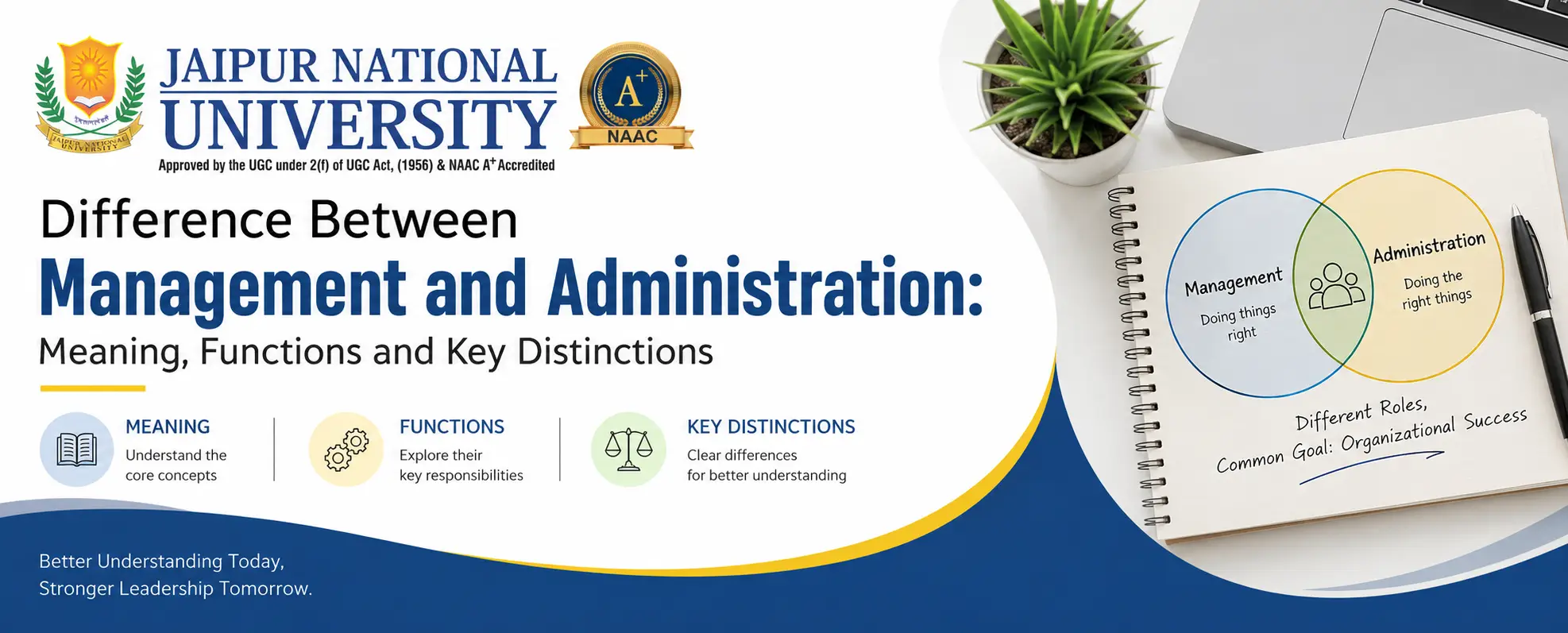
Difference Between Management and Administration: Meaning, Functions and Key Distinctions
The terms management and administration are used interchangeably so often that the difference between them…

The Future of Online Degrees in India: Why BBA, BCA & MCA Are Booming
There is a tremendous amount of change going on in India’s educational landscape. With its…

Why Online BBA Students Will Dominate the Job Market by 2030: A Forward-Looking Guide for Indian Students
Think about the last five years for a moment. The way we work, hire, and…

From Virtual Learning to Corporate Success: A Glimpse of Online BBA Trends in 2026!
Just imagine that you are sitting in a small town or a village with a…
Top BBA Specializations in Demand After 12th in 2026
Every year, thousands of students who finish Class 12 have to answer the same important…