
The Future of Digital Payments in India: UPI, CBDC and the FinTech Careers of 2030
Home / Online MBA / The Future of Digital Payments in India: UPI, CBDC and the FinTech Careers of 2030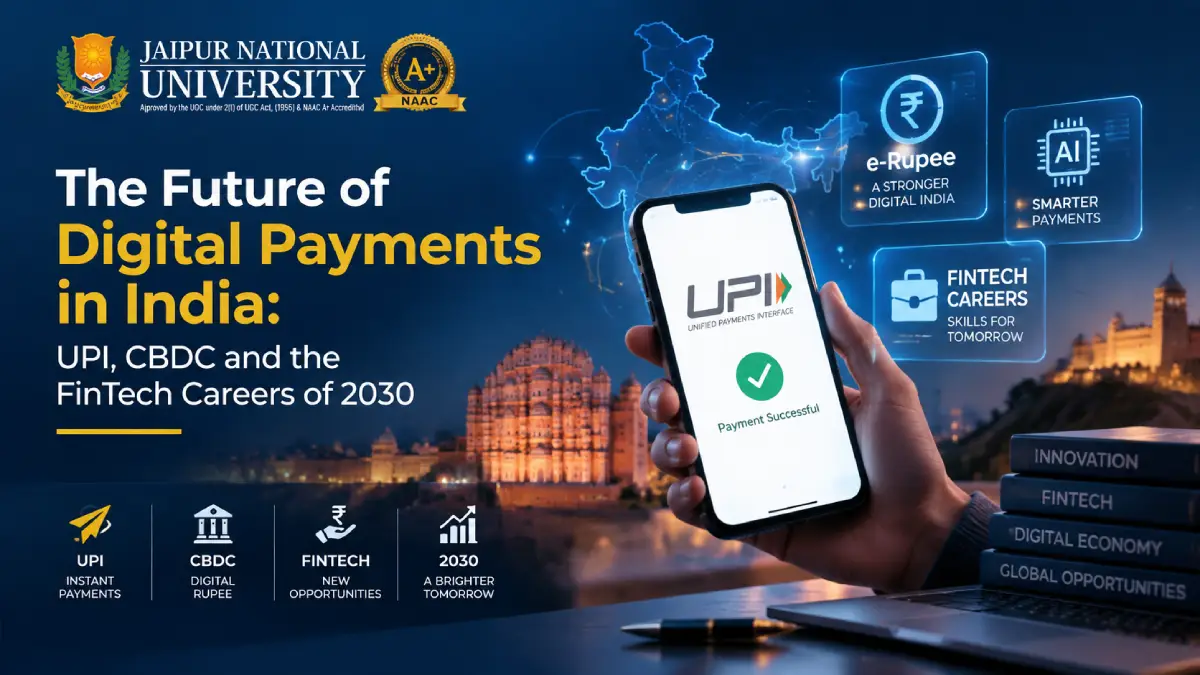
| The future of digital payments in India rests on four layers: UPI for instant retail transfers, the e-Rupee (CBDC) for programmable digital cash, the Unified Lending Interface for paperless credit, and AI agents that will soon pay on your behalf. India already handles close to half of all real-time payment transactions on earth. The skills gap this is creating is exactly why FinTech has become one of the fastest-hiring domains for Indian graduates and why a specialised degree such as the Online MBA in FinTech from JNU Jaipur has become a practical career move rather than an academic one. |
Count how many times you paid for something today without touching a note or a card. The morning chai. The auto ride. Splitting a dinner bill. Topping up a recharge. For most people in India, that number is somewhere between four and fifteen and almost none of those moments felt like a financial transaction at all. That invisibility is the point. It is also the single biggest clue to where money in this country is heading.
India now accounts for roughly 49% of the world’s real-time payment volume. One in every two instant payments made anywhere on the planet happens here, more than the United States, the United Kingdom and the European Union put together. No other country has moved this far, this fast, on public digital infrastructure. And the shift is nowhere near finished.
This guide breaks down the entire money stack: where it came from, how it actually works under the hood, what the Reserve Bank of India is building next, and which jobs this ecosystem is creating. If you are a student, a commerce graduate or a working professional trying to figure out where to place your next two years, the last three sections matter most.
What Is Actually Driving the Future of Digital Payments in India?
Four forces, working at the same time. First, a public rail (UPI) that is free at the point of use and interoperable by design. Second, a digital identity layer (Aadhaar) that collapsed the cost of verifying a customer. Third, a regulator that keeps shipping new primitives CBDC, ULI, tokenisation, agent protocols instead of waiting for the private market. Fourth, an AI layer now being welded onto all three.
Most write-ups treat these as separate news items. They are not. They are the four load-bearing walls of the same building, and understanding how they connect is what separates someone who uses FinTech from someone who can build a career in it.
From Barter to QR Codes: How India’s Payment Story Evolved
India was, until remarkably recently, a cash-first economy. Salaries came in envelopes. Rent was paid in notes. Digital banking existed, but it was something you did at a branch counter or a desktop computer, not something woven into a chai stall. The structural break happened in stages:
| Year | Milestone | What It Changed |
|---|---|---|
| 2004 | RBI launches NEFT | First real bank-to-bank electronic transfer at scale. Today it survives mostly for high-value, non-urgent transfers alongside RTGS. |
| 2010 | Rise of digital wallets | Paytm and peers introduce prepaid wallets. Useful, but siloed—you had to load money into a closed system before spending it. |
| 2016 | Demonetisation + UPI launch | NPCI launches UPI in the same window as the note ban. Digital transaction volumes jumped roughly 300% in FY2017. The habit was formed under compulsion and never reversed. |
| 2020 | Pandemic acceleration | Branch visits became impossible. Merchants who had resisted QR codes adopted them in weeks. Rural and tier-3 penetration deepened sharply. |
| 2022 | e-Rupee (CBDC) pilot begins | RBI introduces sovereign digital currency—programmable, offline-capable, legal tender. |
| 2023–2026 | Absolute dominance | UPI now carries around 95% of all digital consumer transactions in India. Cards, PPI wallets, NEFT and RTGS split the remaining 5%. |
Notice what is missing from that timeline: a single dominant private company. Unlike China, where payments consolidated around two super-apps, India built a public utility and let private apps compete on top of it. That architectural choice is the reason the future of digital payments in India looks different from anywhere else.
The JAM Trinity: The Three Pillars Nobody Sees
UPI gets the headlines. JAM did the heavy lifting. The acronym stands for Jan Dhan, Aadhaar and Mobile and without all three arriving within a few years of each other, the rail would have had nobody to carry.
- Jan Dhan (J): Launched in 2014 to bank the unbanked, the scheme has opened over 580 million new accounts. A payment rail is worthless if the receiving end has no account.
- Aadhaar (A): Over 1.3 billion Indians more than 95% of the population, hold an Aadhaar number. This collapsed KYC from a multi-day, paper-heavy process to an instant electronic check, cutting customer acquisition costs by orders of magnitude.
- Mobile (M): India has over 1.1 billion mobile connections, of which roughly 750 million are smartphones. The entry of low-cost telecom disruptors pushed data prices from around ₹250 per GB to under ₹10 per GB, making always-on payments economically viable for a daily-wage earner.
Financial inclusion, digital identity and cheap bandwidth. Remove any one pillar and the entire structure fails. This is also why several countries are now studying India’s stack rather than simply licensing a payment product.
How UPI Actually Works Under the Hood
When you scan a QR code, you are triggering a tightly choreographed handshake between four parties in under three seconds. The clearest way to picture NPCI’s role is as an air traffic controller. It owns no aircraft, no runway and none of the money but nothing moves safely without its coordination.
- You and the merchant: You transact using a virtual payment address (VPA) such as name@okaxis, which identifies your account without ever exposing your actual account number. That abstraction is a security feature, not a convenience feature.
- Third-party apps (TPAPs): PhonePe, Google Pay and Paytm together command over 80% of the interface layer, with Cred, BHIM, Navi and Super Money splitting the rest. They own the experience; they do not own the money.
- Payer and payee banks: The transaction rides on existing IMPS rails. Your PIN or increasingly your fingerprint or face, now permitted up to ₹5,000 — triggers a real-time debit and a simultaneous credit at the other end.
- NPCI as the router: It validates, routes and settles, 24 hours a day, 365 days a year, with no batch windows and no holidays.
The design decision that made everything else possible was mandatory interoperability. A Google Pay user can pay a PhonePe user who banks somewhere else entirely. Compare that to messaging apps, where a WhatsApp message cannot reach a Telegram user. UPI behaves like a highway that every car can drive on, not a private toll road.
To stop the highway from being captured, NPCI has proposed capping any single app’s market share at 30%. Because users are so entrenched with the dominant players, that deadline has been pushed to 31 December 2026, giving newer apps room to scale organically rather than forcing a disruptive migration.
Know More: Online MBA for Working Professionals: How to Pick the Right Format Without Pausing Your Career
UPI Transactions in India: The Numbers That Make Global Banks Uncomfortable
Abstractions are easy to dismiss. Volume is not. Here is what UPI transactions in India look like in hard figures:
| Metric | Latest Figure | What It Means In Plain English |
|---|---|---|
| Monthly transaction volume (May 2026) | 23.2 billion | More transactions in one month than most countries process in a decade. |
| Monthly transaction value (May 2026) | ₹29.9 lakh crore (~$312 billion) | Roughly the annual GDP of a mid-sized European economy, moving in 31 days. |
| Full-year volume (FY2026) | 241.62 billion | A per-capita average of over 165 transactions a year across the entire population. |
| Transactions per second | ~7,600 | Several thousand payments settled in the time it takes you to read this row. |
| Share of India’s digital consumer payments | ~95% | Cards and wallets are now a rounding error in everyday retail. |
| Share of global real-time payments | ~49% | Every second instant payment on earth is Indian. |
What makes these UPI transactions in India genuinely unusual is that they cost the user nothing. There is no swipe fee, no transaction charge and no minimum ticket size, which is precisely why a ₹10 payment to a vegetable vendor is economically sensible. We will come back to why that creates a real sustainability problem.
Know More: Best Degree Courses for Science Students After 12th: 2026 Guide to Programs, Careers & Fees
Going Global: UPI Beyond Indian Borders
India is now exporting the rail itself. UPI acceptance has gone live across a growing list of markets like Singapore, the UAE, France, Qatar, Bhutan, Nepal, Sri Lanka, Mauritius, Cambodia and, most recently, Greece. Nepal is notable for supporting two-way transfers, meaning Nepali citizens can use the architecture too.
Practically, this means a traveller no longer needs an expensive forex card. You enable international transactions inside your regular app, scan a foreign merchant’s QR, see the amount converted live into rupees, and pay. Your account is debited in INR; the merchant receives euros or dirhams. For a country that sends home the world’s largest remittance flows, the implications for cross-border transfer costs are significant.
The e-Rupee: Understanding India’s Central Bank Digital Currency
Introduced by the RBI in December 2022, the e-Rupee is frequently confused with cryptocurrency. It is close to the opposite. A cryptocurrency is privately issued, volatile and speculative. The e-Rupee is sovereign legal tender with a fixed 1:1 value against physical cash; it is not an investment, it is cash that happens to be digital.
| Attribute | Physical Cash | UPI | e-Rupee (CBDC) | Cryptocurrency |
|---|---|---|---|---|
| Issuer | RBI | Commercial banks (rail by NPCI) | RBI directly | Private / decentralised |
| Legal tender | Yes | Moves bank deposits, not tender itself | Yes | No |
| Value stability | Stable | Stable | Stable (1:1 with rupee) | Highly volatile |
| Works offline | Yes | No | Yes | No |
| Programmable | No | No | Yes | Partially |
| Anonymity | High | None | Configurable | Pseudonymous |
| Needs a bank account | No | Yes | No (wallet-based) | No |
The programmability column is the one worth staring at. Money can be given conditions. If the government disburses a ₹50,000 agricultural subsidy as e-Rupee, that balance can be coded so it is spendable only on fertiliser, seed or farm equipment and only until a certain date. Leakage in welfare transfer, a problem India has fought for decades, becomes a software setting rather than an enforcement problem.
Offline capability matters just as much. e-Rupee transactions work without connectivity, and losing your phone does not mean losing your money — balances are recoverable once you obtain a duplicate SIM and re-authenticate. As of March 2026, roughly ₹7.7 billion of CBDC is in circulation across more than 8 million users and 50-plus pilot cities, with active deployments in states including Maharashtra and Gujarat. It is still early, but it is no longer theoretical.
Know More: CA Salary in India 2026: Fresher to Partner Pay Scale, Monthly In-Hand & Career Path
Credit on UPI and the Unified Lending Interface
Payments were the easy part. Credit is where the next decade will be decided. Historically, you needed money in your account to scan and pay. Credit on UPI changed that by letting you link a pre-approved credit line or a RuPay credit card to your payment app.
The competitive consequence has been dramatic. Visa and Mastercard once owned card rails in India almost entirely; RuPay now accounts for roughly 38% of new credit card issuances, largely because it works at any QR code without the merchant needing a POS terminal. A tea stall with a printed QR sticker can now accept credit card payments; something that was economically impossible five years ago.
Running alongside this, the Reserve Bank Innovation Hub has introduced the Unified Lending Interface (ULI). Where UPI standardised the movement of money, ULI aims to standardise the movement of the information needed to lend it. Instead of couriering bank statements, land records and income proofs to a lender, ULI provides a consent-based open architecture that pulls verified data — credit history, land titles, cash-flow records, GST filings and automates underwriting.
The social stake here is high. Formal credit in India has always been slow and paperwork-heavy, which pushes small borrowers and farmers toward unregulated lenders charging 30–40% annually. Compressing loan approval from weeks to minutes is not a convenience upgrade; it is a consumer protection measure.
What Comes Next: Agentic Payments, AI Fraud Detection and the Zero-MDR Problem
1. AI agents that transact for you
The convergence of generative AI and payment rails has already begun. Pine Labs, Razorpay and OpenAI have built protocols where an AI agent can search a catalogue, compare prices, pick the cheapest option and complete the purchase within limits you set, using UPI Reserve Pay mandates. NPCI is developing a Unified Agent Protocol (UAP) to register, verify and authorise AI agents to transact directly on UPI rails, with RBI oversight expected before any broad rollout. Agentic commerce is roughly where UPI itself was in 2016.
2. Fraud is falling, not rising
This surprises people. Despite explosive transaction growth, RBI data shows annual card, internet and digital payment fraud dropping from around ₹1,400 crore in FY2023–24 to approximately ₹29 crore in FY2026. Machine-learning models that score every transaction in milliseconds, flagging device changes, velocity anomalies and behavioural mismatches have done what manual rule engines never could.
3. The zero-MDR question nobody has answered
Zero Merchant Discount Rate means neither consumer nor merchant pays anything to use UPI. Banks contribute a token 0.02% infrastructure fee to NPCI. That is wonderful for adoption and structurally awkward for sustainability: someone has to fund servers, fraud systems, dispute resolution and 24/7 uptime for 23 billion monthly transactions. How India resolves this — cross-subsidy, tiered pricing for large merchants, or continued state support is arguably the most consequential open question in the future of digital payments in India.
Read More: Online IT Courses After 12th: Fees, Eligibility, Salary & Career Scope in 2026
FinTech Career Opportunities in India: Where the Hiring Is
Everything above translates into demand for a fairly specific kind of professional, someone who understands both the regulation and the technology. Pure coders struggle with compliance. Pure finance graduates struggle with APIs. The people getting hired sit in the middle.
Here is how the main FinTech career opportunities in India map to the skills you would need and the qualification that gets you there:
| Role | What You Actually Do | Core Skills Needed | Typical Entry Range (₹ LPA) | Suitable JNU Online Program |
|---|---|---|---|---|
| Payments Product Manager | Own a payment flow end-to-end — success rates, decline reasons, new rails | UPI architecture, product analytics, NPCI circulars, UX | 8–16 | Online MBA (FinTech) |
| RegTech / Compliance Analyst | Automate KYC, AML and RBI reporting obligations | Regulatory frameworks, data validation, audit logic | 5–10 | Online MBA (FinTech) |
| Risk & Fraud Analyst | Build models that score transactions in real time | Statistics, ML basics, SQL, behavioural analytics | 6–12 | Online MBA (Business Analytics) / Diploma in Data Science |
| Blockchain & CBDC Specialist | Work on tokenisation, digital currency pilots, smart contracts | Distributed ledgers, cryptography basics, settlement logic | 7–14 | Online MBA (FinTech) |
| Digital Lending Manager | Design underwriting journeys on ULI and account aggregator data | Credit policy, data interpretation, collections strategy | 6–12 | Online MBA (Finance) / Online B.Com |
| FinTech Backend Engineer | Build and secure payment APIs and reconciliation systems | Java/Python, API design, system reliability, encryption | 6–14 | Online MCA / Online BCA |
| Cybersecurity Analyst (BFSI) | Protect payment infrastructure from intrusion and data loss | Network security, threat modelling, incident response | 6–13 | Diploma in Cyber Security / Online MCA |
| Financial Data Analyst | Turn transaction data into commercial decisions | Excel, SQL, Power BI/Tableau, financial modelling | 5–10 | Online B.Com / Diploma in Data Science |
Two patterns are worth noting. First, almost none of these roles existed in this form ten years ago, which means there is no deep bench of experienced candidates, an unusually good position for a new entrant. Second, the highest-paying roles are hybrid roles. That is an argument for a management qualification with genuine technical depth rather than a purely technical or purely managerial one.
Know More: Types of Indexes in SQL Server: All 12 Types Explained with Syntax (2026)
Build Your Career in FinTech with JNU Jaipur Online
This is where Jaipur National University (JNU Jaipur) Online becomes relevant to the story rather than an afterthought. JNU Jaipur is a NAAC A+ accredited, UGC Section 2(f) recognised university, ranked 2nd in Rajasthan by the India Today Group, with all online and distance programs entitled by UGC-DEB. More importantly for this topic, its Centre for Distance and Online Education has already built the FinTech curriculum that the ecosystem described above demands.
The online MBA in FinTech specialisation is not a rebadged finance elective. The discipline-specific papers read like a syllabus written from RBI circulars: Digital Payment Systems, Regulatory Technology (RegTech), Blockchain and Cryptocurrencies, Advanced FinTech Solutions, Financial Markets and Technology, and a dedicated FinTech Project Management module. Sitting alongside core papers in Corporate Finance, Management Information Systems and Strategic Management, it produces exactly the hybrid profile that payment companies, NBFCs and banks are short of.
Why learners choose JNU Jaipur Online
- UGC-DEB entitled and NAAC A+ accredited — degrees hold the same academic value as on-campus programs and are accepted for government exams, higher study and employment.
- Genuinely affordable — the two-year Online MBA is ₹1,11,550 in total, payable across four semesters, with a 10% early-bird scholarship on the program fee.
- Eight specialisations inside one MBA — FinTech, Business Analytics, Digital Marketing, Finance, Marketing, HR, Supply Chain and Healthcare Management.
- Built for working professionals — 24×7 LMS access, recorded and live sessions, self-learning material and self-paced progression across January and July intakes.
- Placement support with 100+ hiring partners, an 80,000+ strong student community and 70+ national and international academic collaborations.
If an MBA is not the right stage for you yet, the same ecosystem knowledge is reachable through other routes. A commerce foundation through the Online B.Com or Online BBA builds the accounting and financial-services base; the Online BCA and Online MCA cover the engineering side of payment systems; and one-year specialisations such as the Diploma in Data Science, Diploma in Cyber Security or Diploma in AI & ML add a sharp, hireable skill on top of an existing degree.
You can verify every approval on the recognitions and accreditations page, review eligibility on the admission policy page, and begin an application through the JNU Jaipur online admission portal.
Frequently Asked Questions
What is the future of digital payments in India?
The future of digital payments in India is moving beyond simple transfers toward programmable money and automated credit. The four pillars are UPI for instant retail payments, the e-Rupee (CBDC) for programmable, offline-capable digital cash, the Unified Lending Interface for consent-based instant lending, and AI agents authorised to transact on a user’s behalf under RBI-supervised protocols.
How many UPI transactions happen in India every month?
UPI transactions in India crossed 23.2 billion in May 2026 alone, worth approximately ₹29.9 lakh crore. Across FY2026, the system processed about 241.62 billion transactions, roughly 7,600 every second.
Is the e-Rupee the same as cryptocurrency?
No. The e-Rupee is issued by the Reserve Bank of India, is legal tender, and holds a fixed 1:1 value with physical cash. Cryptocurrencies are privately issued, unbacked and highly volatile. The e-Rupee is best understood as digital cash, not a digital asset.
Which degree is best for a FinTech career in India?
For managerial and product roles, an online MBA in FinTech is the strongest fit because it combines finance fundamentals with payment technology, RegTech and blockchain modules. For engineering roles, an MCA or BCA plus a cybersecurity or data science specialisation works better. JNU Jaipur Online offers all of these routes as UGC-DEB entitled programs.
Is an online MBA from JNU Jaipur valid for jobs and government exams?
Yes. JNU Jaipur is UGC Section 2(f) recognised and NAAC A+ accredited, and its online programs are entitled by UGC-DEB. As per UGC norms, such online degrees carry equivalence to corresponding on-campus degrees for employment, higher education and competitive examinations.
What are the highest-paying FinTech career opportunities in India right now?
Payments product management, blockchain and CBDC roles, and BFSI cybersecurity currently command the strongest premiums, typically starting between ₹7 and ₹16 LPA for candidates with a relevant specialisation. Hybrid profiles that combine regulatory literacy with technical fluency are scarcest and therefore best paid.
Can I pursue the Online MBA in FinTech while working full time?
Yes. The JNU Jaipur Online MBA is delivered entirely through a 24×7 LMS with recorded lectures, live interactive sessions, digital self-learning material and online examinations, so it can be completed alongside a full-time job across a two-year duration.
The Bottom Line
A decade ago, the question was whether India would go cashless. That question is settled. The live question now is who will build, secure, regulate and price the layer that comes next: programmable currency, automated credit, agent-driven commerce and the compliance frameworks holding all of it together.
The future of digital payments in India will not be written by policymakers alone. It will be written by product managers who understand settlement, analysts who understand risk models, engineers who understand reconciliation and compliance professionals who understand what a regulator is actually asking for. Those are learnable skills, and the demand for them is running well ahead of supply.
If you want to be on the building side of that shift rather than the using side, the Online MBA in FinTech from JNU Jaipur gives you the domain depth, the accredited credential and the flexibility to do it without stepping away from your current job. Applications for the January and July sessions are open — apply online or talk to an admission counsellor to find the right program for your background.
Related Blogs

India’s New Labour Codes Rewrote HR’s Job Description Overnight — Does Your Skillset Match?
On 21 November 2025, the rulebook that governs every payslip, provident fund deduction and termination…

What Are the 7Ps of Marketing Mix? A Complete Guide to the Extended Marketing Mix
The 7Ps of Marketing Mix are Product, Price, Place, Promotion, People, Process and Physical Evidence….

What Is IoA Accreditation and Why Does It Matter for Students?
A student finishes an analytics or data science course. The marks are good. The projects…

How Do the Top Online MBA Colleges in India Help Shape Your Career?
Thinking about an MBA but can’t step away from your job or family? You’re not…

Online MBA vs Distance MBA: Which One Should You Choose in 2026?
Introduction It’s not easy to pick the best MBA course in 2026. It’s a major…

MBA Case Studies with Solutions: 20 Real Business Examples, Frameworks & How to Solve Them
MBA case studies are real business situations, such as a turnaround, a failed product or…