
AI Killed the Content Writer? No, It Created the Prompt Engineer. Why an Online Master’s Degree in English Is the Sleeper Degree of the AI Era
Home / Online MA English / AI Killed the Content Writer? No, It Created the Prompt Engineer. Why an Online Master’s Degree in English Is the Sleeper Degree of the AI Era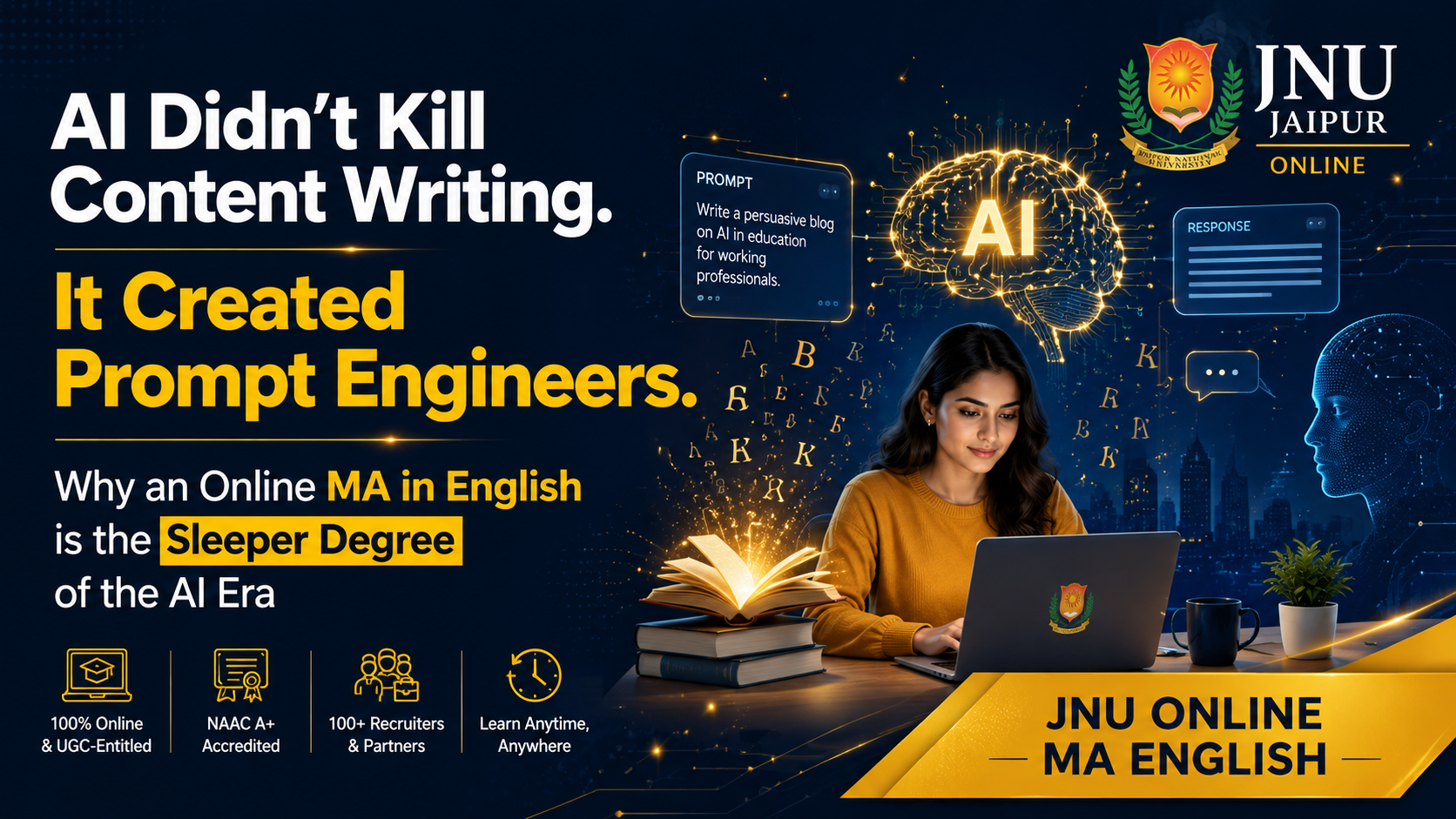
For anyone typing this into Google at 2 a.m. No, artificial intelligence has not made the English postgraduate obsolete. It has quietly turned language into the single most valuable interface skill in the economy. Every time ChatGPT, Gemini, or Claude drafts a paragraph, a human still has to decide whether that paragraph is true, on-brand, persuasive, culturally aware, and legally safe. That judgment is exactly what a Master of Arts in English trains you to make. Which is why an online master’s degree in English is turning out to be one of the most underrated, future-proof qualifications of 2026 a “sleeper degree” hiding in plain sight while everyone else chases coding bootcamps and burns out on tutorials they never finish.
This blog does what no other program page will tell you: it maps the MA English scope in AI era honestly what the machines actually took, what they created, the real MA English jobs and salary 2026 numbers, and the full spread of career options after MA English that didn’t exist even three years ago.
AI Didn’t Delete Language Work — It Repriced It
Here is the trend the fear-mongering headlines miss. Generative AI made producing average text almost free. When a skill becomes free, the value doesn’t vanish it moves up the chain to whoever can direct, judge, and correct the machine. In 2026 that person has a name: the prompt engineer, and increasingly, the AI content editor.
The surprise is who is winning those roles. Prompt engineering is repeatedly ranked among the hottest fields of 2026, and it draws far more heavily on linguistics, cognitive science, philosophy, and journalism than on computer science. A large share of successful prompt engineers come from non-technical, humanities-first backgrounds, people who understand how meaning, ambiguity, tone, and context actually work in language. That is a literature graduate’s home turf.
Look at any Indian content or communications job listing today and the pattern repeats: fluency with AI tools, the ability to fact-check and edit AI output, and stated almost word for word across postings the ability to “write for people, not just algorithms.” NASSCOM projects India will need around a million AI-and-data professionals, with supply meeting barely 40% of demand. Crucially, a growing slice of that demand is for language-side roles, not just model-building engineers.
India’s online education market is compounding at roughly 23% a year and pushing hard into Tier-2 and Tier-3 cities, which means more working professionals than ever are upgrading their qualifications without pausing their careers. The learners who combine that flexibility with a deliberately AI-relevant subject are the ones pulling ahead. An English postgraduate who understands how models generate, distort, and flatten language is not competing with automation, they are being paid to supervise it. That is the shift competitor blogs, still selling literature as a purely academic pursuit, have completely missed.
Table 1: What the machines took vs. what they created
| Task AI now automates | The human-premium job it created | Core skill it rewards |
|---|---|---|
| First-draft blog copy, product blurbs | AI content editor / quality lead | Critical reading, fact-checking |
| Generic captions and emails | Brand voice & prompt engineer | Register, tone, rhetoric |
| Rough translation | Localization & transcreation specialist | Cultural nuance, idiom |
| Bulk SEO filler | AEO / GEO content strategist | Semantic structuring, authority |
| Template chatbot replies | Conversational AI designer | Dialogue, persona, clarity |
Notice the column on the right. Not one of those roles is asking for a computer science degree. Every one is asking for advanced control of language the exact competency a two-year English master’s is built around.
Why an English Master’s Is Secretly an AI Degree
Strip an online master’s degree in English down to what it actually trains, and it reads like a job description for the AI economy. Close reading is prompt evaluation. Critical analysis is hallucination detection spotting where a confident machine is quietly wrong. Rhetoric and register control is brand-voice engineering. Understanding semantics and ambiguity is the difference between a prompt that works and one that wastes ten attempts. Literary theory is reading a text against its social, political, and historical context — is precisely the audience-and-context awareness that separates a usable AI output from an embarrassing one.
This is the real MA English scope in AI era: not “learn to use ChatGPT” (anyone can), but learn to out-think it, direct it, and be the accountable human on top of it. Chain-of-thought prompting, the technique of making a model reason step by step, is essentially structured argumentation something an English postgraduate practises in every essay.
Table 2: Your MA English skill → the AI-era job it powers
| Skill you build in an MA English | How AI work uses it | Job it maps to |
|---|---|---|
| Close reading & textual analysis | Judging, refining and evaluating AI output | AI content editor |
| Argument structure & logic | Chain-of-thought & prompt design | Prompt engineer |
| Register, tone & rhetoric | Controlling brand voice at scale | Brand / UX writer |
| Context & literary theory | Framing prompts for audience & culture | GEO/AEO strategist |
| Research & source evaluation | Fact-checking, citations, grounding | Editorial / trust lead |
| Cross-cultural interpretation | Localization & transcreation | Localization specialist |
MA English Jobs and Salary 2026: The New Money Map
Competitor blogs stop at “content writer, teacher, journalist.” Those roles still exist but the ceiling has moved. Here is a grounded view of MA English jobs and salary 2026, blending the traditional roles competitors list with the AI-era roles they ignore. Figures are indicative annual CTC ranges compiled from public Indian salary aggregators (Glassdoor, AmbitionBox, Naukri) and vary with city, portfolio, and AI fluency; treat them as direction, not a promise.
Table 3: Career options after MA English and indicative 2026 salaries
| Role | What you do | Indicative salary (INR/yr) |
|---|---|---|
| Prompt Engineer | Design & optimise prompts for LLM products | 8–25 LPA |
| AI Content Editor | Fact-check, refine & sign off AI-drafted content | 6–14 LPA |
| AEO / GEO Strategist | Write content AI answer engines cite | 7–16 LPA |
| Conversational AI Designer | Script chatbot & voice-assistant dialogue | 8–18 LPA |
| Localization Specialist | Transcreate content across languages/markets | 6–12 LPA |
| Technical Writer | Turn complex products into clear docs | 7–12 LPA |
| Content Strategist / Lead | Own editorial direction & AI workflows | 9–20 LPA |
| Academician (UGC-NET/PhD route) | Teach & research at college/university | 6–15 LPA |
The pattern is unmistakable: the graduate who pairs literary judgment with AI fluency sits at the top of every band. The one who refuses to touch the tools sits at the bottom. Your MA English decides which mindset you graduate with.
AEO and GEO: The New Battleground English Grads Were Born For
The freshest shift in digital content is the move from SEO to AEO (Answer Engine Optimization) and GEO (Generative Engine Optimization). Instead of only ranking blue links, brands now fight to be the source that ChatGPT, Google’s AI overviews, and Perplexity quote when they answer a question. That requires content with crisp semantic structure, clear entity framing, question-led headings, and demonstrable authority, reading like something a knowledgeable human vetted, because AI systems increasingly reward exactly that.
Who is best equipped to write for machines that value clarity, structure, and credibility? Not a coder. A person trained to organise arguments, weigh sources, and control meaning, an English postgraduate. AEO/GEO may be the single clearest example of the scope of MA English in the AI economy translating directly into a paid, in-demand specialism.
There is a deeper reason this matters. AI answer engines are trained to prefer content that reads as trustworthy, well-sourced, and genuinely human-vetted. As machine-generated filler floods the web, the scarce and rising asset is credible, editorially disciplined writing — content a person clearly stands behind. A holder of an online master’s degree in English is trained precisely to produce and certify that kind of writing. In an internet increasingly written by machines, the human editor’s signature becomes the premium.
Career Options After MA English Beyond the Obvious
Beyond the AI-native roles, the traditional roles are themselves being upgraded by automation rather than erased:
- EdTech & instructional design — building AI-assisted learning content and assessments.
- UX writing & product content — the microcopy that makes apps feel human.
- Corporate communications & PR — now supercharged by AI drafting, still needing human judgment and trust.
- Publishing & editorial — commissioning, developmental editing, and AI-workflow oversight.
- Academia, research, UGC-NET and PhD — the scholarly route, where critical theory is only becoming more relevant.
- Civil services & competitive exams — where command of English and argument remains a decisive edge.
The through-line across all of these roles: an online master’s degree in English no longer competes with AI. It positions you as the human the AI economy cannot function without. The degree that critics wrote off as “impractical” turns out to be the one that ages best.
How JNU’s Online Master’s in English Future-Proofs You
This is where the choice of university stops being a formality. Jaipur National University (JNU), Jaipur, delivers its online master’s degree in English through its Centre for Distance and Online Education, and its design lines up unusually well with the AI-era argument above.
JNU’s MA English is built for learners who want to critically engage with texts across social, political, economic, historical, and national contexts. Read that again with the AI economy in mind: contextual, critical, multi-perspective reading is the exact capability that separates a human who can direct AI from one who is replaced by it. JNU’s own program framing — training students to interpret and analyse from diverse viewpoints is, in effect, training the judgment layer the AI stack is missing.
What makes it a credible, low-risk choice:
- Accreditation that holds up: NAAC A+ accredited, UGC-DEB recognised, AICTE-approved, and acknowledged by the Association of Indian Universities (AIU), so the degree carries the same weight as an on-campus one for jobs and higher study.
- NEP-aligned 2-year, 4-semester structure delivered 100% online, so you can upskill without leaving your current job.
- 24×7 web-and-mobile learning with recorded lectures, e-content and virtual classrooms, study at your own pace.
- A placement network of 100+ recruiting companies plus dedicated placement support.
- Low entry friction: just ₹1,000 registration, with a 10% Early Bird Scholarship on program fee and semester-wise, affordable payment.
Pair that JNU foundation with self-driven AI fluency, a prompt engineering short course, a habit of editing AI output critically, and an online MA in English from JNU becomes a genuinely AI-proof credential rather than a nostalgic one.
Table 4: Choosing an AI-ready online MA in English — your checklist
| What to check | Why it matters in the AI era | JNU Online |
|---|---|---|
| UGC-DEB / NAAC / AIU recognition | Ensures job & PhD validity | Yes (NAAC A+, UGC-DEB, AIU) |
| Critical, context-driven curriculum | Builds the judgment AI lacks | Yes — multi-context textual analysis |
| Fully online & flexible | Upskill while employed | Yes — 100% online, 24×7 |
| Placement / recruiter network | Converts degree into a role | 100+ companies |
| Affordable, low entry barrier | De-risks the decision | ₹1,000 reg. + 10% early-bird |
The Bottom Line
The content writer didn’t die. The one who refused to adapt did. AI didn’t kill the value of language, it made the humans who truly command language rarer and more valuable. An online master’s degree in English is not a hedge against the AI era, done right, it is a direct route into prompt engineering, AI editing, AEO/GEO strategy, and every role that needs a mind that can read, judge, and mean things on purpose.
If you want that mind trained by an accredited, flexible, career-connected program, JNU Jaipur’s online master’s degree in English is one of the smartest sleeper bets you can make in 2026. The machines can generate. Learn to be the human who decides.
Frequently Asked Questions
Will AI replace jobs after an MA in English?
No. AI automates average text production, but it increases demand for people who can evaluate, edit, direct and fact-check that output. An MA in English trains exactly that judgment, opening AI-era roles like prompt engineer, AI content editor and AEO/GEO strategist.
Is an online master’s degree in English valid in India?
Yes, when the university is UGC-DEB recognised and NAAC accredited. JNU Jaipur’s online MA English is NAAC A+ accredited, UGC-DEB recognised and AIU-acknowledged, giving it the same validity as an on-campus degree for jobs, government exams and further study.
Can I become a prompt engineer with an MA English?
Yes. Prompt engineering draws heavily on linguistics, argument, and context core MA English strengths. Pair the degree with a short prompt-engineering course and hands-on practice editing AI output, and you have a strong, differentiated profile.
What is the MA English scope in AI era?
The MA English scope in AI era spans AI content editing, prompt engineering, answer-engine (AEO/GEO) content strategy, conversational AI design, localization and UX writing alongside traditional paths in teaching, publishing and civil services.
What are the realistic MA English jobs and salary 2026 figures?
Indicative 2026 ranges: AI content editor 6–14 LPA, prompt engineer 8–25 LPA, AEO/GEO strategist 7–16 LPA, content strategist 9–20 LPA, technical writer 7–12 LPA. Salaries rise sharply with AI fluency and a strong portfolio.
What are the best career options after MA English if I don’t want to teach?
Beyond academia: prompt engineering, AI content editing, AEO/GEO strategy, UX and technical writing, corporate communications, localization, EdTech instructional design and publishing most now AI-augmented rather than AI-threatened.