
AI Skills for BBA Students: Why GenAI and Analytics Are Replacing Traditional Business Modules in 2026
Home / Online BBA / AI Skills for BBA Students: Why GenAI and Analytics Are Replacing Traditional Business Modules in 2026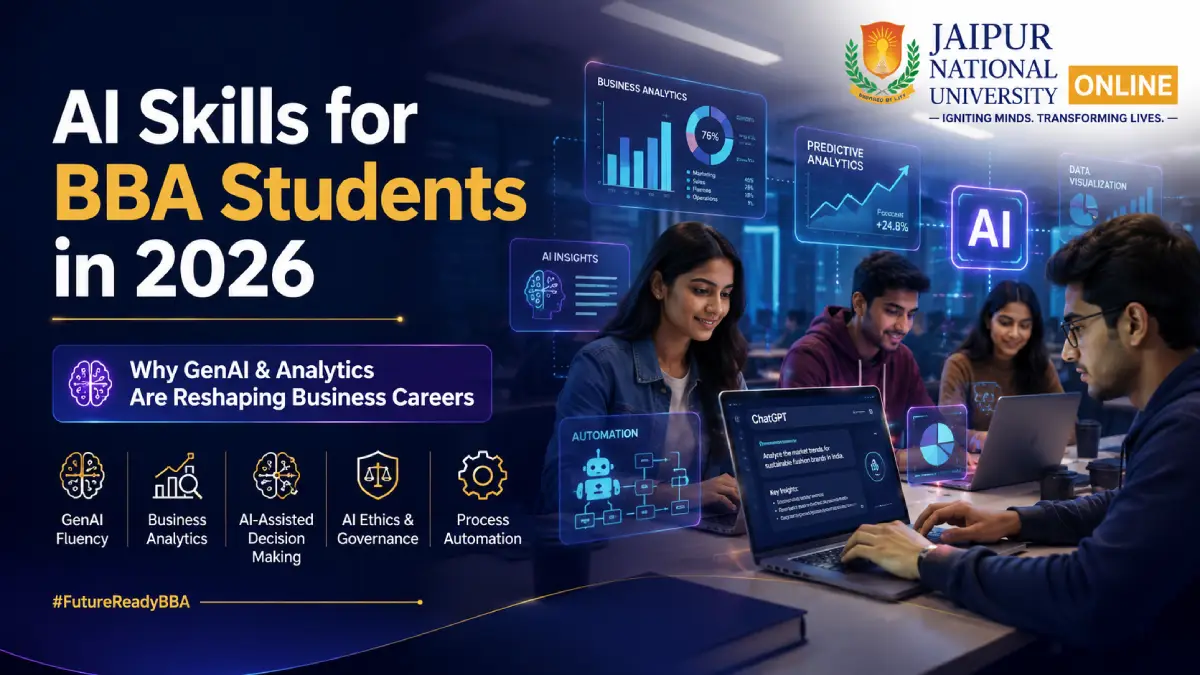
The Bachelor of Business Administration has been India’s go-to undergraduate management degree for over four decades. But in 2026, the program looks fundamentally different from the BBA your seniors graduated with even three years ago. Artificial intelligence, generative AI, and business analytics have moved from optional electives to core modules — and the AI skills for BBA students entering the job market today are the single biggest determinant of where they land.
Walk into any campus placement drive in 2026, and the pattern is clear. Recruiters from Deloitte, EY, KPMG, Amazon, and TCS are asking BBA candidates about ChatGPT prompts, Power BI dashboards, predictive analytics, and AI ethics in the same interview where they once asked about marketing mix and SWOT analysis. Industry reports suggest nearly 78% of Indian employers now list digital and AI proficiency as a mandatory requirement for 2026 management hires.
This shift is forcing universities to rebuild their BBA curricula from the ground up. The traditional modules, pure theory, paper-based case studies, and manual financial calculations are being phased out. In their place are hands-on AI tools, GenAI use cases for business, data visualization labs, and automation projects. Forward-looking institutions like Jaipur National University Online have already restructured their BBA program to embed these AI competencies alongside the foundational business subjects.
This guide breaks down exactly what AI skills for BBA students matter in 2026, which AI modules are being added to the BBA curriculum, what the future BBA-graduate job market looks like, and how to choose the right program.
Why AI Skills for BBA Students Are No Longer Optional in 2026
For decades, a BBA degree meant building a foundation in marketing, finance, HR, and operations. That foundation still matters — but it’s no longer enough on its own. Three forces have made AI skills for BBA students a baseline expectation rather than a competitive edge:
- Automation has eaten the entry-level business job. Tasks that used to define a fresher’s first two years — data entry, basic reporting, scheduling, even first-draft proposals — are now handled by AI tools. Companies are hiring BBA graduates expected to manage AI workflows, not perform tasks AI has replaced.
- The skills premium is real. BBA freshers in India with verified AI and analytics skills now command ₹3.5–5 LPA starting packages, versus ₹2.5–3 LPA for general BBA graduates without them, according to AmbitionBox and Glassdoor 2026 data.
- Indian companies have crossed the GenAI tipping point. Over 60% of Nifty 500 companies have rolled out generative AI tools internally for marketing, finance, and HR teams. A 2026 BBA graduate who can’t write a basic prompt or interpret a model’s output is competing for a shrinking pool of “non-AI” roles.
This is why integrating AI in BBA curriculum is no longer something a single forward-thinking university is doing; it’s something the UGC’s 2026 guideline updates have effectively pushed every accredited institution to do. The question for students isn’t whether to study a BBA with AI components; it’s which program does it well and which one just adds the word “AI” to the brochure.
What “AI Skills for BBA Students” Actually Means in 2026
“AI skills” is a phrase universities use loosely. For a BBA student in 2026, it specifically means four categories of capability:
- Generative AI fluency — using ChatGPT, Gemini, Claude, and similar tools to draft business documents, run market research, summarize reports, and prototype marketing copy.
- Business analytics — pulling insights from data using Excel advanced functions, Power BI, Tableau, and Google Analytics 4.
- AI-assisted decision-making — understanding predictive models, recommendation systems, and the basic math behind them well enough to interpret outputs.
- AI ethics, governance, and bias awareness — recognizing where AI fails, how to audit it, and how to communicate AI-driven decisions responsibly inside an organization.
A 2026-ready BBA curriculum delivers all four through hands-on coursework, not just one elective on “Introduction to AI.” When you evaluate online BBA programs, this is the filter to apply. The AI in BBA curriculum at top institutions today should include practical assignments where students use real AI tools on real business problems.
5 Core AI Skills for BBA Students Every Graduate Should Master
These five competencies define what the AI skills for BBA students’ conversation looks like in 2026. Every credible online or campus BBA program should help you build them.
1. Generative AI Prompt Engineering for Business
The ability to write clear, structured prompts for ChatGPT, Claude, and Gemini has become the spreadsheet of 2026. BBA students learn how to use GenAI to draft a marketing brief, analyze a competitor’s financial statement, generate sales scripts, or summarize a 50-page market research report into a one-page executive summary. Companies hiring BBA freshers now openly test prompt-writing skills during interviews.
2. Data Analytics and Business Intelligence
Power BI and Tableau are no longer optional. Every modern BBA curriculum now trains students to build interactive dashboards, run pivot analyses in advanced Excel, and visualize sales, marketing, and operations data. Google Analytics 4 has also become a baseline expectation for marketing-track BBA students.
3. Predictive Analytics and Forecasting
Students learn to use AI-driven forecasting tools to predict sales, customer churn, demand cycles, and inventory needs. This doesn’t mean BBA students become data scientists — it means they learn to interpret the output of regression models, time-series forecasts, and clustering algorithms confidently enough to make decisions.
4. AI Tools for Marketing, Finance, and HR
Each functional area now has its own AI stack. Marketing students learn tools like Jasper, Copy.ai, and HubSpot’s AI features. Finance students learn AI-powered fraud detection and algorithmic investing basics. HR students learn AI-driven recruitment platforms, sentiment analysis on employee feedback, and bias detection tools.
5. AI Ethics, Privacy, and Governance
The least-taught but increasingly critical skill. Students learn the rules under India’s DPDP Act, how to spot algorithmic bias, when not to use AI, and how to defend AI-driven decisions to non-technical stakeholders. This is the layer that separates BBA graduates who simply use AI from those who can lead AI initiatives.
Together, these five form the practical core of any 2026-ready BBA program. Notice that none of them require advanced math or coding — they require business judgment layered on top of AI fluency, which is exactly what the BBA degree is designed to develop.
Traditional BBA vs AI-Integrated BBA: A Side-by-Side Comparison
Most students searching for a BBA in 2026 don’t realize how different two programs with the same name can be. Here’s the practical breakdown:
| Dimension | Traditional BBA | AI-Integrated BBA (2026) |
|---|---|---|
| Core focus | Marketing, finance, HR, operations theory | Same foundation + GenAI, analytics, automation tools |
| Hands-on tools | Manual Excel, paper case studies | Power BI, Tableau, ChatGPT, GA4, automation platforms |
| Project work | Group presentations, written reports | AI-driven dashboards, prompt-engineered campaigns, predictive models |
| Faculty profile | Pure academic background | Mix of academic + industry-experienced AI practitioners |
| Industry exposure | Guest lectures, occasional internships | Live AI/analytics projects, certifications baked in |
| Average fresher salary (2026) | ₹2.5 – ₹3.5 LPA | ₹3.5 – ₹6 LPA |
| Job market in 5 years | Shrinking: automation displacing roles | Expanding: new AI-business hybrid roles |
| MBA admission edge | Standard profile | Differentiated profile, especially for analytics MBAs |
The salary difference alone is roughly 30–40% higher; starting compensation for BBA graduates with verified AI skills pays back the additional effort within the first year of employment. More importantly, the trajectory diverges over time: an AI-fluent BBA graduate enters the workforce in a category that’s growing, while a traditional BBA graduate enters one that’s defending its ground against automation.
How Forward-Looking Universities Are Integrating AI into Their BBA Programs
Not every university has moved at the same pace. The institutions getting AI in BBA curriculum right share a few common practices: they integrate AI modules into core semesters (not as bolted-on electives), they pair the BBA with industry-recognized certifications, and they invest in faculty who have actually worked with AI tools, not just read about them.
Jaipur National University Online is one of the institutions taking this approach seriously. As a UGC-DEB entitled, NAAC A+ accredited university with 18 years of academic legacy and a campus ranked second in Rajasthan by the India Today Group, JNU Online has restructured its three-year BBA program to embed analytics and GenAI competencies alongside the traditional management foundation. The curriculum includes data visualization modules, AI tools labs, and assignments built around real business scenarios.
What makes the JNU Online approach particularly useful for working professionals and Tier-2 and Tier-3 city students is the option to stack additional diplomas in AI & ML, Data Science, Digital Marketing, or Cyber Security alongside the BBA without significantly extending the program duration. A student can graduate with a UGC-recognized BBA plus a focused AI/data diploma for roughly the same total investment as a single program at many private universities.
Other UGC-DEB approved online BBA providers including Manipal, Amity, Chandigarh University, Manav Rachna, and LPU have also moved in this direction with varying levels of depth. The right one for any individual student depends on three factors: the depth of AI integration in the actual curriculum (not the marketing copy), the fee structure relative to outcomes, and the credibility of the institution’s accreditation. JNU Online’s three-year BBA at ₹1,04,160 sits at the affordable end of the credible-NAAC-A+ spectrum, which is why it’s gaining traction with cost-conscious students who don’t want to compromise on degree recognition.
| Quick Note on Programme Stacking at JNU Online Students enrolled in the JNU Online BBA can pair the degree with a one-year online diploma in AI & ML, Data Science, Cyber Security, or Digital Marketing, building a dual-credential profile recognised by UGC-DEB. This is one of the few affordable routes in India to combine a full BBA degree with an AI specialization. |
How JNU Online Embeds AI Skills for BBA Students Into Its 2026 Programme
Among the UGC-DEB entitled online BBA programmes in India, Jaipur National University Online has built one of the most balanced AI-integrated curricula for cost-conscious students. Four things make the JNU Online approach worth a closer look for anyone evaluating where to study a BBA in 2026:
1. Curriculum depth without curriculum bloat
The three-year online BBA at JNU Online embeds data analytics, business intelligence tools, and GenAI use-case modules within the core semesters, not as bolt-on electives that students can skip. By the time a JNU BBA graduate completes the programme, they have worked on dashboards in Power BI, structured prompts for business research using ChatGPT-class tools, and applied predictive frameworks to real case studies. This ensures the AI skills for BBA students at JNU Online are practical and resume-ready, not theoretical.
2. Diploma stacking for genuine AI specialization
This is the real differentiator. JNU Online offers separate one-year diplomas in AI & ML, Data Science, Digital Marketing, and Cyber Security, and students can pursue one alongside their BBA. The result is a dual-credential profile (BBA + AI specialization) for total fees that are still lower than a single specialized BBA-in-AI degree at most private universities. For a student aiming at roles like Business Analyst, FinTech Analyst, or Digital Marketing Specialist, this stacking strategy maps directly to what recruiters are testing for.
3. Affordability paired with credibility
At ₹1,04,160 for the full three-year online BBA, JNU sits at the affordable end of the credible-NAAC-A+ spectrum. With NAAC A+ accreditation, UGC-DEB entitlement, 18 years of academic legacy, and a rank of second in Rajasthan by India Today Group, the degree carries the regulatory and employer recognition that smaller private universities cannot always claim. For working professionals from Tier-2 and Tier-3 cities, this combination of price and trust is hard to find elsewhere.
4. Built-in support for working professionals
Live online sessions, 24×7 LMS access, recorded lectures, an interactive learning platform, and a structured admission process designed for students balancing jobs or family responsibilities make this one of the most accessible AI-integrated BBA options in India. Add a 10% early-bird scholarship, EMI-based fee payment, and 100+ hiring partners, and the cost-to-outcome ratio shifts decisively in favour of the student.
For students serious about building AI skills for BBA students inside a recognized, affordable BBA degree, JNU Online deserves a top-three slot on the shortlist alongside Manipal and Amity.
Career Outcomes: Jobs and Salaries for BBA Graduates with AI Skills
The clearest argument for building AI skills as a BBA student is the salary data. Here’s what 2026 entry-level roles look like for BBA graduates with verified AI and analytics competencies:
- Business Analyst — ₹6–10 LPA (entry level), reaching ₹15+ LPA in 3–5 years
- AI Business Strategist — ₹5–8 LPA at fresher level, premium track in consulting
- Data Analyst (Business) — ₹5–9 LPA
- Digital Marketing Specialist (AI tools) — ₹4–7 LPA
- Product Analyst — ₹5–8 LPA
- FinTech Analyst — ₹5.16–8 LPA (fastest-growing segment per AmbitionBox 2026)
- Customer Success Manager (AI-CRM) — ₹5–7 LPA
- E-commerce Analyst — ₹6 LPA
- HR Tech Analyst — ₹4–6 LPA
For comparison, traditional BBA roles without AI skills, junior sales executive, back-office operations, and generic management trainee sit in the ₹2.5–4 LPA band and have weaker career growth slopes.
The top recruiters for BBA graduates with AI skills in 2026 include Deloitte, EY, KPMG, Accenture, TCS, Amazon, ZS Associates, ICICI Bank, HDFC Bank, Reliance Jio, Flipkart, Wipro, Infosys, and a fast-growing tier of fintech and SaaS startups.
Government roles have also opened up to this profile. IBPS, SBI, SSC CGL, and state PSUs now actively recruit candidates who combine a UGC-recognized BBA with AI/data certifications, particularly for analytics, fraud-detection, and customer-insight roles inside public sector banks.
For students planning to continue to a postgraduate degree, the same AI-integrated BBA profile dramatically improves CAT/XAT/CMAT shortlisting odds at IIMs, ISB, and top private B-schools, particularly for MBA in Business Analytics, Digital Business, or FinTech tracks.
Should You Choose a BBA With AI Skills in 2026? A Quick Framework
A short decision framework if you’re choosing between programs:
Choose a BBA with strong AI integration if:
- You’re starting your career in business, marketing, finance, or operations
- You want to keep MBA options open at top B-schools
- You’d rather work in analytics, consulting, fintech, or product roles than traditional admin
- You’re a working professional who needs an AI-enhanced credential to stay competitive
- You’re from a Tier-2 or Tier-3 city and want a credential that travels well
A traditional BBA may still suffice if:
- You’re inheriting a family business, and your immediate context is operational
- You’re using the BBA as a stepping stone to law (BBA LLB) or CA/CS
- You already have strong AI/analytics skills from another source
For most students in 2026, the AI-integrated path is the safer bet even if you ultimately move into a non-technical role. Having AI fluency as a baseline is now the equivalent of having Microsoft Office literacy in 2005. It’s no longer differentiated; it’s expected.
Frequently Asked Questions
Q1. What AI skills should BBA students learn in 2026?
BBA students in 2026 should master five core AI skills: generative AI prompt engineering (using ChatGPT, Gemini, and Claude); data analytics and business intelligence (Power BI, Tableau, and Excel); predictive analytics and forecasting; function-specific AI tools for marketing/finance/HR, and AI ethics and governance. These five competencies form the standard baseline for entry-level business roles.
Q2. Is AI being taught in BBA programs in India?
Yes. As of 2026, most UGC-DEB approved BBA programs, including online programs from Jaipur National University, Manipal, Amity, Chandigarh University, LPU, and others, have integrated AI and analytics modules into their core BBA curriculum. The depth of integration varies significantly between universities, so checking the syllabus before enrolling is essential.
Q3. Can BBA students learn AI without a coding background?
Yes. Modern AI tools used in business — like ChatGPT, Power BI, Tableau, and HubSpot AI — are designed for non-coders. The AI skills for BBA students focus on using these tools to make business decisions, not on building AI models from scratch. Coding is an advantage but not a prerequisite.
Q4. What is the salary after a BBA with AI skills in India?
Fresh BBA graduates with verified AI and analytics skills earn ₹3.5–6 LPA at the entry level in 2026, compared to ₹2.5–3.5 LPA for traditional BBA graduates. Roles like Business Analyst and FinTech Analyst can go up to ₹8–10 LPA at the fresher level for top performers.
Q5. Which is better — a BBA in AI or a BBA with AI modules in the curriculum?
For most students, a strong BBA with AI in BBA curriculum integration is more flexible than a niche BBA in AI degree. The integrated approach builds business judgment alongside AI fluency, which keeps multiple career paths open. A specialized BBA in AI suits students fully committed to AI-focused business roles.
Q6. Does JNU Online’s BBA include AI and analytics modules?
Yes, Jaipur National University Online’s three-year BBA program embeds analytics, data visualization, and AI tools modules within the core curriculum. Students can also stack additional diplomas in AI & ML, Data Science, or Digital Marketing to deepen specific skills.
Q7. Is an online BBA with AI skills valid for MBA admissions?
Yes. A UGC-DEB approved online BBA including one with AI specialization is equivalent to a regular BBA for MBA admission purposes. CAT, XAT, CMAT, SNAP, and CUET PG accept online BBA graduates from accredited universities.
Q8. Will AI replace BBA jobs?
AI is replacing some BBA-level tasks (data entry, basic reporting, scheduling), not BBA roles overall. The jobs that survive and grow are the ones where the BBA graduate manages AI workflows. Building AI skills is precisely how to future-proof a BBA career.
The Bottom Line
The BBA degree in 2026 is not the BBA your seniors completed in 2022. The AI skills for BBA students that define the new graduate profile, GenAI fluency, data analytics, predictive thinking, and ethical AI use are reshaping every aspect of management education in India. Universities that have moved early on AI in BBA curriculum integration are producing graduates with measurably better placements, salaries, and long-term career trajectories.
For students choosing a program right now, the priority is no longer just NAAC accreditation or fee affordability — it’s the actual depth of AI integration in the curriculum. Programs like Jaipur National University Online’s BBA, which combine UGC-DEB recognition, NAAC A+ credentials, an 18-year legacy, and a curriculum updated for the 2026 AI economy, represent a credible middle ground between cost and capability.
The right time to build these AI skills was yesterday. The next-best time is your next admission cycle.
| Ready to Future-Proof Your Career? Explore Jaipur National University Online’s UGC-DEB approved BBA programme with embedded AI and analytics modules, a three-year duration, NAAC A+ accreditation, ₹1,04,160 total fee, and the option to add specialised diplomas in AI & ML, Data Science, or Digital Marketing. Visit online.jnujaipur.ac.in to apply for the next intake. |
Related Blogs

How To Get Internships While Doing An Online BBA Degree Course: A 6-Step Guide For Working Students
The economy of India is witnessing rapid change with the rise of digital transformation and…

From Virtual Learning to Corporate Success: A Glimpse of Online BBA Trends in 2026!
Just imagine that you are sitting in a small town or a village with a…

BBA vs BCA vs MCA: Which is Better for Your Future in 2026?
Introduction: Career Uncertainty Post 12th or College Selecting a course after Class 12 or college…

Why the Best Online University for Online BBA Must Focus on Real-World Business Exposure
CEPT University announced its MBA in Real Estate program, and what caught everyone’s attention wasn’t…

Is Digital Marketing a Good Career in 2026? Salary & Job Trends
Introduction In 2026, digital marketing is not just trendy, but it’s also necessary. Every brand…

Why JNU Online BBA Is the Smarter Choice for Your Business Degree in 2025–26
So, you’ve been Googling “online BBA course” for the past few days. Maybe you’ve already…