
MSc Computer Science vs MCA: Which Course Fits Your Career Goals?
Home / Distance MCA / MSc Computer Science vs MCA: Which Course Fits Your Career Goals?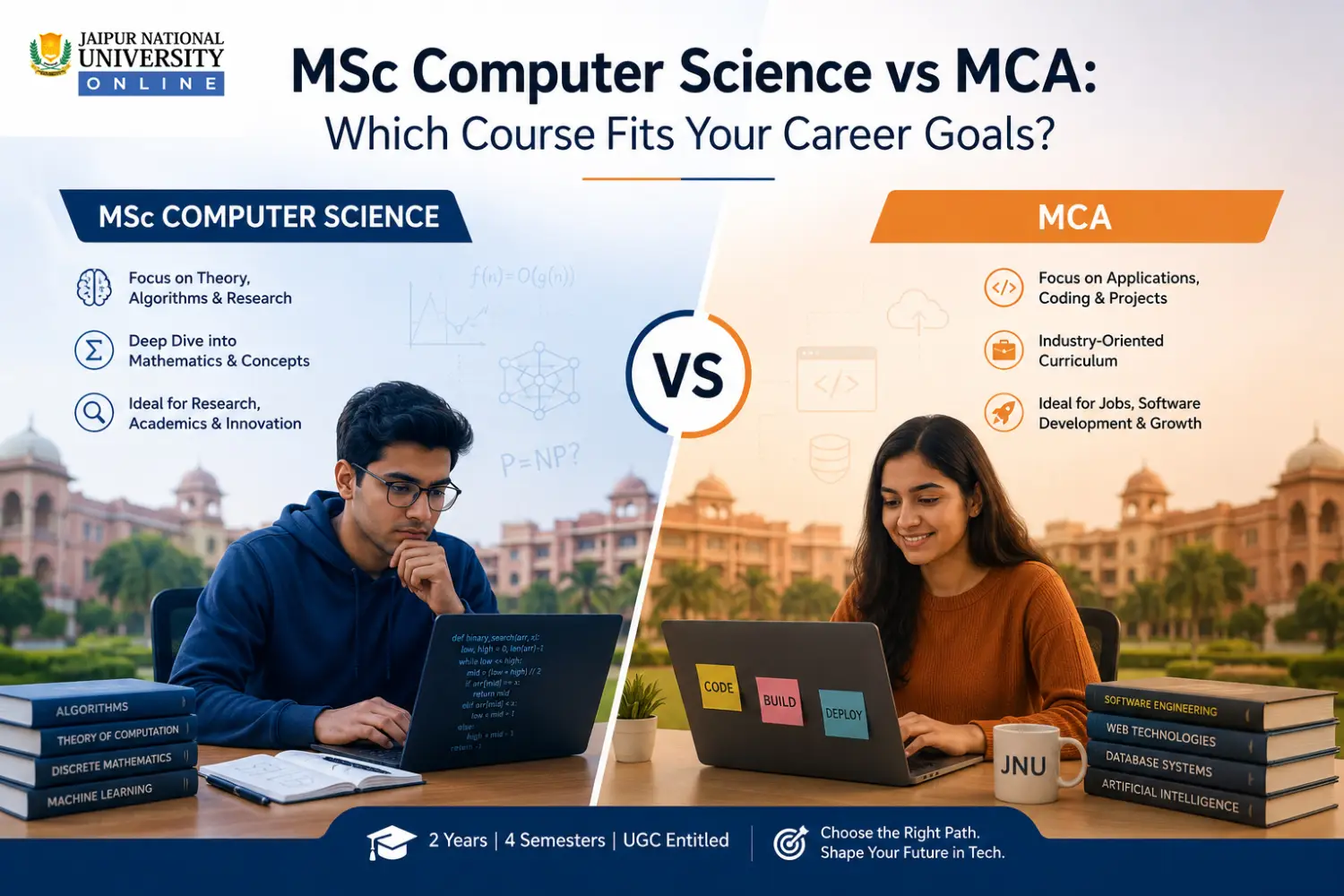
MSc Computer Science and MCA are both two-year postgraduate computing degrees, yet they suit different students. This guide compares eligibility, syllabus, specialisations, fees, salary, career scope and online availability, then shows which degree matches your background so you can choose with evidence instead of guesswork.
If you are weighing MSc Computer Science vs MCA, here is the short answer before the detail. Choose MSc Computer Science if you enjoy mathematics, algorithms, theory and research. Choose MCA if you want to build software, work on live projects and move into an IT job quickly. Both degrees run for two years across four semesters. Both are postgraduate qualifications recognised by the University Grants Commission. Both open the same job titles across the Indian technology industry.
The differences that genuinely change your outcome are narrower than most articles suggest. They sit in four places: who is eligible, how the teaching is structured, which specialisations are on offer, and whether you can study the degree online while you work. This guide compares MSc Computer Science and MCA on each of those points, with tables you can scan in a minute. Figures come from nasscom, the University Grants Commission and live university programme pages, and every source is listed at the end.
Which course fits you? The 30-second answer
| If this sounds like you | The Stronger Fit |
|---|---|
| You want to write code and ship applications from the first semester | MCA |
| You enjoy proofs, mathematics and algorithm design | MSc Computer Science |
| Your degree is BCA, BSc IT or any stream that included Mathematics | MCA |
| Your degree is BSc Computer Science and you are aiming at research or a PhD | MSc Computer Science |
| You are already working and need a UGC-entitled degree you can study online | MCA |
| You want to teach in higher education | MSc Computer Science, followed by UGC NET or a PhD |
| You are switching into technology from commerce, arts or science | MCA, with a bridge course where Mathematics is missing |
What is the difference between MSc Computer Science and MCA?
Both names describe a postgraduate computing qualification, so the confusion is reasonable.
MSc Computer Science is the short form of Master of Science in Computer Science. It is an academic science degree, awarded through a university science faculty. The teaching leans towards concepts: how algorithms behave at scale, why one data structure outperforms another, and what the mathematics underneath computing actually proves.
MCA is the short form of Master of Computer Applications. It is a professional degree built around industry practice. Assessment weight sits on laboratory work, coding assignments and projects, and All India Council for Technical Education norms shape MCA delivery at approved institutions.
A simple way to hold the difference in your head: MSc Computer Science asks why a system behaves the way it does. MCA asks how to build a system that works, and works on schedule.
What does an MSc Computer Science degree teach?
A typical MSc Computer Science syllabus includes advanced algorithms, theory of computation, discrete mathematics, operating systems, machine learning theory, research methodology and a dissertation in the final semester. Mathematics carries real weight across all four semesters. Students who dislike formal proofs usually find the second year hard going. The reward is depth. An MSc Computer Science graduate is trained to question a method, test it and improve it.
What does the Master of Computer Applications teach?
The Master of Computer Applications covers object oriented programming, database management systems, software engineering, web technology, computer networks, information security, and applied artificial intelligence and machine learning. Programmes normally close with industrial training or a live client project. On the Online MCA at Jaipur National University, for example, the fourth semester carries 20 credits for industrial training and 5 credits for a research paper publication. That weighting tells you exactly where the emphasis sits.
MSc Computer Science vs MCA: which is better for your goals?
Neither degree is better in the abstract. One is better for you. This table sets the two side by side on the points that decide admission, learning and hiring.
| Comparison Point | MSc Computer Science | MCA |
|---|---|---|
| Full form | Master of Science in Computer Science | Master of Computer Applications |
| Degree type | Academic, science faculty | Professional, application focused |
| Duration | 2 years, 4 semesters | 2 years, 4 semesters |
| Core emphasis | Theory, mathematics, algorithms, research | Software build, projects, industry practice |
| Typical eligibility | BSc Computer Science, BSc IT, BCA or a closely related degree | Any bachelor’s degree of at least three years, with Mathematics |
| Mathematics rule | Usually required at graduation level | Required at 10+2 or graduation, with a bridge course where missing |
| Final semester output | Dissertation or research project | Industrial training or live industry project |
| Specialisation choice | Fewer, usually elective based | Wider, including AI & ML, Data Science, Cyber Security, Cloud Computing and Full Stack Development |
| Availability in online mode | Limited across Indian universities | Widely available and UGC entitled |
| Regulator touchpoints | University Grants Commission (UGC) | University Grants Commission (UGC) and AICTE |
| Strongest opening roles | Research associate, Data Analyst, Academic roles, Software Engineer | Software Developer, Full Stack Developer, Systems Analyst, Cloud Engineer |
| Higher study route | PhD, MTech, Academic Research | PhD, MTech, Professional Certifications |
| Best suited to | Concept-first learners | Build-first learners |
The honest position is this. Recruiters in India rarely reject a candidate because the certificate reads MSc Computer Science instead of MCA, or the other way round. They reject candidates who cannot code, cannot explain a project and cannot pass a technical round. The degree gets you eligibility. Your portfolio gets you hired.
How does MCA vs MSc Computer Science eligibility compare?
Eligibility filters more applicants than any other factor, so check it before you shortlist universities.
| Eligibility Factor | MSc Computer Science | MCA |
|---|---|---|
| Qualifying Degree | Usually BSc Computer Science, BSc IT, BCA or an allied science degree | Any bachelor’s degree of at least three years, in any stream |
| Minimum Marks | Commonly 50%, varies by university | Commonly 40% to 50%, varies by university |
| Mathematics Condition | Mathematics expected in the undergraduate programme | Mathematics at 10+2 or graduation level |
| Route Without Mathematics | Rarely available | Bridge programme offered by many universities |
| Admission Basis | Merit, with entrance tests at some universities | Merit or entrance test, depending on the institution |
| Work Experience | Not required | Not required, though it helps in placements |
Two practical points follow from that table.
First, MCA is the more open door. If your bachelor’s degree is in commerce, arts, life sciences or management and you want a technology career, MCA is usually the only postgraduate computing route available to you. MSc Computer Science admissions normally expect a computing or allied undergraduate background.
Second, the Mathematics condition is negotiable in MCA and rarely negotiable in MSc Computer Science. Jaipur National University states the rule plainly for its Online MCA: a bachelor’s degree of at least three years in any stream, at least 40 per cent in the qualifying examination, with Mathematics as a subject, and candidates who did not study Mathematics at graduation level complete a bridge programme before they enrol. That single provision is why so many career changers pick MCA.
Which entrance exams matter, and when do you not need one?
| Entrance Exam | Who Accepts It | Relevance |
|---|---|---|
| NIMCET | National Institutes of Technology (NITs) | Main national entrance test for on-campus MCA admissions |
| CUET PG | Central and participating universities | Used for MCA and MSc Computer Science admissions |
| MAH MCA CET | Maharashtra state institutions | State-level MCA admission |
| TANCET | Tamil Nadu state institutions | State-level MCA admission |
| University-Level Tests | Individual private universities | Varies; often waived for merit-based admissions |
Most private universities and all UGC-entitled online programmes admit on academic merit, with no entrance examination. If you are a working professional, this matters more than the exam list itself, because it removes months of preparation from your timeline.
How does the MCA vs MSc Computer Science syllabus differ?
Comparing subject names alone is misleading. Both degrees teach programming, databases, operating systems, networks and artificial intelligence. The difference is what you are asked to produce with that knowledge.
| Semester | MSc Computer Science, Typical Focus | MCA, Typical Focus |
|---|---|---|
| Semester 1 | Discrete mathematics, advanced data structures, computer architecture, operating systems | Object-oriented programming with C++, database management systems, computer graphics, information and network security, advanced data structures with laboratory work |
| Semester 2 | Theory of computation, design and analysis of algorithms, database systems, statistics | Theory of computation, software engineering, web technology, optimisation techniques, microprocessor and assembly language, e-commerce and digital marketing |
| Semester 3 | Machine learning, advanced networks, elective specialisation, research methodology | Compiler design, .NET framework, introduction to artificial intelligence and machine learning, with electives in big data analytics, cloud computing, Internet of Things, Android programming and human-computer interaction |
| Semester 4 | Dissertation, seminar, advanced elective | Industrial training worth 20 credits, research paper publication worth 5 credits |
| Assessment Weight | Written examinations, analytical assignments, dissertation | Laboratory work, coding projects, industry training report |
| Skill You Leave With | Ability to analyse and improve a method | Ability to design, build and deploy a working product |
Read the fourth row again. An MSc Computer Science student spends the final semester writing a dissertation. An MCA student spends it inside an organisation, shipping work. If you already know you want a software development career rather than a research career, that structural difference is worth more than any subject list.
The MCA syllabus above reflects the live curriculum published on the Jaipur National University Online MCA programme page, which is a useful benchmark because it is current and publicly verifiable rather than generic.
Should you choose MSc Computer Science or MCA after BSc?
This is the most common version of the question, and the answer depends on which BSc you hold.
| Your Background | Recommended Choice | Reason |
|---|---|---|
| BSc Computer Science, aiming at research, teaching or a PhD | MSc Computer Science | Direct academic continuity, dissertation experience and a natural route to UGC NET and PhD. |
| BSc Computer Science, aiming at an industry job | Either, with MCA slightly ahead | MCA adds industrial training and project depth that shortens the path to a first role. |
| BSc IT or BCA | MCA | Application-heavy curriculum builds directly on your existing coding foundation. |
| BSc in Physics, Chemistry, Mathematics or Life Sciences | MCA | Broader eligibility rules accept non-computing graduates, with bridge courses where required. |
| BCom, BBA or BA | MCA | Usually the only postgraduate computing route available to graduates from these streams. |
| Working professional in IT support or testing | Online MCA | UGC-entitled degree that can be studied alongside a full-time job, with a specialisation applicable at work. |
If you are still torn after that table, use this test. Ask whether you would rather spend six months writing a dissertation that advances an idea, or six months inside a company building something that customers use. Your honest answer names your degree.
What is the MCA vs MSc Computer Science career scope in India?
The market context matters more than either syllabus, so start with the numbers.
| Indian Technology Sector Indicator | FY26 Estimate | Source |
|---|---|---|
| Total Industry Revenue | US$315 billion, growing at approximately 6.1% year-on-year | NASSCOM Strategic Review 2026 |
| Direct Employment | Approximately 5.95 million professionals | NASSCOM Strategic Review 2026 |
| Net Jobs Added During the Year | Approximately 135,000, a rise of 2.3% | NASSCOM Strategic Review 2026 |
| IT Services Segment | US$149 billion | NASSCOM Strategic Review 2026 |
| Engineering, Research and Development Segment | US$63 billion | NASSCOM Strategic Review 2026 |
| Artificial Intelligence Revenue | US$10–12 billion | NASSCOM Strategic Review 2026 |
Two signals are worth reading carefully. Revenue is growing faster than headcount, which means hiring is shifting towards higher-skill roles. And artificial intelligence revenue is now a measurable line item rather than a talking point. Both signals reward candidates with demonstrable applied skills, which is the case for choosing a programme that forces you to build.
Which job roles suit each degree?
| Role | How an MCA Graduate Typically Enters It | How an MSc Computer Science Graduate Typically Enters It |
|---|---|---|
| Software Developer | Through project portfolios, internships and applied coding rounds | Through strong fundamentals in algorithms and problem-solving |
| Full Stack Developer | Direct fit, with web technologies and framework-based coursework supporting the role | Possible, usually after self-directed project work |
| Data Analyst | Through applied analytics and business reporting exposure | Through statistics, modelling and analytical depth |
| Machine Learning Engineer | Through applied AI and ML coursework plus deployment projects | Through model theory, evaluation and research grounding |
| Cloud Engineer | Through cloud computing electives and deployment labs | Through systems and architecture understanding |
| Cyber Security Analyst | Through information and network security coursework | Through cryptography and formal security concepts |
| Systems Analyst | Direct fit, bridging business requirements and technical implementation | Possible, with additional business exposure |
| Research Associate or Lecturer | Less common without further study | Direct fit, particularly after qualifying UGC NET or completing a PhD |
What do MCA and MSc Computer Science graduates earn?
| Career Stage | Commonly Reported Annual Salary Range in India |
|---|---|
| Fresher (0–1 Year) | ₹3.5 lakh to ₹6 lakh per annum |
| Early Career (3–5 Years) | ₹7 lakh to ₹12 lakh per annum |
| Experienced (8–10 Years) | ₹15 lakh to ₹30 lakh per annum |
| Specialist Roles in AI, Cloud or Data | Higher than the bands above, driven by certifications, specialised skills and a strong project portfolio. |
Pay in Indian technology roles tracks skills, certifications and interview performance far more closely than degree nomenclature. Two graduates with the same title and different portfolios routinely receive offers that differ by several lakh rupees. That is the strongest argument for choosing the programme that will actually make you build things.
Which degree supports an Artificial Intelligence specialisation or a Data Science specialisation?
Both can. The difference is how the specialisation reaches you.
In MSc Computer Science, artificial intelligence and data science usually arrive as electives inside a broader science curriculum, taught with mathematical depth. You study why a model works, how it is evaluated and where it fails. That grounding suits research roles and model development.
In MCA, an Artificial Intelligence specialisation or a Data Science specialisation is more often a named track with applied laboratory work. Programmes commonly offer artificial intelligence and machine learning, data science, cloud computing, cyber security and full stack development as structured options. The Online MCA curriculum at Jaipur National University, for instance, includes an introduction to artificial intelligence and machine learning as a core paper, an artificial intelligence laboratory using Python, and electives in big data analytics, cloud computing and the internet of things.
| Specialisation Need | Better Served By |
|---|---|
| Building and Deploying AI Features in Products | MCA |
| Designing, Evaluating and Improving Models | MSc Computer Science |
| Business-Facing Data Analysis and Reporting | MCA |
| Statistical Research and Publication | MSc Computer Science |
| Cloud, Cyber Security or Full Stack Tracks | MCA |
If your goal is a software development career with an applied AI component, MCA reaches that goal faster. If your goal is research-grade modelling, MSc Computer Science gives you the stronger base.
Can you study MSc Computer Science or MCA online in India?
This is the practical difference most comparison articles miss, and for working professionals it is often the deciding factor.
Under the University Grants Commission (Open and Distance Learning Programmes and Online Programmes) Regulations, 2020, an institution may offer only those programmes online that it already runs in conventional or distance mode, and from which at least one batch has graduated. Programmes that require practical or laboratory courses as a curricular requirement are restricted in online mode, and several disciplines including engineering, medicine, pharmacy, nursing, architecture, law and agriculture are prohibited outright. Research degrees such as MPhil and PhD are also prohibited in online and distance mode.
The result on the ground is straightforward. MCA is widely available as a UGC-entitled online degree from Indian universities. MSc Computer Science is offered online far less often, because the laboratory-heavy science curriculum sits awkwardly against those regulations, and many universities restrict their online science offerings to non-laboratory subjects such as Mathematics.
| Question | MSc Computer Science | MCA |
|---|---|---|
| Commonly Available in Online Mode | Limited | Yes, from many UGC-entitled universities |
| Degree Treated as Equivalent to On-Campus | Yes, where entitled | Yes, where entitled |
| Suitable for a Full-Time Working Professional | Depends heavily on programme availability | Yes |
| Verification You Must Complete | Check the UGC-DEB entitlement list | Check the UGC-DEB entitlement list |
If you need a postgraduate computing degree that you can study while employed, without resigning and without relocating, MCA is usually the only realistic option. That is a regulatory reality, not a marketing claim, and you can confirm it yourself on the Distance Education Bureau website before you apply anywhere.
What does an online MCA cost, and what is the return?
Cost varies widely, so compare on total programme fee rather than the first instalment.
| Fee Element | Online MCA at Jaipur National University |
|---|---|
| Fee per Semester (India) | ₹26,600 |
| Total Programme Fee (India) | ₹1,06,400 across four semesters |
| Duration | 2 Years (4 Semesters) |
| Mode | Fully online, with recorded lectures, live interactive sessions and digital self-learning material |
Set that against a fresher band of 3.5 to 6 lakh rupees and the arithmetic is easy to follow. The important caveat is that no fee level guarantees a salary. What raises your return is the work you produce during the programme: projects on a public repository, an internship, two or three vendor certifications, and a dissertation or industrial training report you can talk about confidently in an interview.
Why do working professionals choose the Online MCA at JNU Online?
Jaipur National University runs its online and distance programmes through its Centre for Distance and Online Education. For a candidate comparing MSc Computer Science vs MCA while holding down a job, four points tend to decide it.
- Recognition you can check. The university holds University Grants Commission 2(f) status, UGC-DEB entitlement for its online programmes, NAAC A+ accreditation and Association of Indian Universities membership. Every approval document is published for public inspection on the JNU Online website.
- Open eligibility. A three-year bachelor’s degree in any stream with at least 40 per cent marks and Mathematics as a subject qualifies, and a bridge programme covers candidates who did not study Mathematics at graduation level. Full details sit on the Online MCA programme page.
- Applied curriculum. Core papers in artificial intelligence and machine learning, information and network security and web technology, with electives in big data analytics, cloud computing and the internet of things, plus 20 credits of industrial training in the final semester.
- Admission without an entrance examination. Applications are assessed on merit, and the steps are documented on the registration process page.
If your shortlist still contains an MSc Computer Science option, keep it on the list and compare the two on entitlement status, curriculum depth and study mode rather than on brand recall alone.
How do you make the final call? Six questions to ask yourself
- Do you enjoy mathematics and proofs, or do you enjoy building and shipping?
- Does your bachelor’s degree meet MSc Computer Science eligibility, or is MCA your only open route?
- Do you want a research or teaching career, or an industry role in the next two years?
- Do you need to study while working, which narrows the choice sharply?
- Which specialisation do you want on your certificate, and does the programme actually offer it?
- Can you verify the programme on the UGC-DEB list for your intake year?
Answer those six honestly and the MSc Computer Science vs MCA question usually resolves itself within a few minutes.
What should you verify before you pay any fee?
This section matters more than any comparison table, because the most expensive mistake in Indian online education is enrolling in a programme that is not entitled for your intake year.
- Confirm the specific programme, not just the university, on the University Grants Commission Distance Education Bureau entitlement list for your admission year.
- Record your DEB-ID at the time of application, as the Distance Education Bureau requires it for online and distance learners.
- Read the institution’s public self-disclosure documents, including the commission order and the CIQA report.
- Check the fee refund policy and the grievance redressal mechanism before making any payment.
- Ask for the examination pattern and the mode of assessment in writing.
If any of these items cannot be produced, treat that as your answer and move on. For JNU Online, all of these documents are published on the website, and the admissions team can be reached through the contact page.
Final verdict: MSc Computer Science or MCA?
There is no universal winner in the MSc Computer Science vs MCA debate, and any article that crowns one degree is selling something. What exists is a clean decision rule.
Choose MSc Computer Science if you hold a computing or allied science degree, enjoy mathematics and theory, and see yourself in research, modelling or higher education. Choose MCA if you want an application-heavy postgraduate degree, come from a non-computing background, need broader eligibility, want a named specialisation in artificial intelligence, data science, cloud or cyber security, or need to study online while you work.
Whichever way you go, the degree opens the door and your portfolio walks you through it. Build projects, publish them, take one or two respected certifications, and treat the final-semester project as a professional deliverable rather than a formality. Do that, and both MSc Computer Science and MCA lead to the same place: a technology career you can grow for the next twenty years.
Ready to take the next step? Review the curriculum, fee structure and eligibility on the Online MCA programme page, then complete your application through the registration process. For programme guidance, contact the JNU Online admissions team.
Frequently Asked Questions
MSc Computer Science vs MCA: which is better for a software job?
MCA is generally better for a software job, because the curriculum is application focused and ends with industrial training or a live project. MSc Computer Science graduates also enter software roles successfully, usually on the strength of algorithmic depth and self-directed project work.
Is MCA equal to MSc Computer Science in value?
Yes. Both are two-year postgraduate degrees recognised by the University Grants Commission. Degrees awarded through entitled online and distance modes are treated as equivalent to their on-campus counterparts under the 2020 regulations.
Can I do MCA after a BCom or BA degree?
Yes, in most universities. MCA accepts a bachelor’s degree of at least three years in any stream, provided Mathematics was studied at 10+2 or graduation level. Where Mathematics is missing, many universities offer a bridge programme.
Can I do MSc Computer Science after a BCom degree?
Usually not. MSc Computer Science admissions normally require a computing or allied science background such as BSc Computer Science, BSc IT or BCA. This is the single biggest eligibility difference between the two degrees.
Which has a wider career scope, MCA or MSc Computer Science?
Career scope is broadly similar, and both lead to software development, data, cloud and security roles. MCA has a slight edge in industry-facing roles, while MSc Computer Science has an edge in research, modelling and academic careers.
Is an online MCA valid for government jobs?
Yes, provided the programme is entitled by the University Grants Commission Distance Education Bureau for your intake year. Always confirm the specific programme on the Distance Education Bureau list rather than relying on the university name alone.
Which is harder, MCA or MSc Computer Science?
MSc Computer Science is usually harder mathematically, because of proofs, theory of computation and analytical papers. MCA carries a heavier practical workload, with continuous laboratory and project deadlines. The harder one is the one that does not match your strengths.
Can I pursue a PhD after MCA?
Yes. MCA is a recognised postgraduate degree, so it satisfies the eligibility requirement for PhD admission and for UGC NET in Computer Science and Applications, subject to the minimum marks each institution specifies.
Does MCA still take three years?
No. MCA is now a two-year programme across four semesters at approved institutions, following the revision of the duration norms. Check the programme page of any university that advertises a longer duration.
Is MSc Computer Science available in online mode in India?
It is far less common than online MCA. Programmes with substantial laboratory requirements face restrictions in online mode under the 2020 regulations, so many universities offer online postgraduate science degrees only in non-laboratory subjects such as Mathematics.
Do I need an entrance exam for MCA?
Not always. National and state tests such as NIMCET, CUET PG, MAH MCA CET and TANCET apply to many on-campus seats, while most private universities and UGC-entitled online programmes admit on academic merit.
Which degree pays more, MCA or MSc Computer Science?
Neither degree sets the salary. Indian employers pay for demonstrable skills, project portfolios, certifications and interview performance. Two graduates with the same degree and different portfolios routinely receive very different offers.
Can I take an Artificial Intelligence specialisation or a Data Science specialisation in MCA?
Yes. Named specialisations are more common in MCA than in MSc Computer Science, and applied artificial intelligence, machine learning, data analytics, cloud computing and cyber security appear as core papers or electives in many programmes.
What should I check before enrolling in any online postgraduate computing degree?
Confirm the programme on the UGC-DEB entitlement list for your intake year, record your DEB-ID, read the public self-disclosure documents and the CIQA report, and check the fee refund and grievance policies before paying.