
Online BCA vs Regular BCA: Which Is Better for Your Career in 2026?
Home / Online BCA / Online BCA vs Regular BCA: Which Is Better for Your Career in 2026?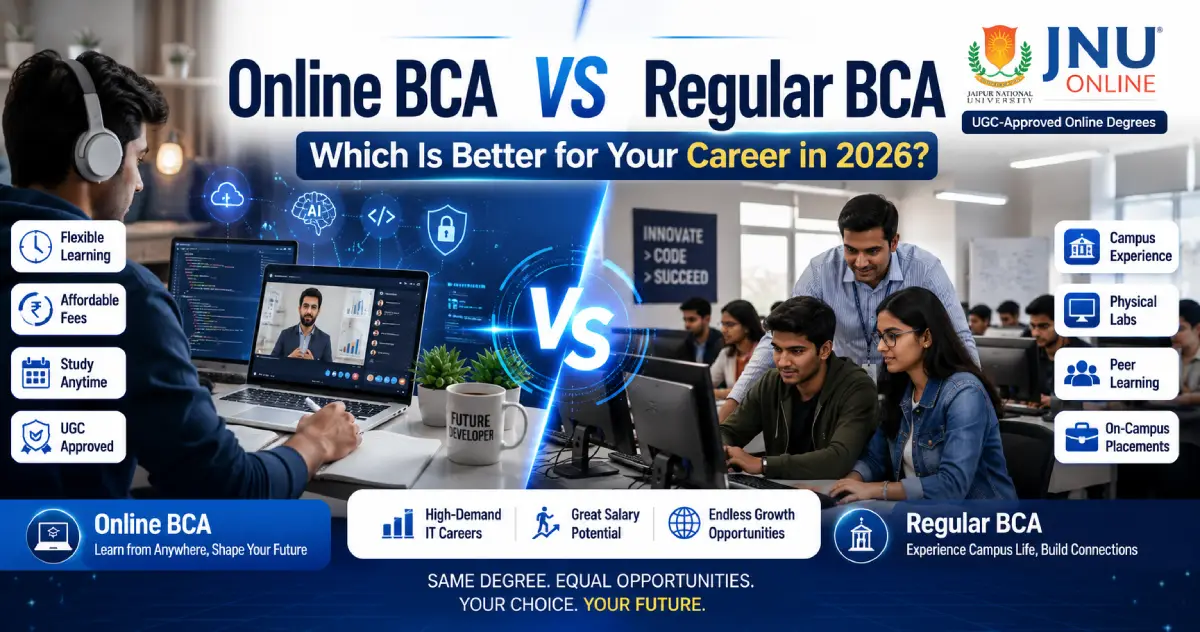
Quick Answer
The choice between online BCA vs regular BCA depends entirely on your situation. An online BCA is the better option if you are a working professional, live in a Tier 2/3 city, want flexible learning, or have budget constraints — its UGC-DEB approved degree that carries the same legal value as a regular BCA degree. A regular BCA is the better choice for fresh 12th-pass students who want a full-time campus experience, in-person peer learning, and on-campus placements. In 2026, both pathways lead to the same career roles in software development, data science, cybersecurity, and cloud computing — what truly matters is the university’s accreditation, curriculum quality, and your own skill-building outside the classroom.
Why This Comparison Matters in 2026
Every year, over 5 lakh Indian students enroll in a Bachelor of Computer Applications (BCA) program, hoping to break into India’s $350 billion IT industry. But in 2026, the decision is no longer just about which college to pick; it’s about which learning mode fits your goals: online or regular?
The online BCA vs regular BCA debate has intensified since the UGC officially declared online degrees from approved universities as equivalent to regular degrees in 2020. As of the 2025-26 academic session, more than 100 UGC-approved universities now offer fully online BCA programs in India, and enrollments have grown by over 50% since 2021.
This guide cuts through the noise. We’ll compare both pathways across 9 critical parameters: fees, flexibility, recognition, placements, specialisations, salary, and more, so you can make the right call for your career in 2026.
What Is an Online BCA Degree?
An Online BCA (Bachelor of Computer Applications) is a 3-year undergraduate degree delivered 100% through a digital learning platform. Students attend live or recorded lectures via a Learning Management System (LMS), submit assignments online, write web-proctored exams, and graduate with a UGC-DEB recognised degree, the same legal value as any on-campus BCA degree.
Key features of a UGC-approved online BCA degree program in 2026 include:
- 24×7 access to recorded video lectures, e-books, and digital study material
- Live interactive sessions on weekends with industry-expert faculty
- Specialisations in Artificial Intelligence, Data Science, Cloud Computing, Cybersecurity, and Full-Stack Development
- Online proctored examinations from home
- Placement assistance through dedicated career-services cells
- Affordable fees compared to traditional on-campus programs
What Is a Regular BCA Degree?
A Regular BCA, also called a traditional, on-campus, or offline BCA, is the conventional 3-year undergraduate degree where students attend physical classes at a college or university campus. Students have fixed timetables, in-person practical labs, mandatory attendance, and direct face-to-face interaction with professors and peers.
Regular BCA programs typically include:
- Classroom-based lectures and computer lab sessions
- Mandatory minimum attendance (usually 75%)
- On-campus internships, workshops, and tech fests
- Direct placement drives by recruiters like TCS, Infosys, Wipro, and Cognizant
- Access to college infrastructure — library, hostels, sports, clubs
- Higher overall cost due to campus, infrastructure, and accommodation fees
Online BCA vs Regular BCA: Side-by-Side Comparison Table
Here’s a quick visual snapshot of the online BCA vs regular BCA comparison across the parameters that matter most to today’s students and working professionals:
| Parameter | Online BCA | Regular BCA |
|---|---|---|
| Mode of Learning | 100% online via LMS, live + recorded lectures | On-campus, physical classrooms |
| Duration | 3 years (6 semesters) | 3 years (6 semesters) |
| Average Fees | ₹60,000 – ₹1,80,000 (total) | ₹2,00,000 – ₹6,00,000 (total) |
| Flexibility | Very high — study anytime, anywhere | Low — fixed timetable, attendance mandatory |
| Eligibility | 10+2 with 40–50% in any stream | 10+2 with 50%+ often with Maths |
| Recognition | UGC-DEB approved, valid for jobs & higher studies | UGC approved, valid for jobs & higher studies |
| Best Suited For | Working professionals, remote learners, Tier 2/3 city students | Full-time students seeking traditional campus life |
| Industry Exposure | Virtual internships, online hackathons, project-based learning | On-campus placements, physical labs, and in-person internships |
| Average Starting Salary | ₹2.5 – ₹6 LPA | ₹3 – ₹7 LPA |
| Specialisations | AI/ML, Data Science, Cloud, cybersecurity, and Full-Stack | Limited to college’s curriculum |
9 Key Differences Between Online BCA and Regular BCA
1. Fees and Affordability
One of the most significant differentiators between online BCA and traditional BCA is fee structure. A regular BCA from a private university typically costs between ₹2 lakh and ₹6 lakh for the full three-year programme and that’s before adding hostel, transport, and miscellaneous campus charges.
In contrast, online BCA fees from a UGC-approved university start as low as ₹60,000 and rarely exceed ₹1.8 lakh for the entire course. There are no hostel fees, no daily travel costs, and no additional campus charges. This makes online BCA an excellent choice for students from middle-income families and those who want to study without taking education loans.
2. Flexibility and Time Management
This is where online BCA decisively wins. Online BCA students can attend lectures on their own schedule, early morning before work, late evening after work, or on weekends. Recorded sessions can be replayed for difficult topics, and the LMS is accessible 24×7 from any device.
A regular BCA, on the other hand, demands a fixed daily commitment of 6-8 hours on campus, leaving no room for parallel employment, freelancing, or family responsibilities. For working professionals upskilling into IT, the regular BCA is simply not a viable option.
3. Mode of Learning and Pedagogy
Online BCA programs leverage modern EdTech interactive video lectures, AI-powered doubt-clearing platforms, gamified assessments, and virtual coding labs that run on cloud-based IDEs. Many universities are now integrating GenAI tutors and personalised learning pathways.
Regular BCA still relies on whiteboards, physical labs, printed textbooks, and instructor-led classroom teaching. Both approaches have merit; online suits self-driven learners, while regular suits those who thrive on structured supervision.
4. Curriculum and Specialisations
In 2026, online BCA programs often offer more cutting-edge specialisations than their regular counterparts. Top online universities now provide BCA tracks in Artificial Intelligence and Machine Learning, Data Science and Analytics, Cybersecurity, Cloud Computing, Full-Stack Development, and even Agentic AI.
This is because online programs can update curricula faster than traditional universities, which are bound by older syllabus committees. If you want to graduate with future-ready skills, an online BCA in a niche specialisation gives you a measurable edge.
5. Recognition and UGC Validity
This is the most googled concern in the entire online BCA vs regular BCA debate. Let’s settle it clearly: as per the UGC notification dated March 2021, online degrees from UGC-DEB approved universities are 100% equivalent to regular degrees for the purposes of employment, higher education, and government job applications including UPSC, SSC, IBPS, and state PSCs.
In other words, an online BCA from a UGC-approved university like JNU Jaipur, Manipal, Amity, or Chandigarh University holds the same legal weight on your resume as any regular BCA degree. Just always verify your chosen university’s UGC-DEB status before enrolling.
6. Industry Exposure and Internships
Regular BCA students traditionally enjoyed an edge here — on-campus placement drives, college-arranged summer internships, and tech fests. But in 2026, this gap has narrowed dramatically. Online BCA students now access remote internships across India and globally, participate in major online hackathons like Smart India Hackathon and MLH events, and contribute to open-source projects on GitHub from day one.
In fact, online BCA students often build stronger real-world portfolios because they aren’t bound by the college’s local network they can apply to companies anywhere in India.
7. Placement Support and Career Opportunities
Regular BCA programs from Tier-1 colleges still offer strong campus placements with average packages of ₹3-7 LPA. However, online BCA universities like JNU Online and Amity Online now provide dedicated career-services teams that conduct virtual placement drives, AI-powered mock interviews, resume building, and direct industry connects.
Both pathways open doors to the same career roles: Software Developer, Web Developer, Database Administrator, QA Engineer, IT Support Specialist, Cyber Security Analyst, Cloud Engineer, and Data Analyst. The salary depends more on your skills, projects, and interview performance than on whether your degree was online or regular.
8. Skill Development Beyond the Classroom
Online BCA students develop two underrated soft skills that regular BCA students often miss: self-discipline and digital literacy. Managing your own learning schedule, navigating LMS platforms, collaborating via Slack and Zoom, and submitting assignments on tight deadlines simulates the modern remote-work environment perfectly. Many recruiters now view online learners as more job-ready for hybrid IT roles in 2026.
9. Higher Education Eligibility
Both online and regular BCA graduates are equally eligible for postgraduate courses like MCA, MBA, M.Sc Data Science, and even overseas master’s programs. WES (World Education Services), the global credential evaluator, officially recognises UGC-approved online degrees for higher studies in the USA, Canada, UK, and Australia.
Online BCA vs Regular BCA: Salary and Career Comparison in 2026
According to NASSCOM data and the latest 2026 placement reports from leading online universities, the salary gap between online and regular BCA graduates has nearly disappeared. Here’s what the numbers look like:
- Software Developer (fresher): ₹3 – ₹6 LPA (same for online and regular)
- Data Analyst (fresher): ₹4 – ₹7 LPA
- Cyber Security Analyst (fresher): ₹4 – ₹8 LPA
- Cloud Engineer (fresher): ₹4.5 – ₹8 LPA
- Web Developer (fresher): ₹2.5 – ₹5 LPA
- AI/ML Engineer (with strong portfolio): ₹6 – ₹10 LPA
With 2-3 years of experience, both online and regular BCA graduates can hit ₹8-15 LPA brackets, provided they continue upskilling with certifications, projects, and specialisations.
Who Should Choose an Online BCA?
An online BCA degree program is the right fit for you if:
- You are a working professional who wants to upskill in IT without quitting your job
- You live in a Tier 2/3 city or rural area without quality IT colleges nearby
- You want to save on accommodation, travel, and ancillary campus costs
- You are a homemaker, mother, or caregiver returning to education
- You want a specialised BCA (AI/ML, cybersecurity, Cloud) that local colleges don’t offer
- You are self-disciplined and comfortable with technology-driven learning
Who Should Choose a Regular BCA?
A regular on-campus BCA degree is the better choice if:
- You are a fresh 12th-pass student seeking the full college experience
- You learn best in a structured classroom environment with peer interaction
- Your family can comfortably afford ₹4-6 lakh in total education costs
- You want access to physical labs, sports facilities, and campus clubs
- You prefer in-person placement drives over remote job applications
- You have a top-tier regular BCA college available in your city
Why Choose JNU Online for Your Online BCA in 2026
If you’ve decided that an online BCA is the right pathway for you, Jaipur National University (JNU) Online deserves a top spot on your shortlist. Here’s why thousands of students across India are choosing JNU Online for their BCA in 2026:
NAAC A+ Accredited: JNU Jaipur is among the leading NAAC A+ accredited private universities in Rajasthan, ensuring rigorous quality benchmarks across teaching, learning, and research.
UGC and AICTE Recognised: JNU Online’s BCA degree is approved by UGC under Section 2(f), recognised by UGC-DEB, AICTE, AIU, and accepted globally for higher studies and employment.
Affordable Per-Semester Fees: JNU Online’s BCA is one of the most cost-effective UGC-approved options in India, with flexible semester-wise payment and a 10% Early Bird Scholarship for early applicants.
Industry-Aligned Curriculum: The BCA curriculum at JNU Online covers Programming (C, Java, Python), Web Development, DBMS, Operating Systems, Software Engineering, and emerging tech like AI, Cloud, and Cyber Security are designed with industry input under NEP 2020 guidelines.
24×7 Learning Platform: JNU Online’s CDOE (Centre for Distance and Online Education) offers a fully responsive web and mobile LMS, recorded lectures, live doubt-clearing sessions, e-books, and interactive virtual labs accessible anytime, anywhere.
Strong Placement Support: Dedicated career counselling, resume building, interview prep, and access to JNU’s industry partner network, including past recruiters like Amazon, IBM, Kotak, Deutsche Bank, and Bank of America.
18+ Years of Academic Excellence: Established in 2007, Jaipur National University has nearly two decades of proven track record in higher education, awarding degrees to over 50,000 alumni now working across India and abroad.
To apply, visit online.jnujaipur.ac.in or call the admissions team for a free counselling session. The January 2026 and July 2026 intakes are currently open.
5 Common Myths About Online BCA — Busted
Myth 1: Online BCA degrees are not valid for government jobs
False. UGC’s official notification confirms that online degrees from UGC-DEB approved universities are valid for all government jobs, including UPSC, SSC, IBPS, state PSCs, ISRO, and railway recruitment exams.
Myth 2: Companies don’t hire online BCA graduates
False. As of 2026, 74% of Indian employers accept online degrees from recognised institutions. Tech companies like TCS, Infosys, Wipro, HCL, Accenture, and product companies like Zoho and Freshworks actively hire online BCA graduates.
Myth 3: Online BCA is easier than regular BCA
False. The syllabus, assessments, project work, and final exams are identical. The only difference is the mode of delivery. Online BCA actually demands more self-discipline.
Myth 4: You can’t pursue an MCA or MBA after an online BCA
False. Online BCA graduates are fully eligible for MCA, MBA, M.Sc., and overseas master’s programs. Many top universities like IGNOU, JNU, IIMs (Executive MBA), and foreign universities via WES verification accept online BCA degrees.
Myth 5: There are no practical labs in online BCA
False. Modern online BCA programs include cloud-based coding labs, virtual machines, simulation tools, and real-world capstone projects. Many programs partner with platforms like AWS, Google Cloud, and Microsoft Learn for hands-on practice.
Final Verdict: Online BCA vs. Regular BCA — Which Wins?
There is no universal winner in the online BCA vs regular BCA debate. Both pathways are legally valid, both lead to the same career roles, and both can earn you a strong starting salary in India’s booming IT sector. What matters is which mode aligns with your life circumstances, learning style, and career goals.
Choose a regular BCA if you’re a fresh 12th-pass student who can commit to full-time campus life. Choose an online BCA, especially from a NAAC A+ accredited university like JNU Online, if you value flexibility, affordability, and the ability to build skills while you earn or manage other responsibilities.
In 2026, the smartest BCA students aren’t asking ‘online vs regular’ they’re asking ‘which UGC-approved university gives me the best curriculum, the best LMS, and the strongest placement support for my chosen specialisation?’ That’s the question that actually shapes your career.
Frequently Asked Questions: Online BCA vs Regular BCA
Q1. Is an online BCA degree valid in India?
Yes, an online BCA degree from a UGC-DEB approved university is 100% valid in India for employment, higher education, and government job applications. The UGC has officially declared online degrees equivalent to regular degrees since 2020.
Q2. Which is better: online BCA or regular BCA?
Neither is universally better. An online BCA suits working professionals, remote learners, and budget-conscious students. A regular BCA suits fresh 12th-pass students who want the full on-campus experience. Both lead to the same career roles in IT.
Q3. What is the difference in fees between online BCA and regular BCA?
Online BCA programs typically cost between ₹60,000 and ₹1.8 lakh for the full 3-year course, while regular BCA from private universities costs ₹2-6 lakh. Online BCA also saves on hostel, food, and travel expenses.
Q4. Can I get a government job after an online BCA?
Yes. Online BCA graduates from UGC-DEB approved universities are eligible for SSC, IBPS PO, UPSC, ISRO, railway recruitment, state PSCs, and bank exams. The degree carries the same legal recognition as a regular BCA.
Q5. Do online BCA degrees have placements?
Yes. Most reputable online universities like JNU Online, Amity Online, and Manipal Online offer dedicated placement assistance, virtual placement drives, resume building, and mock interviews. Online BCA graduates regularly secure jobs at TCS, Infosys, Wipro, HCL, and product companies.
Q6. Can I pursue MCA or MBA after an online BCA?
Absolutely. Online BCA graduates are fully eligible for MCA, MBA, M.Sc Data Science, and other postgraduate programs in India and abroad. Many opt for online MCA programs for further specialisation.
Q7. Is JNU Online BCA UGC approved?
Yes, JNU Online BCA is offered by Jaipur National University, which is NAAC A+ accredited and approved by UGC under Section 2(f), UGC-DEB, AICTE, and AIU. The degree is fully valid for all employment and higher education purposes.
Q8. How long does an online BCA take to complete?
An online BCA is a 3-year (6-semester) undergraduate program, same as a regular BCA. Some universities allow a maximum duration of 6 years if students need extra time due to work or personal commitments.
Ready to start your Online BCA journey? Apply now at https://apply-online.jnujaipur.ac.in/ for the latest intake.
Related Blogs
Best BCA Online Colleges in India (2026): The 7-Point Checklist to Choose the Right One
Searching for the best BCA online colleges in India usually ends the same way: a…

BBA vs BCA vs MCA: Which is Better for Your Future in 2026?
Introduction: Career Uncertainty Post 12th or College Selecting a course after Class 12 or college…

Dive Into The World Of Computer Applications: What Are The Top Reasons To Choose BCA In 2025-26
Digital transformation has become an integral part of the contemporary Indian industries; hence, the majority…

Types of University in India: Which One Fits a Student Best?
Every year, lakhs of students in India finish school with one big question in their…

AI and Cloud Computing in BCA: How Online Programs Are Future-Proofing the Degree in 2026
In 2026, the Bachelor of Computer Applications is no longer a basic programming degree. Leading…
How to Become a Software Developer After BCA: Skills, Courses, and Career Path
To become a software developer after a BCA, master at least one programming language such…